Ozempic butt
back to main page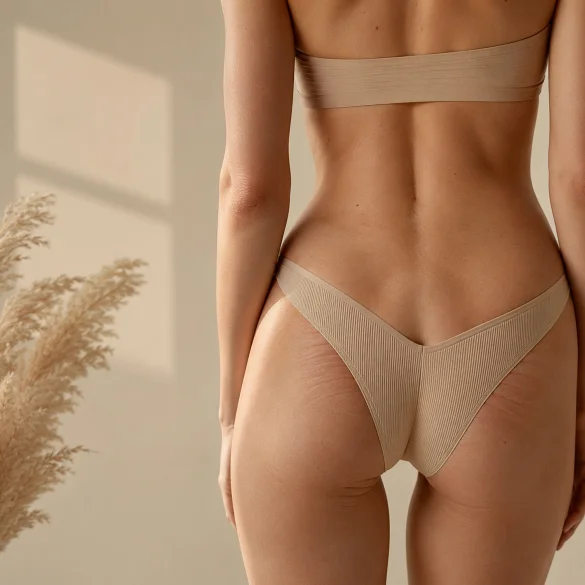
"Ozempic butt" is a colloquial term for changes in body shape appearing after rapid weight loss associated with the use of GLP-1 receptor agonists, such as Ozempic. The phenomenon includes a reduction in the volume of fat tissue in the buttock area, a loss of skin firmness, and a change in the proportions of the lower body. In medical practice, this is not an effect characteristic exclusively of the drug itself, but a consequence of a sudden energy deficit and a rapid decrease in fat and muscle tissue. In some individuals, this leads to a flattening of the buttocks, a reduction in their projection, and the appearance of skin laxity. The severity of the changes depends on age, skin quality, baseline anatomical structure, the rate of weight reduction, and the level of physical activity.
Buttocks after Ozempic - what changes occur
The most characteristic change is the loss of buttock volume resulting from a decrease in subcutaneous fat tissue. The buttocks become less convex, flatter, and lose their natural contour. In some patients, there is also a decrease in skin tension, which leads to a tissue sagging effect.
Changes may include:
- reduction in the volume of the upper part of the buttocks,
- flattening of the lateral outline,
- deepening of the gluteal fold,
- skin laxity,
- loss of tissue elasticity,
- asymmetry resulting from uneven fat reduction.
This process resembles changes observed after intensive weight loss or bariatric procedures. It is worth emphasizing that weight reduction includes not only fat tissue, but also muscle tissue. If adequate protein intake and resistance activity are not maintained during therapy, atrophy of the gluteus maximus muscle, which is responsible for the shape and lift of the buttocks, may occur.
Changes tend to be more visible in individuals who had a large amount of fat tissue in the hip and buttock area before weight reduction. After rapid weight loss, the skin does not always keep up with shrinking, especially after the age of 35-40, when the amount of collagen, elastin, and hyaluronic acid in tissues decreases.
Buttocks after Ozempic - why loss of shape occurs
The mechanism of the loss of shape of the buttocks is multifactorial. A key role is played by the rapid reduction of adipose tissue, which constitutes a natural filling and support for the skin. GLP-1 agonists reduce appetite, prolong gastric emptying time, and decrease calorie intake, leading to an intense negative energy balance.
During rapid weight loss, the body uses energy reserves from various areas of the body. The buttock area is one of the storage sites for hormone-dependent adipose tissue, which is why changes can be particularly visible in women.
The loss of shape is also contributed to by:
- reduction in the volume of subcutaneous adipose tissue,
- loss of muscle mass,
- decreased skin tension,
- degradation of collagen and elastin fibers,
- gravitational aging of tissues,
- deterioration of microcirculation and skin quality.
The rate of weight reduction is also an important element. The body adapts much better to gradual weight loss than to a rapid drop in kilograms in a short period of time. With rapid weight loss, there is a greater risk of skin laxity and loss of body proportions.
Contrary to popular opinion, the problem does not result solely from the use of semaglutide. Analogous changes are observed after any intensive weight reduction, regardless of its cause.
Buttocks after Ozempic - factors influencing the severity of changes
The severity of changes in the buttock area depends on many biological and environmental factors. Not everyone experiences a significant loss of firmness or volume.
The most important are:
Factor | Impact on the appearance of the buttocks |
|---|---|
Rate of weight loss | The faster the weight loss, the greater the risk of sagging |
Age | With age, the skin's ability to contract decreases |
Muscle mass | Low muscle mass intensifies the flattening effect |
Genetics | Influences the distribution of fat tissue |
Level of physical activity | Strength training helps maintain shape |
Amount of weight lost | Significant weight reduction increases the visibility of changes |
Skin condition | Skin rich in collagen adapts better to changes in volume |
Particularly at risk are individuals:
- over 40 years of age,
- after multiple body weight fluctuations,
- with low muscle mass,
- leading a sedentary lifestyle,
- following highly restrictive diets,
- after pregnancies or prior significant weight loss.
Hormonal balance is also important. Estrogen deficiencies during the perimenopausal period accelerate the loss of skin firmness and the reduction of subcutaneous tissue volume.
Buttocks after Ozempic - can the changes be reduced
The possibility of reducing changes depends on the degree of volume loss, skin quality, and the amount of preserved muscle tissue. In many cases, improving the appearance of the buttocks is possible thanks to a combination of appropriate training, nutrition, and aesthetic medicine and cosmetology procedures.
The following are of primary importance:
- resistance training targeted at the gluteal muscles,
- adequate protein intake,
- gradual weight loss,
- maintaining proper muscle mass,
- improving skin quality.
In aesthetic medicine, procedures are used aimed at:
- improving skin firmness,
- stimulating collagen,
- restoring volume,
- improving the contour of the buttocks.
In clinical practice, the following are used, among others:
- tissue biostimulators,
- microneedle radiofrequency,
- HIFU technologies,
- collagen-stimulating treatments,
- muscle-strengthening electromagnetic waves,
- volumetric preparations used in body contouring.
In the case of severe skin laxity or significant loss of volume, more advanced surgical procedures in the field of plastic surgery may be necessary.
The best results are achieved when the weight loss process is carried out gradually, while simultaneously maintaining physical activity and protecting muscle mass. Modern medicine increasingly emphasizes that effective weight loss should involve not only losing kilograms, but also preserving tissue quality and body proportions.
