
Filling wrinkles and facial contouring with hyaluronic acid.
Hyaluronic acid is the most commonly used filler in aesthetic medicine. It naturally occurs in the body and is responsible for skin hydration, firmness, and elasticity. With age, its amount decreases, leading to a loss of tissue volume and the formation of wrinkles and furrows.
The product acts volumetrically, thanks to which, immediately after the procedure, it smooths wrinkles, reduces the depth of furrows, and restores harmonious proportions to the face. At the same time, it binds water, intensively hydrates the skin, and improves its tension and elasticity.
Hyaluronic acid not only fills tissues, but also supports natural regenerative processes by stimulating fibroblasts to rebuild the extracellular matrix. As a result, it improves skin density and quality, and after the gradual absorption of the product, wrinkles often remain shallower than before the procedure.
HOW DOES WRINKLE FILLING AND FACIAL MODELING WITH HYALURONIC ACID WORK??
-
Hyaluronic acid is a polysaccharide naturally present in the skin, responsible for its hydration, firmness, and elasticity. Its filling and rejuvenating action is based on several mechanisms:
- Water binding and volume increase - Hyaluronic acid has the ability to attract and retain water in the skin. When injected into specific areas, it acts as a natural "cushion" - increasing tissue volume, making the skin smoother, firmer, and more hydrated. This mechanism allows for the reduction of wrinkles and creases.
- Support for the skin and tissues - Over time, the skin loses collagen and elasticity, leading to sagging and the formation of wrinkles. Injected hyaluronic acid acts as a "scaffold" for the tissues - lifting sunken areas of the skin and filling lost volume, improving facial contours.
- Stimulation of collagen production - The presence of hyaluronic acid in the skin stimulates fibroblasts to produce collagen and elastin - key proteins responsible for skin firmness. This not only provides immediate effects but also improves skin condition in the long term.
- Non-surgical lifting effect - Due to its ability to fill and lift tissues, hyaluronic acid allows for subtle facial sculpting, such as restoring a youthful oval shape, emphasizing cheekbones, or lifting the corners of the mouth.
What is hyaluronic acid and how does it work?
Hyaluronic acid is a polysaccharide naturally occurring in the human body, present primarily in the skin, subcutaneous tissue, and joints. It is an important component of the extracellular matrix, where it supports collagen and elastin fibers, responsible for firmness, elasticity, and proper tissue hydration. One of its most important properties is the ability to bind large amounts of water – thanks to this, the skin maintains appropriate density, elasticity, and tension.
With age, the amount of natural hyaluronic acid gradually decreases, leading to a loss of tissue volume, deterioration of the facial oval, and the formation of wrinkles and furrows.
After administering a hyaluronic acid preparation into the skin or subcutaneous tissue, several processes occur that are responsible for the effect of the treatment:
- the preparation replenishes lost tissue volume, restoring younger proportions to the face;
- fills wrinkles and furrows, making the skin smoother;
- binds water in the tissues, providing intense and long-lasting hydration;
- creates a scaffold supporting the tissues, improving the contour and oval of the face;
- supports skin regeneration and repair processes occurring in the extracellular matrix;
- participates in the regulation of inflammatory processes and the neutralization of free radicals that accelerate skin aging;
- stimulates fibroblasts to produce new collagen and elastin fibers, improving skin firmness and elasticity.
In aesthetic medicine, preparations of various densities and properties are used – from light ones intended for smoothing fine wrinkles and intense hydration, to more cross-linked fillers used for modeling facial contours and rebuilding lost volume. The choice of preparation always depends on the treatment area, skin quality, and the expected effect.
The first effects of filling and smoothing wrinkles are visible immediately after the treatment, while the improvement in skin quality develops gradually over the following weeks. Depending on the type of preparation used, the area of administration, and individual metabolism, the results usually last from 10 to 12 months.
HYALURONIC ACID’S AREAS OF ACTION
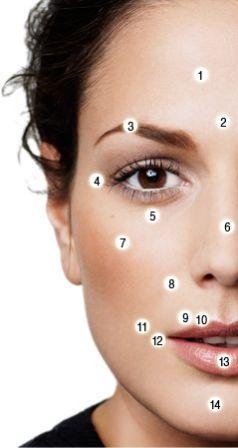 |
Upper part of the face: Middle part of the face: |
Lower part of the face: Body revitalization: 17. Kontur piersi |
WHEN TO USE HYALURONIC ACID ON THE FACE?
- Frown lines between the eyebrows add a stern and aged look to the face. For deep frown lines, we recommend hyaluronic acid to fill the crease. This procedure is often done after relaxing the area with Botox, as these two treatments complement each other. Botox smoothes the wrinkle and prevents rapid degradation of the filler. Hyaluronic acid complements the wrinkle, lifts the depression, and reduces grooves.
- Deep folds running from the sides of the nose to the corners of the mouth can occur even in young individuals. They are a natural indentation of facial skin, but when too deep, they give the impression of sagging cheeks. Deepening around the age of 40 is the result of the cheeks "lowering." For filling the nasolabial folds, we recommend hyaluronic acid preparations of various densities. In addition to reducing grooves and restoring the harmony of facial features, filling treatments also contribute to skin regeneration. The amount of hyaluronic acid depends on the size and depth of the grooves, usually ranging from 1 to 2 ampoules. A beneficial effect of smoothing nasolabial folds can also be achieved by improving cheek shape through facial contouring, known as volumetrics.
- Downturned corners of the mouth are a common cause of a sad, tired expression on the face. In young individuals, the vermilion of the lips is full, well-hydrated, and elastic. With age, the lips become less full. Sunken corners of the mouth and slight skin folds running from the corners of the mouth downward give a sad appearance, making even good makeup unable to conceal it. Filling and lifting the corners of the mouth with hyaluronic acid restores a cheerful expression to the entire face.
- Smoker's lines are vertical wrinkles above the upper lip, particularly noticeable when the lips are pursed as if whistling. They most commonly appear after the age of 45 and can be filled with hyaluronic acid. Often, for individuals with "smoker's lines," slight lip augmentation and filling of the corners are recommended. This comprehensive procedure can be performed at once.
- Marionette lines, also known as sadness wrinkles, are wrinkles below the corners of the mouth, running vertically downward. A good effect is achieved by filling these creases with dense hyaluronic acid. The amount of product depends on the size and depth of the grooves.
- A flat chin makes the face less defined. Even slight depressions on the chin can give it an uneven appearance. To correct the chin to its natural look, fillers can be used. Sunken chin hollows, commonly found in men, can also be filled to achieve a firm and healthy appearance.
- Facial cheek shaping with hyaluronic acid restores the proper proportions of the face and adds volume to the cheeks.
-
Crow's feet are expression lines that result from facial movements. Initially visible only when smiling, they deepen over time, becoming permanently etched in the skin. The filler used to treat crow's feet should contain low-crosslinked hyaluronic acid – a low-density product optimal for filling fine wrinkles in delicate skin. It is also important for the filler to have appropriate viscosity for correct distribution and low hygroscopic properties, meaning it has low water absorption capacity.
HYALURONIC ACID FACIAL TREATMENTS GIVE THE FOLLOWING EFFECTS:
Treatments using hyaluronic acid allow for the simultaneous smoothing of wrinkles, restoration of lost volume, and improvement of skin quality. The initial results are visible immediately after the procedure, but the final effect is evaluated after a few days, once the swelling subsides and the product binds water in the tissues.
- smoothing of static wrinkles and shallowing of deep folds, including nasolabial folds and marionette lines;
- restoration of lost volume in the cheeks, temples, and midface;
- improvement of the facial contour and oval, as well as better tissue support;
- contouring of the jaw, chin, nose, and other facial features;
- augmentation, hydration, and definition of the lip contour;
- intense skin hydration and improvement of its tension and elasticity;
- increase in skin density and firmness;
- reduction of signs of fatigue and restoring a fresher look to the face;
- improvement of facial symmetry and proportions; subtle rejuvenation effect without altering natural features.
The effects usually last from 10 to 12 months, although this time depends on the type of product, injection area, lifestyle, age of the patient, and individual metabolic rate. In the case of areas with high mobility, such as the lips, the product may be absorbed faster, whereas in volumetric areas, the result often lasts longer.
CONTRAINDICATIONS FOR HYALURONIC ACID TREATMENT
Before the procedure, a consultation with a specialist is always necessary to assess health status, skin quality, and rule out any possible contraindications. Although hyaluronic acid is a substance naturally occurring in the body, there are situations in which the procedure should be postponed or foregone.
The most important contraindications include:
- pregnancy and breastfeeding;
- active viral, bacterial, or fungal infections;
- skin inflammation at the site of the planned procedure;
- herpes in the active phase;
- fever and general weakness of the body;
- uncontrolled autoimmune diseases;
- active cancer;
- blood clotting disorders;
- use of anticoagulant medications after consultation with a doctor;
- a tendency to form hypertrophic scars and keloids;
- hypersensitivity to the ingredients of the product;
- recently performed surgical or aesthetic procedures in the area undergoing treatment.
The final decision regarding qualification for the procedure is made by the specialist after a thorough medical interview and an assessment of the patient's individual needs.
RECOMMENDATIONS AFTER HYALURONIC ACID TREATMENT
For a few days after the procedure, slight swelling, redness, or tissue tenderness may persist. Following post-procedure recommendations supports proper healing and helps achieve optimal aesthetic results.
For 24–48 hours after the procedure, it is recommended to:
- avoid touching and massaging the treated area, unless advised otherwise by a specialist;
- refrain from intense physical exertion;
- avoid saunas, hot baths, tanning beds, and intense sun exposure;
- limit alcohol consumption;
- refrain from cosmetological treatments at the site of product administration;
- avoid strong pressure, especially while sleeping;
- drink an adequate amount of water to support proper tissue hydration.
For about 2 weeks, it is advisable to refrain from facial massages, laser treatments, peels, and other procedures that may affect the distribution of the product. The final effect of the procedure is usually evaluated after 10–14 days.
PRICE OF THE HYALURONIC ACID TREATMENT
The price of a hyaluronic acid treatment depends on several factors, primarily on the type and amount of product used, the area undergoing correction, and the expected aesthetic effect. A different amount of product is needed for gentle smoothing of wrinkles, and a different amount for lip or jawline contouring or restoring lost cheek volume.
The cost of the treatment is influenced by, among other things:
- the type of product used and its degree of cross-linking;
- the area undergoing treatment;
- the scope of correction and the amount of product needed;
- individual anatomy and tissue quality;
- the administration technique and the complexity of the procedure.
During the consultation, the specialist assesses the condition of the skin, facial proportions, and the patient's expectations, and then selects the appropriate product and presents an individual treatment plan along with a detailed cost estimate.
Below is a detailed price list for treatments using hyaluronic acid.

Threatment prices
Facial modeling using hyaluronic acid aims to provide a gentle lift and contour to the face, helping to restore its proper oval shape and overall improvement of facial features. The procedure helps subtly enhance cheekbones, sculpt the chin and jawline, fill in sunken areas of the skin, and improve the facial shape, giving it a youthful and harmonious appearance. Additionally, this treatment can address any facial asymmetries or changes related to the aging process, restoring harmony and proper proportions. Facial modeling with hyaluronic acid effectively improves skin condition and restores its former volume, making the face look more radiant and youthful.
How does facial filling with hyaluronic acid work?
- Volume restoration – hyaluronic acid increases the volume of the skin in areas where it has been lost, such as cheeks or temples.
- Lifting and tissue support – acts as a natural scaffold, gently lifting the skin and improving its tension.
- Facial contouring – precise application of the product allows for highlighting features and improving facial proportions.
- Improvement in skin hydration and elasticity – by binding water, hyaluronic acid moisturizes the skin and stimulates its regeneration.
When to consider facial modeling with hyaluronic acid?
The treatment is recommended for individuals who want to:
- Restore a younger, more harmonious shape to the face.
- Emphasize cheekbones, chin, or jawline.
- Fill in sunken areas of the face and improve its volume.
- Correct asymmetry or gently lift sagging tissues.
- Rejuvenate the appearance of the skin without invasive surgical methods.
Effects of facial modeling with hyaluronic acid:
- Restoration of volume and improvement in facial proportions – the skin becomes fuller, and the face regains a youthful appearance.
- Highlighting facial features and contours – the treatment enhances cheekbones, shapes the jawline, and chin.
- Subtle lifting effect – lifting sagging tissues improves skin tension.
- Correction of asymmetries – adjusting differences in volume in different areas of the face.
- Improvement in skin hydration and elasticity – the face becomes more radiant and firm.
Frequency of treatments
- Effects last from 9 to 24 months, depending on metabolism and the type of product used.
- It is recommended to repeat the treatment every 9-18 months to maintain the achieved effect.
- In some cases, a minor correction may be possible a few weeks after the initial application of the product.
Filler injections with hyaluronic acid are one of the most effective ways to reduce signs of skin aging. The procedure involves precisely injecting a special gel based on hyaluronic acid into areas where wrinkles and folds have appeared. This substance, naturally occurring in the body, acts as an internal "filler" - moisturizing and tightening the skin, restoring its youthful appearance. The effects are visible almost immediately after the procedure, and the skin becomes smoother, firmer, and more radiant.
How Does the Procedure Work?
Hyaluronic acid has an extraordinary ability to bind water - one molecule can bind up to 1000 times more water than its weight. After being injected into the skin:
- Fills wrinkles and folds, adding volume in the areas where they form.
- Deeply moisturizes the skin, making it more elastic and firm.
- Stimulates skin regeneration, improving its structure and quality.
- Contours the face, restoring its youthful oval shape.
When to Use Hyaluronic Acid?
The procedure of filling wrinkles with hyaluronic acid is recommended for individuals who want to:
- Reduce expression lines and nasolabial folds, marionette lines, or crow's feet.
- Improve skin density and elasticity, especially in cases of dryness and loss of firmness.
- Restore a youthful face contour and correct subtle asymmetries.
- Refresh and rejuvenate the skin's appearance without undergoing invasive surgical procedures.
Effects of the Procedure
- Immediate smoothing and filling of wrinkles - the skin becomes smoother, and wrinkles and expression lines become less visible.
- Improved skin moisture and elasticity - thanks to hyaluronic acid's ability to bind water, the skin becomes firmer and more elastic.
- Refreshed, younger-looking face - the face looks rested, gains a natural glow and freshness.
- Subtle accentuation of features and natural rejuvenation effect - it is possible to subtly sculpt the face, such as enhancing cheekbones or lifting the corners of the mouth.
Frequency of Procedures
- Filler injections with hyaluronic acid provide effects lasting from 6 to 12 months, depending on the type of product, body metabolism, and lifestyle.
- For maintaining results, it is recommended to repeat the procedure every 9-12 months before the hyaluronic acid is completely absorbed. In some cases, especially with the first procedure, additional corrections may be possible after a few weeks.
- Regular procedures help maintain skin firmness, delay aging processes, and improve its quality over time.
Precise Correction, Safety, and Restoration of Natural Anatomy
Dissolving hyaluronic acid using hyaluronidase is a specialized medical procedure aimed at partially or completely removing a hyaluronic acid-based filler. The procedure is used in both aesthetic corrections and medical situations requiring urgent intervention.
Hyaluronidase is an enzyme naturally present in the human body, responsible for breaking down hyaluronic acid by hydrolyzing its bonds. In aesthetic medicine, it is used in a controlled and targeted manner, exclusively by experienced doctors.
At the Beauty Embassy, this procedure is performed based on ultrasound diagnostics of soft tissues, allowing for precise and responsible action without unnecessary interference with healthy structures.
How the Procedure Works – Biological Mechanism and Precision of Action
The effectiveness of the procedure is based on controlled enzymatic action and a thorough assessment of the filler’s location.
- Hyaluronidase breaks down exogenous hyaluronic acid into smaller fragments → facilitating their resorption by the lymphatic and vascular system
- Ultrasound allows the localization of hyaluronic deposits → determining their depth, volume, and relationship to tissues and vessels
- The enzyme is administered precisely → directly to the location of the filler
- The enzyme acts locally, in the area of administration → it does not "spread" across the entire face with correct technique
- The speed and extent of action depend on → the type of filler used (degree of cross-linking), its amount, depth of administration, and enzyme dose
- The enzymatic effect can be → partial or complete, depending on the therapy's goal
- Thanks to ultrasound control, it is possible → to use the minimal effective amount of hyaluronidase. This approach limits the risk of excessive dissolution and unnecessary loss of natural tissue volume.
In scientific literature, hyaluronidase is considered the gold standard in treating complications after HA fillers.
Indications for Dissolving Hyaluronic Acid
The procedure is performed only with clearly defined clinical indications.
- Unsatisfactory aesthetic effect → overcorrection, overemphasis, lack of facial harmony
- Migration of hyaluronic acid → especially in the area of the eyes, lips, nasolabial folds, and jawline
- Asymmetries after fillers → visible at rest or in facial expressions and confirmed by ultrasound
- Chronic swelling → distinguished in ultrasound from inflammatory swelling or lymphatic congestion
- Thickening and lumps → palpable or visible
- Tyndall effect → bluish skin tint with too superficial HA administration
- Vascular complications requiring rapid and precise intervention → pain, skin blanching, cyanosis, risk of necrosis (urgent state)
At the Beauty Embassy, the decision to administer hyaluronidase is always preceded by an anatomy analysis, interview, and risk assessment. Ultrasound confirms that hyaluronic acid is indeed the cause of the problem, rather than other tissue changes.
Procedure of Dissolving Hyaluronic Acid
The procedure is brief but requires high precision and doctor experience.
- Medical consultation → interview, analysis of previous procedures, clinical assessment
- Ultrasound examination → identification of the filler and planning of injection points
- Administration of hyaluronidase → using a thin needle or cannula, in controlled conditions
- Observation of tissue reaction → immediately post-procedure and in subsequent days
The procedure usually lasts no longer than a few minutes, while the resorption process can take from a few hours to a few days. Thanks to imaging diagnostics, the procedure is more predictable and safe.
Effects of the Hyaluronic Acid Dissolving Procedure
Results depend on the clinical indication, amount of filler, and individual body response.
- Reduction in volume or complete removal of the filler → restoration of natural facial features
- Reduction of swelling and tissue tension → particularly in delicate facial areas
- Improvement of symmetry and proportions → effect consistent with anatomy
- Reversal of tissue compression symptoms → clinically and ultrasound confirmed
- Facilitation of further therapy planning → after full tissue regeneration
It should be noted that hyaluronidase also dissolves natural hyaluronic acid in tissues, so precision is crucial.
Frequency and Therapy Plan
The procedure is not performed routinely.
- Most commonly, → one session is sufficient
- In cases of larger deposits → gradual dissolution over several stages may be possible
- Decision on further stages → based on clinical effect and ultrasound control
This approach protects tissues and maintains the natural structure of the face.
Why Perform the Procedure with an Experienced Doctor at the Beauty Embassy?
Dissolving hyaluronic acid is a procedure requiring medical knowledge, anatomical experience, and responsibility.
- The procedure is based on → knowledge of anatomy and imaging diagnostics
- Ultrasound increases safety → and limits the risk of incorrect decisions
- Precise dosing → reduces the risk of depressions and volume loss
- An experienced team → can differentiate aesthetic correction from a medical situation
This approach prioritizes patient safety and quality of outcome over the speed of the procedure.
Hyaluronic threads are an advanced tissue modeling and strengthening technique that involves administering cross-linked hyaluronic acid along strategic skin tension vectors. The preparation creates a kind of biological scaffold in the tissues, which improves skin support, subtly lifts sagging structures, and simultaneously stimulates regenerative processes.
The procedure combines lifting, biostimulating, and moisturizing properties, allowing you to regain a more defined facial oval, improve skin tension, and restore a younger, more rested appearance. The effects are harmonious and natural, without altering facial features.
How do hyaluronic threads work?
During the treatment, hyaluronic acid is administered linearly, following the natural lines of skin tension. This allows for simultaneous tissue support and the stimulation of tissue remodeling.
- Creation of a biological scaffold supporting tissues – linearly administered hyaluronic acid creates a network that strengthens skin structure and improves its tension.
- Restoration of lost support – the product stabilizes tissues, gently lifting areas affected by laxity.
- Biostimulation of fibroblasts – the presence of hyaluronic acid stimulates skin cells to produce new collagen and elastin.
- Intense tissue hydration – hyaluronic acid binds water, restoring proper hydration levels to the skin.
- Improvement of microcirculation and cellular metabolism – tissues become better nourished, more elastic, and resistant to aging processes.
The skin remodeling process continues for several weeks after the procedure, allowing the effects to gradually intensify.
Who are hyaluronic threads recommended for?
The treatment is intended for people who notice initial or moderate signs of loss of firmness and wish to improve their facial appearance without surgery or traditional lifting threads.
Hyaluronic threads are recommended in cases of:
- loss of skin tension and elasticity,
- sagging facial oval,
- deepening furrows and folds,
- loss of facial contour definition,
- laxity of cheeks and jawline,
- first signs of aging,
- dehydration and deterioration of skin quality,
- the need for a natural rejuvenation effect.
Areas of application
The hyaluronic thread technique can be used in many areas requiring improved tension and restoration of tissue support:
- facial oval,
- cheeks,
- jawline,
- jaw and chin area,
- nasolabial folds,
- marionette area,
- temples,
- neck.
Effects of the treatment
Results are partially visible immediately after the procedure, but the full effect develops gradually over several weeks, along with skin remodeling.
- Improvement of the facial oval and subtle tissue lifting – contours become more distinct, and the face regains harmonious proportions.
- Strengthening and thickening of the skin – tissues become more resistant to gravity and aging processes.
- Increased firmness and elasticity – stimulation of collagen production improves skin tension.
- Intense hydration – the skin regains freshness, softness, and a healthy glow.
- Smoothing of fine lines and furrows – the skin surface becomes more uniform.
- Improvement of skin quality and structure – the complexion looks younger, healthier, and more radiant.
- Natural rejuvenation effect – the face retains its individual features, gaining a fresher and more rested appearance.
Frequency of treatments
The treatment plan is always determined individually during consultation and depends on the patient's age, degree of skin laxity, and expected results.
In most cases, a single treatment is performed.
- Effects usually last from 9 to 18 months.
- If necessary, a touch-up treatment can be performed after a few weeks.
- To maintain the results, repeating the therapy every 9–18 months is recommended.
Why choose hyaluronic threads at Ambasada Urody Clinic & Spa?
The effectiveness of the treatment depends not only on the quality of the preparation, but primarily on the precise planning of injection vectors and an in-depth knowledge of facial anatomy. At Ambasada Urody Clinic & Spa, every therapy is preceded by a detailed consultation that allows matching the technique to the patient's individual needs.
- individual treatment plan tailored to facial anatomy,
- use of proven hyaluronic acid products,
- natural effects without changing facial features,
- a combination of lifting, biostimulation, and intense hydration,
- experience of specialists in anti-aging therapies,
- a comprehensive approach to skin rejuvenation and regeneration.
Hyaluronic threads are an excellent solution for people expecting a subtle improvement of the facial oval, restoration of skin quality, and a long-lasting rejuvenation effect without the need for more invasive procedures.
We perform procedures on preparations

Correction of fine and superficial wrinkles, skin biorevitalization, delicate lip modeling
Neauvia® Organic Rheology is an innovative premium filler designed for individuals with the first signs of skin aging. It contains pure hyaluronic acid extracted from Bacillus subtilis at a concentration of 22 mg/ml, cross-linked with PEG polymer, ensuring exceptional biocompatibility and safety.
The formula enriched with amino acids: glycine and L-proline, naturally present in collagen, supports skin regeneration, improves its structure and hydration, as well as stimulates collagen production by fibroblasts. Ideal for correcting shallow wrinkles, delicate lip modeling, and rejuvenating hands.
Key Features
- Hyaluronic acid concentration: 22 mg/ml
- HA Source: Bacillus subtilis - pure, biotechnological hyaluronic acid
- PEG cross-linking - safe, modern cross-linking
- Contains amino acids: glycine and L-proline - essential for collagen synthesis
- Rheological technology - supports water binding and nutrient absorption
- No mask effect - natural mimicry and invisible effect
- Tissue stability - does not migrate or form clumps
- Aesthetic effects + improvement of skin quality
Application
Neauvia Rheology is ideal for anti-aging prevention and gentle aesthetic corrections. Areas of application:
- smoker's lines
- fine lines around the mouth and eyes
- early mimic wrinkles
- gentle lip correction
- dorsal hands
Effects
- Smoothing of fine wrinkles
- Subtle improvement of volume and contour
- Activation of collagen synthesis (biorevitalizing action)
- Improvement of skin firmness and hydration
- Natural effect without visible filling
Effect Duration
On average 6-9 months, depending on the area, injection technique, and patient's skin characteristics

Correction of medium and deep wrinkles, restoring volume
Neauvia® Organic Intense Flux is an innovative filler based on pure hyaluronic acid derived from the bacterium Bacillus subtilis. The product stands out for its exceptional ability to adapt to tissues - the hydrogel dynamically adjusts to the conditions of the injection area, providing natural, harmonious aesthetic results.
Thanks to its high plasticity, elasticity, and HA concentration, Neauvia Flux is excellent for correcting medium and deep wrinkles, as well as for delicate facial contouring.
Key features
- High concentration of hyaluronic acid: 26 mg/ml
- HA origin: biotechnologically pure HA from Bacillus subtilis
- No lidocaine added - perfect for patients sensitive to anesthetics
- High plasticity and elasticity - excellent integration with the skin
- Autonomous adaptation of the gel to tissue conditions
- Effect lasts an average of 9-12 months
Application
Neauvia Intense Flux is designed for natural volume restoration and smoothing of deeper wrinkles without limiting facial expressions. Areas of application:
- Nasolabial folds
- Marionette lines
- Cheeks
- Facial contours
Action
- Correction of deep wrinkles and folds
- Restoration of natural volume
- Increased skin firmness and hydration
- Subtle facial oval shaping
- Adaptation to dynamic areas without overfilling
Duration of effect
On average 9-12 months, depending on the injection area, patient's metabolism, and injection technique

Teosyal® RHA 1 is the first resilient hyaluronic acid (Resilient Hyaluronic Acid) designed specifically for the dynamic areas of the face that undergo intense facial movements daily: smiling, talking, yawning, blinking. With the patented Teoxane technology, RHA 1 not only smoothens wrinkles but also adapts to the skin's movements, providing a natural effect and excellent tissue integration.
Key Features
- Hyaluronic acid concentration: 15 mg/ml
- Combination of cross-linked and non-cross-linked HA for maximum flexibility and hydration
- RHA® Technology - maintains long HA chains, increasing its resilience and elasticity
- Contains 3 mg lidocaine (lidocaine hydrochloride) - ensures comfort during the procedure
- Viscoelastic properties - gel adjusts to the skin's movements
- Natural effect without losing facial expressions
- Winner of the "Best Filler" award - AMEC 2015
Application
Teosyal RHA 1 is intended for superficial filling of mimic wrinkles and improving skin quality in delicate, mobile areas. Areas of application include:
- perioral area
- crow's feet
- glabellar lines
- nasolabial folds
- smoker's lines
- marionette lines
- temples
- forehead lines
- neck and décolletage areas
Mechanism of Action
- Fills fine lines and wrinkles
- Increases skin elasticity, firmness, and hydration
- Becomes part of the skin structure, supporting its natural functions
- Does not crack or move under movement, ensuring a natural look even with intense facial expressions
Duration of Effect
On average 6-9 months depending on the area, patient's age, and lifestyle

Medium wrinkles in mimic areas
Teosyal® RHA 2 is an elastic dermal filler from the RHA (Resilient Hyaluronic Acid) line developed by Teoxane Laboratories, designed to correct medium mimic wrinkles in highly mobile facial areas. The product works in harmony with the natural facial expressions, offering a natural look and full expression without stiffness.
Thanks to the patented RHA technology, the hyaluronic acid in the product maintains its elasticity properties and integrates with the skin, filling wrinkles, nourishing, and moisturizing tissues.
Key features
- Hyaluronic acid concentration: 23 mg/ml
- Combination of cross-linked and non-cross-linked HA
- Lidocaine: 3 mg lidocaine hydrochloride for procedural comfort
- RHA® technology - maintains natural HA chains for maximum elasticity
- Viscoelastic properties - gel adapts to skin movements
- Natural skin appearance even with intense mimicry
- AMEC 2015 Award - best aesthetic filler in Europe
Application
Teosyal RHA 2 is ideal for filling medium mimic wrinkles, providing subtle aesthetic improvement without losing the natural expression of the face. Areas of application:
- crow's feet
- smoker's lines
- marionette lines
- nasolabial folds
- glabellar lines
- forehead wrinkles
Mechanism of action
- Fills medium-depth wrinkles
- Provides natural skin elasticity and flexibility
- Maintains optimal hydration levels
- Harmonizes with mimicry - does not cause stiffness or exaggeration
Duration of effect
On average 9-12 months, depending on the application area and patient's lifestyle

Deeper mimic wrinkles and volumetry
Teosyal® RHA 3 is a flexible filler from the RHA® line (Resilient Hyaluronic Acid), developed by Teoxane Laboratories for reducing deep mimic wrinkles in the dynamic areas of the face. Thanks to its high concentration of HA and elastic structure, it is perfect for correcting distinct grooves without losing natural facial expressions.
Thanks to patented production technology, RHA 3 not only smooths wrinkles but also nourishes, moisturizes, and strengthens the skin, adapting to its movements.
Key features
- Hyaluronic acid concentration: 23 mg/ml
- Combination of cross-linked and non-cross-linked HA
- Lidocaine: 3 mg (lidocaine hydrochloride) - for treatment comfort
- Viscoelastic properties - the product "works" with the skin
- Structure: medium density, high stability
- Natural smoothing effect without limiting facial expressions
- AMEC 2015 award - best filler of the year
Application
Teosyal RHA 3 is designed for filling deep mimic wrinkles and improving facial contours in its dynamic areas. Areas of application:
- Nasolabial folds
- Marionette lines
- Smoker's wrinkles
- Crow's feet
- Glabellar lines
- Forehead wrinkles
Actions
- Fills and smooths deep wrinkles
- Firms and moisturizes the skin
- Improves skin structure and its resistance to movement
Duration of effect
On average 9-12 months, depending on the treated area, patient's lifestyle, and metabolism

Deep volumizing and contouring of the face in motion
Teosyal® RHA 4 is the densest and most volumizing filler from the RHA (Resilient Hyaluronic Acid) series, created by Teoxane Laboratories. It was designed to restore lost volume and contour the face in dynamic areas such as cheeks, chin, or temples.
The product integrates perfectly with tissues, preserving the natural mimic properties of the skin while lifting and strengthening its structure. It is the perfect solution for patients with visible volume loss and signs of aging.
Key features
- Hyaluronic acid concentration: 23 mg/ml
- Combination of cross-linked and non-cross-linked HA
- Lidocaine: 3 mg (lidocaine hydrochloride) – high treatment comfort
- RHA® technology – elasticity and adaptation to facial expressions
- High tissue lifting capacity and improvement of facial oval
- AMEC 2015 Award – best filler in Europe
Application
Teosyal RHA 4 is intended for restoring volume, tissue lifting, and shaping the facial oval in movable areas. Areas of application include:
- Cheekbones
- Cheeks
- Chin
- Jawline
- Temples
Action
- Deep facial volume rebuilding
- Visible firming and lifting of contours
- Effective shaping while maintaining natural mimicry
- Strong moisturizing and nourishing properties
Effect duration
On average 12-15 months, depending on the area of injection, technique used, and individual patient characteristics

Deep volumizing modeling, facial contouring, skin tension and moisturizing improvement
Neauvia® Organic Intense is the most concentrated filler from the Neauvia line, containing up to 28 mg/ml of biotechnologically sourced hyaluronic acid (Bacillus subtilis). Thanks to its dense, plastic structure and high elasticity, it is perfect for deep volumizing corrections, facial contour modeling, as well as improving skin firmness and moisture.
The product is effective not only on the face but also in more demanding areas such as: ear lobes, lips, hands, feet, and intimate areas.
Key Features
- Hyaluronic acid concentration: 28 mg/ml – the highest in the series
- HA source: Bacillus subtilis – pure, biocompatible composition
- Single-phase hydrogel – optimal smoothness and durability
- Advanced purification technology – no organic solvents
- Gel structure similar to skin tissue – excellent integration
- High plasticity and elasticity – no product migration effect
Application
Neauvia Intense is a versatile product designed for deep skin modeling and regeneration. Areas of application:
- face (contouring, volume)
- lips
- ear lobes
- hands
- tops of feet
- intimate areas
Action
- Filling volume deficiencies
- Improving skin contour and tension
- Long-lasting moisturizing and biorevitalization
- Natural effect without overfilling
Effect Duration
Average of 12-15 months, depending on the area of application and injection technique

Volume correction, volumetry, collagen stimulation, skin structure improvement
Neauvia® Organic Stimulate is a unique filler that combines aesthetic effects with active skin stimulation. Based on pure hyaluronic acid (26 mg/ml) derived from Bacillus subtilis bacteria, it is further enriched with calcium hydroxyapatite microspheres that stimulate collagen production and support long-term tissue regeneration.
By combining volumetric and bio-stimulating properties, the product is perfect for areas requiring volume, structure, and skin density improvement - both on the face and other body parts.
Key features
- Concentration of hyaluronic acid: 26 mg/ml
- Calcium hydroxyapatite content - collagen stimulation and skin density improvement
- Bio-compatible HA from Bacillus subtilis - minimal risk of reactions
- Innovative purification technology - no organic solvents
- Gel structure similar to dermal tissue - natural integration
- High durability and resistance to biodegradation
Application
Neauvia Stimulate is designed for volumetry, skin regeneration, and tissue rebuilding with simultaneous fibroblast-stimulating action. Areas of application:
- Cheekbones
- Cheeks
- Dorsal hands
- Knees
- Other areas requiring volume and density replenishment
Effects
- Filling volume voids
- Biostimulation: collagen production and skin regeneration
- Long-term improvement in tissue density and elasticity
- Natural appearance without product migration
Duration of effect
On average 12-18 months, thanks to the synergy of HA and calcium hydroxyapatite

Deep volume loss, tissue lifting, facial contouring
Teosyal® Ultra Deep PureSense is an advanced filler based on highly cross-linked hyaluronic acid with the addition of lidocaine (an anesthetic), created by the renowned Teoxane Laboratories from Switzerland. The product is specially developed for volume reconstruction, facial contouring, and treating deep wrinkles and skin folds in individuals with thick or visibly aging skin.
Key features
- High concentration of hyaluronic acid - 25 mg/ml
- Strong cross-linking of molecules - ensures durability and stability
- Addition of lidocaine (0.3%) - enhances comfort during the procedure
- Immediate corrective effect - with a natural lifting effect
- Long-lasting results - up to 12 months
Areas of application
Teosyal Ultra Deep PureSense is intended for:
- Restoring volume lost with age (e.g., cheekbones, cheeks, chin)
- Shaping facial contours and jawlines
- Filling deep grooves and folds (e.g., nasolabial folds)
- Lifting drooping eyelids (gentle lifting)
- Improving the structure and moisturization of aging skin
- Filling indentations caused by scars
- Reconstructing lost volume due to lipoatrophy
Areas of application
Face - particularly:
- Cheekbones
- Cheeks
- Jawline
- Chin
- Areas around grooves and folds
Duration of effect
On average 12 months, depending on the area of injection and the patient's lifestyle. In some cases - especially with deep injection and proper care - the effect can last up to 18 months.

Filling deep wrinkles, lip enhancement, scar correction
Restylane® Lidocaine is a filler based on stabilized non-animal hyaluronic acid, obtained by the fermentation method of Streptococcus equi bacteria. The product is manufactured by the Swedish biotechnological company Q-MED AB and contains 0.3% lidocaine, which ensures patient comfort during the procedure.
Due to the medium size of molecules and administration to the middle layer of the dermis, the product works perfectly in reducing deep wrinkles, correcting lip contours, and filling acne scars.
Characteristic features
- HA concentration: 20 mg/ml – cross-linked hyaluronic acid
- Lidocaine: 0.3% lidocaine hydrochloride – comfortable procedure
- HA source: fermentation of Streptococcus equi
- Administration: middle layer of the dermis
- Structure: medium-sized molecules – suitable for deep wrinkles
- Safe and biocompatible – non-animal origin product
Application
Restylane Lidocaine is designed for filling deep wrinkles, lip enhancement, and scar correction. Application areas include:
- nasolabial folds
- marionette lines
- smile lines
- vermilion border
- lip enhancement
- philtrum
- lip augmentation
- acne scars (atrophic)
Effects
- Deep filling of wrinkles and creases
- Improvement of lip contour and perioral area
- Smoothing of the skin and improvement of its density
- Correction of acne scars
Duration of effect
On average 8-12 months, depending on the technique, area, and individual skin characteristics

Restoring facial volume, gentle lifting effect, and improving facial shape
Juvéderm® Voluma is an advanced implant based on cross-linked hyaluronic acid with a unique stabilization technology - 3D matrix, which allows for deep, long-lasting, and naturally looking restoration of facial volume. The product integrates perfectly with the tissues, providing an immediate lifting effect and skin firmness.
Thanks to its formula, Voluma is designed for deep volume-rebuilding treatments in areas such as cheeks, temples, or chin. The results are natural, proportional, and lasting - from 12 to 18 months.
Key Features
- HA concentration: 20 mg/ml - cross-linked hyaluronic acid
- 3D matrix technology - deep tissue integration
- Lidocaine: 3 mg/ml - painless administration for comfort
- Duration of effect: 12 to 18 months
- Lifting properties - lifts and rebuilds facial contours
- Immediate and natural effects
Application
Juvéderm Voluma is ideal for individuals with visible loss of volume in the middle and lower parts of the face who want to achieve a natural lifting and firming effect on the skin. Areas of application:
- cheeks
- cheekbones
- temples
- chin
- facial contours
Effects
- Restoration of lost skin volume
- Shaping of cheeks and jawline
- Gentle, natural facial lifting
- Firming and moisturizing deep layers of the skin
Duration of Effect
Average of 12-18 months, depending on injection technique and patient's skin characteristics