Hirsutism
back to main page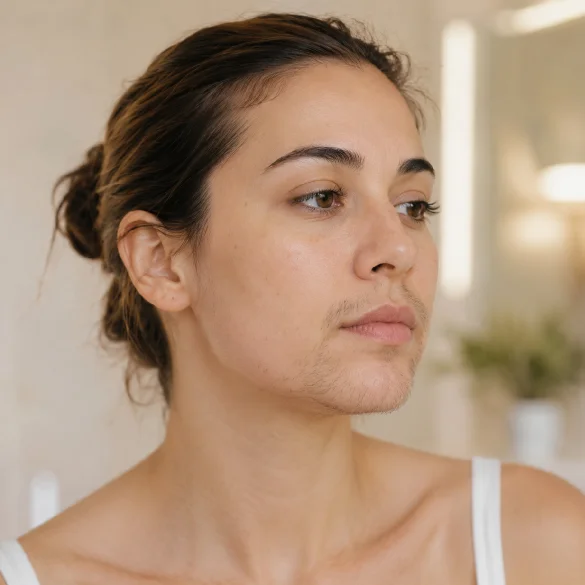
Dark, thick hair above the upper lip, on the chin, chest, or abdomen - in women, this is not only an aesthetic issue, but often a sign of hormonal disorders. Hirsutism affects up to a dozen or so percent of women, and polycystic ovary syndrome is most commonly behind it. Below, we discuss how to assess the severity of the problem, when hormonal diagnostics are necessary, and why laser hair removal provides the most long-lasting results in hair reduction.
Hirsutism - what is it
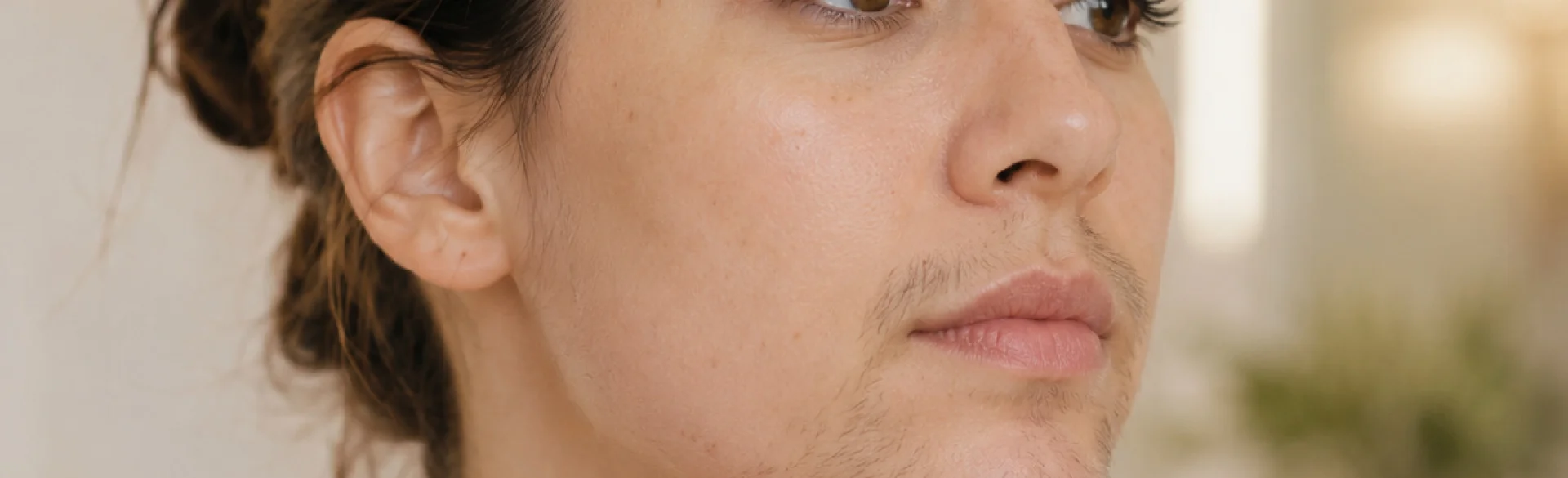
Hirsutism is the excessive growth of dark, thick, and terminal hair in women in areas typical of male-pattern hair, most often resulting from the increased influence of androgens on hair follicles. The hair appears primarily on the face, chest, abdomen, back, or inner thighs, causing not only an aesthetic problem but often also a significant psychological burden.
Hirsutism must be distinguished from hypertrichosis. In hirsutism, androgen-dependent hair growth occurs in characteristic locations, whereas hypertrichosis means excessive hair growth independent of sex hormones and can occur in both women and men.
Two main mechanisms are responsible for the development of hirsutism:
- increased concentration of androgens in the blood,
- normal concentration of androgens with a simultaneous increased sensitivity of hair follicles to their action.
Under the influence of androgens, thin, light vellus hair gradually transforms into thick, dark terminal hair. This process occurs gradually and involves subsequent hair growth cycles, which is why the development of hirsutism usually takes many months or years.
The most common cause of hirsutism is polycystic ovary syndrome (PCOS), which accounts for the majority of cases. Other causes include, among others:
- congenital adrenal hyperplasia,
- Cushing's syndrome,
- androgen-secreting ovarian or adrenal tumors,
- insulin resistance and obesity,
- certain medications (e.g., androgens, danazol, anabolic steroids),
- idiopathic hirsutism, in which hormone test results remain normal.
Most commonly, excessive hair appears:
- above the upper lip,
- on the chin,
- on the cheeks,
- on the neck,
- around the nipples,
- on the sternum,
- on the abdomen (especially along the linea alba),
- on the back,
- on the buttocks,
- on the inner surfaces of the thighs.
Hirsutism is not a disease in itself, but a symptom that may indicate hormonal disorders. For this reason, any woman who experiences sudden or rapidly progressing hair growth should undergo appropriate diagnostics.
Hirsutism - Ferriman-Gallwey scale - how to assess severity
The most recognized method for assessing the severity of hirsutism is the Ferriman-Gallwey scale (Modified Ferriman-Gallwey Score, mFG), used in both clinical practice and scientific research.
The assessment consists of evaluating the amount of terminal hair in nine androgen-dependent areas of the body.
The following are evaluated:
- upper lip,
- chin,
- chest,
- upper back,
- lower back,
- upper abdomen,
- lower abdomen,
- upper arms,
- thighs.
Each area receives a score from 0 to 4:
- 0 - no terminal hair,
- 1 - single hairs,
- 2 - moderate hair growth,
- 3 - pronounced hair growth,
- 4 - very severe hair growth.
After summing up the points, the total score is obtained.
Most commonly, the following is assumed:
- below 8 points - no hirsutism,
- 8-15 points - mild hirsutism,
- 16-25 points - moderate hirsutism,
- above 25 points - severe hirsutism.
It is worth emphasizing that the cutoff values vary between populations and ethnic groups. Women of Mediterranean, Middle Eastern, or South Asian origin naturally have denser hair than women of Northern European origin, which is why the interpretation of the result should always take into account the patient's origin.
The Ferriman-Gallwey scale does not replace medical diagnosis, but it is a valuable tool for:
- monitoring disease progression,
- evaluating the effectiveness of hormonal treatment,
- planning dermatological therapy,
- documenting treatment effects.
Hirsutism - when does it require hormonal diagnostics
Not every case of excessive hair growth requires extensive diagnostics. However, there are situations in which an urgent endocrinological or gynecological consultation is necessary.
Particular attention should be paid to:
- sudden development of hirsutism within a few months,
- very rapid worsening of symptoms,
- coexisting menstrual disorders,
- difficulty getting pregnant,
- severe acne,
- androgenetic alopecia,
- deepening of the voice,
- increased muscle mass,
- enlargement of the clitoris,
- nipple discharge,
- symptoms of Cushing's syndrome.
Diagnostics primarily include the assessment of the levels of hormones responsible for androgen balance.
The most commonly performed tests are:
- total and free testosterone,
- DHEA-S,
- androstenedione,
- SHBG,
- 17-hydroxyprogesterone,
- LH and FSH,
- prolactin,
- TSH,
- cortisol in justified cases.
In many patients, the following are also performed:
- ovarian ultrasound,
- assessment of carbohydrate metabolism,
- measurement of insulin and glucose,
- assessment of the lipid profile.
If excessive hair growth appears suddenly, increases very rapidly, and is accompanied by symptoms of virilization (masculinization), it is necessary to rule out rare but potentially dangerous androgen-secreting tumors.
Proper diagnostics are of great importance because causal treatment often limits the further development of hirsutism and improves the effectiveness of aesthetic therapies.
Hirsutism - laser hair removal as a method of long-term reduction
Laser hair removal is currently considered the most effective method for long-term hair reduction in women with hirsutism. The treatment does not eliminate the hormonal cause, but it effectively reduces the number of active hair follicles and significantly improves the patients' quality of life.
The laser emits light of an appropriately selected wavelength, which is selectively absorbed by the melanin located in the hair shaft and bulb. Light energy is converted into heat, leading to selective damage to the structures responsible for hair growth, while preserving the safety of the surrounding tissues.
The best results are achieved in the case of:
- dark hair,
- light skin,
- hair in the anagen phase.
Since only a portion of the hair is in the active growth phase at the same time, the therapy requires a series of treatments.
Most commonly, it includes:
- 6-10 treatments performed every 4-8 weeks depending on the area,
- followed by maintenance treatments performed individually, usually once every 6-12 months.
In women with active hormonal disorders, the number of required treatments may be higher, and maintenance treatment performed more frequently. The best results are achieved by simultaneously treating the cause of hirsutism and performing laser hair removal.
The benefits of laser therapy include:
- permanent reduction in the number of hairs,
- reduction in the thickness and dark coloration of regrowing hair,
- limiting the problem of ingrown hairs,
- reducing the risk of folliculitis,
- improving the appearance of the skin,
- reducing the need for daily shaving or hair removal,
- a clear improvement in the quality of life and psychological comfort.
Modern laser systems equipped with advanced cooling systems enable treatments to be performed safely on various skin phototypes and in many body areas. However, proper patient qualification, appropriate selection of treatment parameters, and the experience of the personnel performing the therapy are of key importance.
In the case of hirsutism, laser hair removal is an element of comprehensive therapeutic management. The combination of hormonal diagnostics, causal treatment, and modern laser methods allows for the most durable and satisfying results in both medical and aesthetic terms.
