Subcutaneous facial fat
back to main page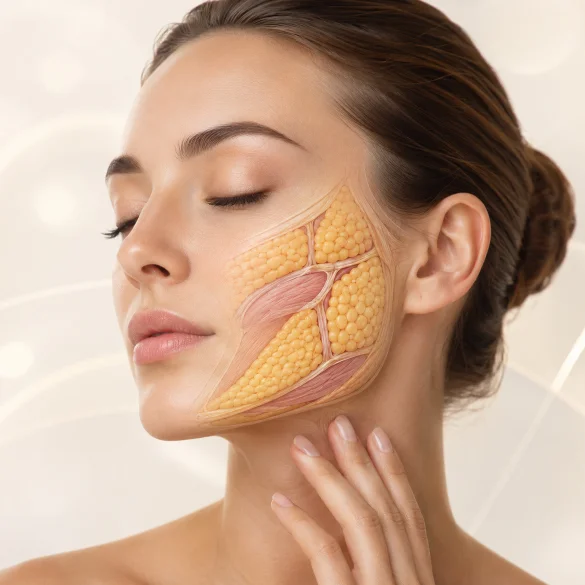
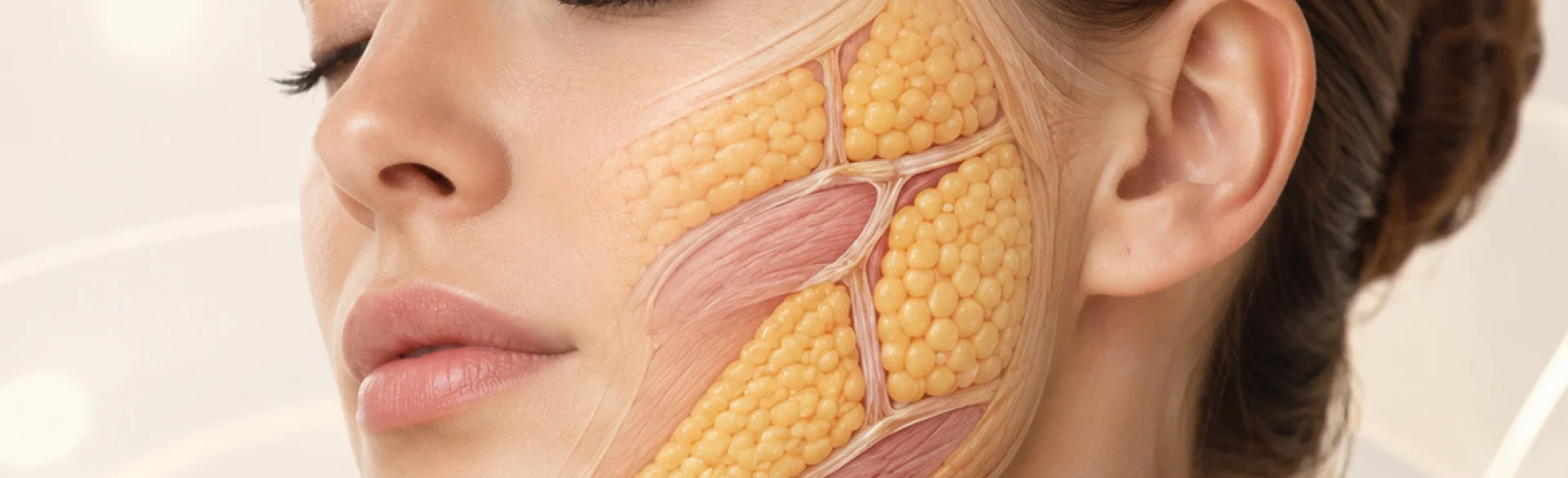
Facial subcutaneous fat is a specialized adipose tissue located between the skin and deeper musculoaponeurotic structures of the face. It plays an important biomechanical, aesthetic, and metabolic role, being responsible for the volume, proportions, and youthful appearance of the face. Unlike adipose tissue in other areas of the body, facial fat has a complex anatomical architecture consisting of distinct fat compartments of varying size, density, and susceptibility to aging processes. With age, there is a gradual atrophy of some fat structures, their displacement under the influence of gravity, and qualitative changes within the skin and facial ligaments. This process plays a key role in the occurrence of such symptoms as sunken cheeks, sagging of the facial contour, or the deepening of furrows.
Subcutaneous facial fat - what it is
Subcutaneous facial fat is a variety of adipose tissue composed mainly of adipocytes, i.e., lipid-storing cells. This tissue is located directly beneath the dermis and forms a layer separating the skin from the mimic muscles and fascial structures. Within the face, however, it does not have a uniform character. Modern aesthetic anatomy describes the face as a system of multiple independent fat compartments, referred to as fat compartments.
Each of these compartments has its own blood supply, innervation, and individual aging process. The most important superficial and deep fat compartments include, among others:
- cheek fat pads,
- temporal fat compartments,
- zygomatic region fat,
- infraorbital fat,
- mandibular fat,
- deep cheek fat (deep medial cheek fat),
- buccal fat pad, i.e., the so-called Bichat's fat.
Subcutaneous facial fat is responsible for cushioning tissues, protecting vessels and nerves, and maintaining appropriate anatomical proportions. Its amount and distribution are partially genetically determined, but they also change under the influence of age, hormones, body weight, and lifestyle.
Subcutaneous fat of the face - how it is structured
The structure of facial subcutaneous fat significantly differs from the adipose tissue present on the abdomen or thighs. This structure is more complex, more strongly connected with the system of retaining ligaments, and much more dependent on the anatomy of mimic muscles.
Facial adipose tissue consists of:
- adipocytes,
- collagen and elastin fibers,
- fibrous septa,
- blood vessels,
- lymphatic vessels,
- adipose tissue stem cells,
- elements of the immune system.
Individual fat compartments are separated by connective tissue septa, which stabilize tissues and limit the movement of fat. Thanks to this, a young face maintains clear contours and a harmonious volume distribution.
An important role is also played by retaining ligaments, i.e., facial retaining ligaments. They connect the skin with deeper bone and fascial structures. With age, they weaken, which causes the downward displacement of fat compartments.
In aesthetic anatomy, the following are distinguished:
Type of fat | Location | Function |
|---|---|---|
Superficial fat | Directly under the skin | Smoothing and softness of features |
Deep fat | Above bony structures | Volume support of the face |
Bichat's fat | Middle part of the cheek | Modeling of the midface |
Changes occurring in these structures constitute one of the main mechanisms of facial aging.
Subcutaneous facial fat - role in skin appearance
Facial subcutaneous fat is of fundamental importance for facial aesthetics and skin quality. It is the appropriate volume of fat compartments that is responsible for a youthful, rested, and harmonious appearance.
Properly distributed adipose tissue:
- gives the face softness,
- smooths transitions between bony structures,
- supports skin tension,
- shapes the contours of the cheeks and jawline,
- reduces the visibility of vessels and bony structures,
- affects facial proportions.
A youthful face is typically characterized by a greater volume of the midface, especially in the area of the cheeks and cheekbones. With fat loss, the face becomes flatter, skeletal, or tired.
Excessive fat loss can lead to:
- sunken cheeks,
- tear troughs,
- increased visibility of nasolabial folds,
- loss of the facial oval,
- the formation of so-called jowls,
- an increased effect of gravitational aging.
On the other hand, excess fat or its uneven distribution can cause heaviness of the lower face, puffiness, and disrupted proportions.
In aesthetic medicine, the assessment of the quality and distribution of adipose tissue forms the basis for planning volumetric, lifting, and biostimulating treatments.
Subcutaneous facial fat - what affects its amount
The amount of subcutaneous facial fat depends on many biological and environmental factors. Processes occurring within facial adipose tissue are dynamic and change throughout life.
The most important factors affecting facial fat volume include:
Age
Aging leads to gradual atrophy, i.e., the loss of some fat compartments. This most strongly affects the midface and the temple area.
Genetics
Genetic predispositions influence:
- fat distribution,
- skin thickness,
- the rate of aging,
- susceptibility to volume loss.
Body weight
Sudden weight loss causes a reduction in adipocyte volume, also within the face. This is particularly visible after intensive weight loss or GLP-1 agonist therapy.
Hormones
Estrogens affect adipose tissue metabolism and skin quality. After menopause, there is often an accelerated loss of facial volume.
Lifestyle
A negative impact is shown by:
- tobacco smoking,
- chronic stress,
- lack of sleep,
- UV radiation,
- a diet poor in protein and antioxidants,
- chronic inflammation.
Diseases and pharmacological treatment
Changes in fat volume may occur in the course of:
- lipodystrophy,
- autoimmune diseases,
- hormonal disorders,
- steroid therapy,
- wasting diseases.
Facial subcutaneous fat and the aging process - mechanism
Facial aging is a multi-level process involving bones, ligaments, muscles, skin, and adipose tissue. Currently, it is believed that changes within subcutaneous fat are among the most important mechanisms of aesthetic aging.
The aging process of facial fat simultaneously includes:
- atrophy of some compartments,
- downward displacement of fat,
- loss of ligamentous support,
- deterioration of microcirculation,
- tissue fibrosis,
- decrease in stem cell activity.
As a result, facial proportions change:
- the mid-face loses volume,
- the lower face becomes heavier,
- skin creases and folds deepen,
- the facial contour loses definition.
Subcutaneous fat aging also co-occurs with bone resorption. Craniofacial bones gradually lose volume, which additionally reduces support for soft tissues.
Thus, modern aesthetic medicine focuses not only on skin tightening, but also on restoring lost volumetric structures. For this purpose, the following are used, among others:
- tissue biostimulators,
- autologous fat grafting,
- volumetric treatments with hyaluronic acid,
- lifting technologies utilizing RF waves and ultrasound,
- procedures stimulating collagen production.
In clinical practice, treatments available in the offer of Ambasada Urody Clinic & SPA are also used, including:
- facial volumetry,
- microneedle radiofrequency,
- HIFU,
- collagen biostimulators,
- treatments stimulating skin tension and tissue remodeling.

