Forehead wrinkles
back to main page
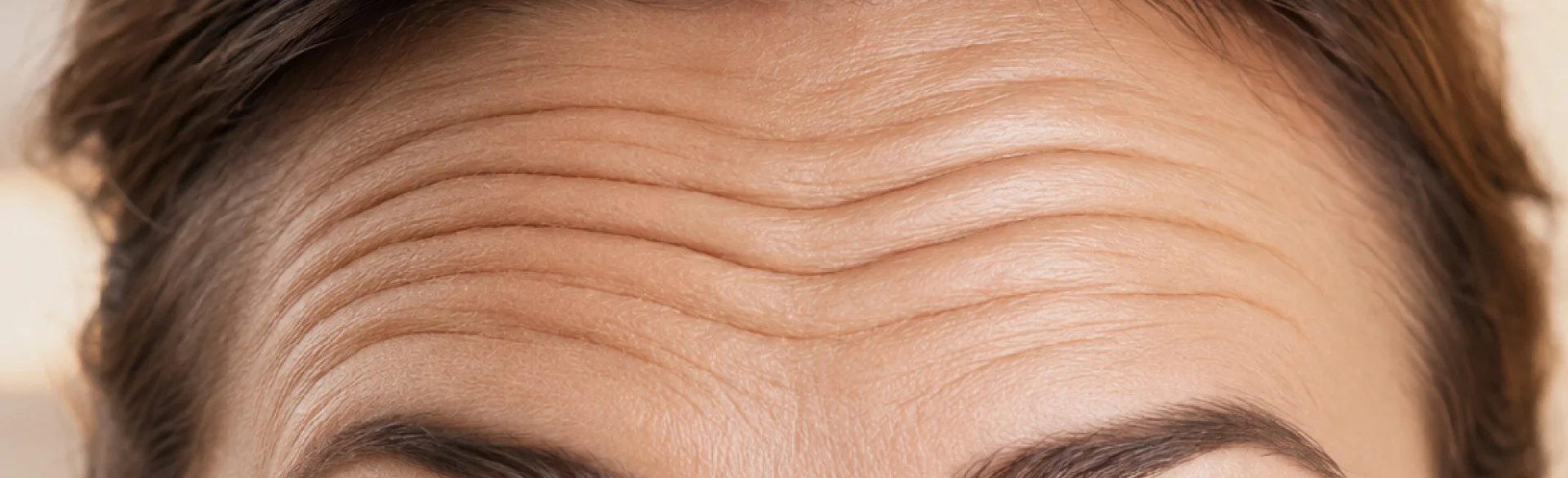
Forehead wrinkles are among the first signs of aging, which become visible in people between 25 and 35 years of age. Initially, they appear only when raising the eyebrows or furrowing the forehead, but over time, they become permanent and remain visible even at rest. Their formation is the result of the simultaneous action of facial muscles, natural skin aging processes, and environmental factors, primarily UV radiation.
The forehead is an exceptionally active area in terms of facial expressions. The frontalis muscle is responsible for raising the eyebrows and creating horizontal wrinkles, while the corrugator supercilii muscles and the procerus muscle are responsible for the formation of vertical furrows between the eyebrows, referred to as the lion's wrinkle. Every muscle contraction causes repeated folding of the skin in the same places. In young skin, wrinkles quickly disappear, but with age, there is a decrease in the amount of collagen, elastin, and hyaluronic acid, causing expression lines to become permanent.
The rate of their formation is also influenced by photoaging. UVA radiation penetrates deep into the dermis and causes the degradation of collagen fibers, increased activity of metalloproteinases (MMPs), and chronic inflammation referred to as inflammaging. As a result, the skin becomes thinner, less elastic, and less able to withstand daily mechanical stress associated with facial expressions.
Forehead wrinkles can be:
- dynamic - visible only during muscle activity,
- static - present even when the face is completely relaxed,
- mixed - combining features of both types and most commonly found in people over 35-40 years of age.
Modern aesthetic medicine allows for effective slowing down of this process. Depending on the type of wrinkles, botulinum toxin, skin biostimulation, laser treatments, microneedling radiofrequency, tissue stimulators, and in selected cases, also hyaluronic acid fillers are used. The best results are achieved by an individually tailored combination therapy, which simultaneously reduces excessive muscle activity and improves skin quality.
Forehead wrinkles - horizontal vs. frown line - difference
Although both types of wrinkles occur in the same area of the face, they develop as a result of the action of different muscles and require a different therapeutic approach. Their correct identification is crucial for achieving a natural treatment effect.
Horizontal forehead wrinkles
They are formed as a result of the activity of the frontalis muscle (musculus frontalis), whose task is to raise the eyebrows and open the field of vision.
Characteristic features:
- they run horizontally across the entire width of the forehead,
- they intensify when raising the eyebrows,
- they often coexist with drooping eyebrows or eyelids,
- over time, they also remain visible at rest.
Botulinum toxin is most commonly used in treatment, and the dose must be selected very precisely. Excessive weakening of the frontalis muscle can lead to lowering of the eyebrows and deepening of eyelid drooping.
Frown line
These are vertical or oblique furrows appearing between the eyebrows. They are caused by the corrugator supercilii muscles, the procerus muscle, and partially the orbicularis oculi muscle.
Characteristic features:
- forms one, two, or several vertical furrows,
- appears when frowning,
- gives the face a stern, tired, or angry appearance,
- can cause persistent muscle tension and headaches in some people.
The lion's wrinkle responds very well to botulinum toxin treatment, especially when the therapy is started at the stage of dynamic wrinkles.
In practice, both types of wrinkles often occur simultaneously. An experienced doctor assesses the entire biomechanics of the upper face, because the treatment of one area affects the function of the remaining mimic muscles.
Forehead wrinkles - why they appear early
In many people, the first forehead wrinkles appear even before the age of 30. This does not mean accelerated aging of the entire body. Most often, it results from individual predispositions and very intense activity of mimic muscles.
The most important causes include:
- strong facial expressions - frequent raising of the eyebrows leads to repeated creasing of the skin in the same places,
- genetic factors - some people have thinner skin or more active forehead muscles,
- photoaging - UVA radiation weakens collagen and elastin fibers every day,
- insufficient photoprotection - the lack of daily use of SPF creams accelerates the setting of wrinkles,
- chronic stress - increases the tension of mimic muscles and intensifies the body's inflammatory reactions,
- smoking tobacco - restricts microcirculation and accelerates collagen degradation,
- visual impairment - frequent raising of the eyebrows to improve visual acuity causes constant overloading of the frontalis muscle,
- drooping eyelids or heavy eyebrows - the body compensatorily activates the frontalis muscle to widen the field of vision,
- improper care - chronic dehydration of the epidermis increases the visibility of fine lines.
The early appearance of wrinkles does not mean the necessity of intensive treatment. Much more beneficial effects are brought by prevention carried out at the stage of dynamic wrinkles, before they become permanently set.
Forehead wrinkles - facial expressions vs photoaging - which is more harmful
There is no single dominant factor responsible for the formation of forehead wrinkles. This process is the result of the interaction of facial expressions and UV-induced aging.
Facial expressions are responsible for the mechanical formation of wrinkles.
Every eyebrow raise causes the skin to crease in exactly the same places. Repeating this movement thousands of times a day leads to the setting of expression lines.
Photoaging weakens the structure of the skin.
UVA radiation:
- destroys collagen fibers,
- reduces the production of new collagen,
- damages elastin,
- increases the activity of enzymes degrading the extracellular matrix,
- intensifies the chronic micro-inflammatory aging process.
It can be said that:
- facial expressions create wrinkles,
- photoaging makes them permanent.
Therefore, modern treatment includes two parallel directions:
- limiting the excessive activity of facial muscles,
- rebuilding skin quality by stimulating collagen production.
Such a comprehensive approach provides more natural and long-lasting results than treatment focused solely on a single aging mechanism.
Forehead wrinkles - botulinum toxin and fillers
Treatment of forehead wrinkles should be tailored individually to the type of wrinkles, the patient's age, skin quality, and the anatomy of facial muscles. Not every furrow requires filling, just as not every one qualifies exclusively for botulinum toxin treatment.
Botulinum toxin
It is the gold standard for the treatment of dynamic forehead wrinkles.
The mechanism of action involves a temporary reduction of neuromuscular conduction, thanks to which the muscles contract much more weakly. The skin is no longer intensely creased, and existing wrinkles are gradually smoothed out.
The greatest benefits include:
- smoothing of horizontal wrinkles,
- reduction of the frown line,
- inhibiting the deepening of existing furrows,
- preventing the formation of new wrinkles,
- a more rested and serene facial appearance.
The effect lasts on average from 3 to 6 months, depending on muscle activity and individual characteristics of the body.
Hyaluronic acid fillers
They are used much less frequently than botulinum toxin and only in appropriately selected cases.
They can be used when:
- permanent furrows remain visible despite properly performed botulinum toxin therapy,
- loss of tissue volume has occurred,
- additional smoothing of deep static wrinkles is necessary.
However, the forehead area is one of the most anatomically demanding areas of the face. Due to the course of important blood vessels, the administration of fillers requires very extensive experience of the doctor and an excellent knowledge of anatomy. For this reason, modern tissue stimulators, microneedling radiofrequency, fractional laser or biostimulating treatments turn out to be a better choice for many patients, as they improve skin quality without increasing the risk associated with filler administration.
The most natural results are achieved through multi-level therapy, which simultaneously limits excessive muscle activity, stimulates collagen production and rebuilds the skin structure. This approach allows to maintain unrestricted facial expressions, avoid the "frozen forehead" effect and effectively slow down the aging process.

