Furrows on the face
back to main page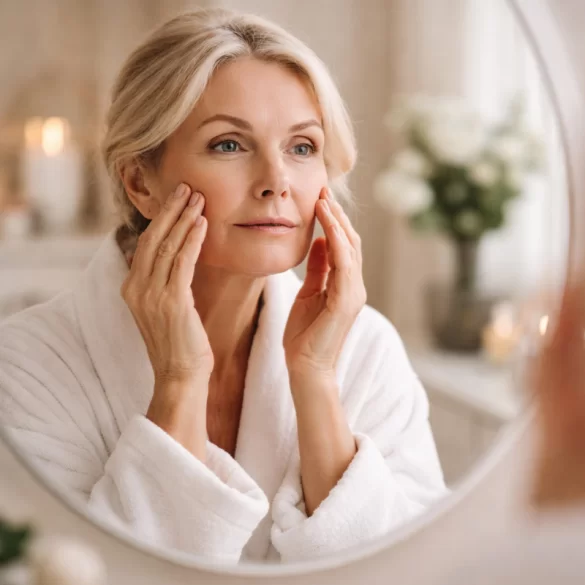

Facial grooves are visible depressions and linear folds in the skin, resulting from the loss of tissue volume, weakening of collagen and elastin fibers, as well as the effects of gravity and repetitive facial expressions. Unlike fine wrinkles, grooves are deeper and structural in nature, affecting not only the epidermis but also the dermis and subcutaneous tissue. They are most commonly found in the nasolabial folds, marionette lines, tear troughs, and transverse forehead lines. Their presence affects the proportions of the face and the perception of biological age, and sometimes also the emotional expression (tired, sad face).
Furrows on the face – what are they
From a medical perspective, a furrow is a permanent indentation of the skin, resulting from:
- loss of fatty tissue (lipoatrophy),
- weakening of the collagen-elastin framework,
- remodeling of the craniofacial bones,
- chronic tension of the facial muscles.
Furrows differ from expression wrinkles:
- expression wrinkles – appear mainly during muscle movement,
- static furrows – are visible at rest, having a structural nature.
The most common types of furrows:
- nasolabial folds – running from the wings of the nose to the corners of the mouth,
- marionette lines – from the corners of the mouth downward,
- tear trough – indentation in the medial area of the lower eyelid,
- horizontal forehead furrows,
- smoker's lines around the mouth.
At the histological level, the following can be observed:
- decrease in the number and quality of fibroblasts,
- fragmentation of type I and III collagen fibers,
- reduction in hyaluronic acid content,
- microcirculation disorders.
Therefore, a furrow is the result of multi-level structural degeneration, not merely a superficial loss of hydration.
Facial Wrinkles – Causes
The formation of wrinkles is multifactorial in nature. Key mechanisms include:
1. Intrinsic aging (chronological)
- decrease in collagen synthesis (approximately 1% annually after the age of 25),
- reduced elastin production,
- loss of fat tissue volume,
- bone resorption in the jaw and eye sockets.
2. Extrinsic aging (photoaging)
- UV radiation inducing matrix metalloproteinases (MMPs),
- oxidative stress,
- degradation of the skin's supportive fibers.
3. Facial expressions and biomechanics
- repetitive muscle movements (smiling, frowning),
- asymmetry of muscle tension,
- chronic bruxism.
4. Environmental factors and lifestyle
- smoking,
- diet low in antioxidants,
- hormonal imbalances (e.g., decrease in estrogen),
- rapid weight loss.
It is worth noting that nasolabial folds can be present even in young individuals—their depth depends on facial structure, genetic predisposition, and fat distribution.
Facial furrows – diseases
While wrinkles are most often a part of physiological aging, in some situations they may be associated with pathological conditions.
1. Lipoatrophy
The loss of fatty tissue may occur:
- in the course of autoimmune diseases,
- as a side effect of medications (e.g., in antiretroviral therapy),
- as a result of severe nutritional deficiencies.
2. Connective tissue diseases
- systemic sclerosis,
- systemic lupus erythematosus,
- Ehlers-Danlos syndrome (collagen synthesis disorders).
3. Endocrine disorders
- hypothyroidism (myxedema altering facial contour),
- hyperandrogenism,
- postmenopausal period with a rapid decrease in estrogens.
4. Neurological diseases
Asymmetry of wrinkles may appear in the course of:
- facial nerve palsy,
- stroke.
A sudden deepening of the wrinkle on one side of the face requires differential diagnostics.
Wrinkles on the face – home remedies
It must be clearly stated: home methods will not remove deep structural furrows. However, they can:
- improve skin quality,
- increase its elasticity,
- slow down the progression of changes.
1. Photoprotection
- SPF 30–50 creams throughout the year,
- avoid excessive UV exposure.
2. Topical retinoids
- stimulate fibroblasts,
- improve dermal thickness.
3. Antioxidants
- vitamin C,
- vitamin E,
- ferulic acid.
4. Proper diet
- high-quality protein,
- omega-3 fatty acids,
- plant polyphenols.
5. Sleep hygiene and stress reduction
Chronic cortisol accelerates collagen degradation.
However, one must remain realistic – if a furrow results from tissue volume loss, a cream will not rebuild adipose tissue nor reverse bone remodeling.
Facial Furrows – Massages
Facial massages are a method that supports the therapy of wrinkles, although their effectiveness depends on the etiology of the condition. For wrinkles of a musculo-fascial nature (resulting from chronic tension and biomechanical disturbances of the face), they can bring real improvement. In structural wrinkles, associated with volume loss and bone remodeling, the effects of massage are limited and supportive.
Mechanisms of Massage Action
From the perspective of facial physiology and anatomy, massage influences:
- improvement of microcirculation – increased tissue perfusion promotes oxygenation of fibroblasts,
- enhancement of lymphatic drainage – reduction of stasis and swelling, which can visually deepen wrinkles,
- normalization of muscle tension – reduction of hypertonicity of muscles lowering the corners of the mouth or furrowing the brows,
- mobilization of the superficial fascia (SMAS) – improvement in the glide of tissue layers,
- stimulation of mechanotransduction – mechanical stimuli can affect fibroblast activity and collagen production.
It is worth noting that the face is a multi-layered structure, and tensions around the jaw, zygomatic bones, or cranial base can secondarily deepen nasolabial folds and marionette lines.
Techniques Used in Wrinkle Therapy
1. Manual Lifting Massage
Working along the tension lines of the skin (Langer's lines) with elements of tissue lifting upwards. The aim is to counteract the gravitational effect.
2. Facial Lymphatic Drainage
Gentle, rhythmic techniques improving lymph outflow – particularly important for tear troughs and wrinkles that intensify in the morning.
3. Fascial Therapy
Deeper mobilization of fascia within the cheeks and jaw. It may reduce tissue stiffness and improve elasticity.
4. Osteopathic Craniofacial Techniques
Working on tensions within cranial sutures and temporomandibular joints, especially in patients with bruxism.
5. Aesthetic Kinesiotaping
Tapes applied in a direction counteracting tissue drooping – short-term effect supporting drainage.
When Does Massage Make Real Sense?
The best results are observed in cases of:
- mimic wrinkles in the early stage,
- face with chronic jaw tension,
- edematous lower face,
- patients aged 30–45 without significant volume loss.
It is necessary to clearly define the boundaries of this method:
- massage does not rebuild lost fat tissue,
- will not reverse bone remodeling,
- will not fill deep nasolabial folds resulting from mid-face ptosis.
In cases of advanced changes, manual therapy should be considered as a component of combined therapy, including collagen stimulation, skin quality improvement, and possible volume restoration.
Frequency and Safety
- Professional therapy: 1–2 times a week in a series of 6–10 treatments.
- Self-massage: daily 5–10 minutes, maintaining directions consistent with the anatomy of lymphatic drainage.
Contraindications include:
- active skin inflammations,
- cystic acne,
- recent fillers or surgical procedures,
- blood clotting disorders.
In summary, facial massages can improve the tone and quality of tissues and slow down the deepening of lines; however, they do not serve as a standalone method for treating advanced structural changes. Proper patient qualification and setting realistic expectations are crucial for achieving satisfactory therapeutic effects.

