Wrinkles on the knees
back to main page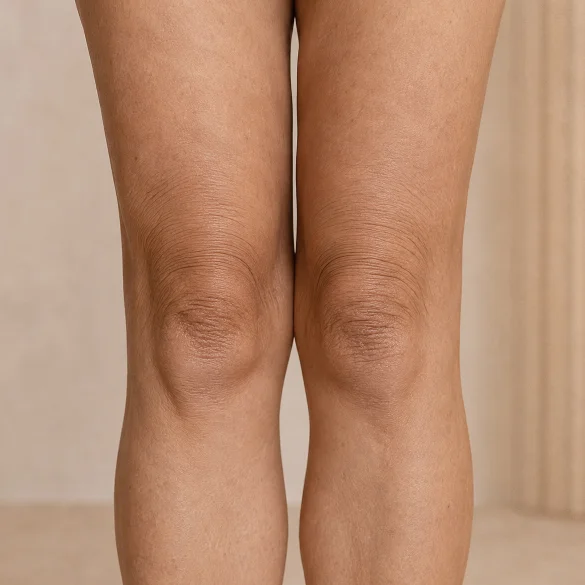
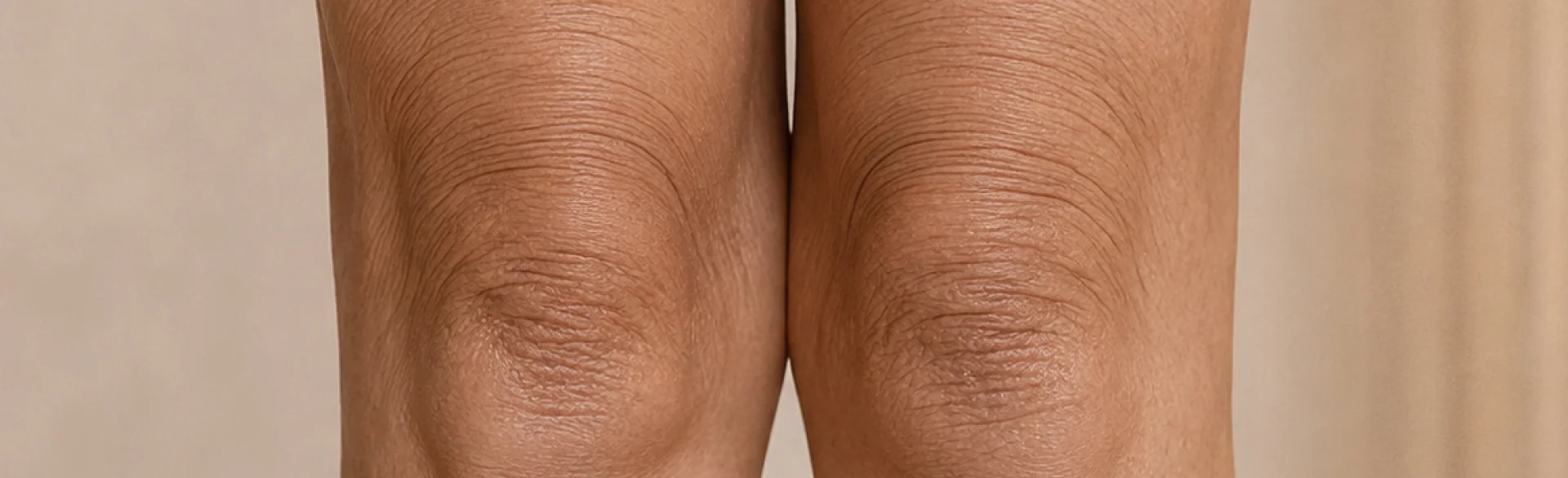
Knee wrinkles are linear creases, folds, and skin overhangs that appear on the anterior surface of the joint, particularly above the patella. They result primarily from the loss of skin elasticity, a decrease in the content and organization of collagen and elastin, atrophy of subcutaneous tissue, the effects of gravity, and repeated bending of the limb. They may become more visible with age, after significant weight reduction, under the influence of ultraviolet radiation, or as a consequence of hormonal changes. They are not a disease; however, a distinct, sudden, or asymmetrical change in the appearance of the knee, especially combined with swelling, pain, or a skin lesion, requires medical evaluation.
Wrinkles on the knees - why do they appear
The skin over the knees works under specific biomechanical conditions. During joint flexion, it must create a temporary excess of surface area, which is why horizontal motion folds are visible even in young people. Over time, the skin returns to its original position less effectively, and dynamic wrinkles, initially present only during flexion, can turn into permanent static wrinkles.
The key mechanisms include:
- intrinsic aging, associated with a decrease in the activity of fibroblasts, the cells that produce extracellular matrix components;
- fragmentation of collagen fibers, which limits the proper anchoring of fibroblasts and reduces the synthesis of new collagen;
- disorganization of elastin fibers, responsible for the skin's ability to deform and return to its initial shape;
- thinning of the dermis and atrophy of subcutaneous tissue, limiting its support;
- photoaging, in which UVA and UVB radiation increases oxidative stress and the activity of matrix metalloproteinases, enzymes that degrade collagen;
- a decrease in estrogen levels, especially after menopause, affecting skin thickness, hydration, and elasticity;
- tobacco smoking, chronic oxidative stress, nutritional deficiencies, and low physical activity, which can accelerate tissue aging processes.
The appearance of the knees is also influenced by anatomical structure. In some people, the skin is naturally thin, and the transition between the lower thigh and the patella is weakly supported by adipose tissue. Genetic predisposition can therefore cause folds to become visible relatively early.
Wrinkles should be distinguished from changes related to joint disease or disorders of the venous-lymphatic system. Swelling, redness, increased local warmth, reduced mobility, a palpable lump, or a unilateral increase in limb circumference are not typical symptoms of physiological skin aging.
Wrinkles on the knees - why they worsen after weight loss
During weight gain, the skin gradually stretches under the influence of the increasing volume of subcutaneous tissue. If weight loss is significant, after it is completed, an area of skin remains that is unadapted to the smaller tissue volume. A loose fold drooping toward the patella may then form above the knee.
The degree of spontaneous skin retraction depends, among other things, on:
- age and the biological quality of the skin;
- the magnitude and duration of excess body weight;
- the total number of weight loss and regain cycles;
- genetic predispositions;
- the degree of photodamage;
- tobacco smoking;
- hormonal changes;
- the amount of preserved fat and muscle tissue;
- the rate of collagen synthesis and remodeling after weight loss.
Rapid weight loss reveals laxity in a short period of time, but there is no strong evidence that a slower rate of reduction alone prevents excess skin after significant weight loss. The most important factors are its baseline stretching, age, the duration of obesity, and the individual capacity of tissues for remodeling.
The severity of the folds may also result from a decrease in the volume of the quadriceps muscle. This occurs especially when a high-energy-deficit diet is not accompanied by adequate protein intake and resistance training. Muscle loss reduces tissue support, making the skin above the knee appear even looser.
After weight stabilization, partial, gradual skin retraction may occur, but in the case of significant excess skin, the potential of this process is limited. Moisturizing creams temporarily improve the smoothness of the stratum corneum, but they do not eliminate a large excess of the dermis and subcutaneous tissue.
Wrinkles on knees - do exercises help
Exercise does not directly shorten stretched skin or remove established wrinkles. However, it can improve the appearance of the knee area by increasing the volume and tone of the thigh muscles, stabilizing body weight, improving tissue blood flow, and limiting further loss of muscle mass.
Resistance training involving the quadriceps femoris, hamstrings, and gluteal muscles is of particular importance. Depending on the condition of the joints, squats within a safe range of motion, chair stands, resistance band exercises, lunges, leg extensions, and exercises performed under the supervision of a physiotherapist can be used. The load should increase gradually and must not cause acute joint pain.
An interventional study conducted in middle-aged women showed that both aerobic and resistance training can improve the elasticity and structure of the upper dermis. Furthermore, resistance training was associated with an increase in its thickness. However, the results obtained on facial skin cannot be automatically applied to the knee area, which is why physical activity should be considered a supportive measure rather than a method for eliminating significant laxity.
Conservative management should include:
- maintaining a stable body weight;
- regular resistance and aerobic training;
- adequate intake of complete protein adjusted to health status;
- not smoking tobacco;
- protecting exposed knees from UV radiation;
- using emollients for dry and rough skin.
Hydrolyzed collagen supplements may slightly improve skin hydration and elasticity, but study results are heterogeneous, some papers are burdened by conflicts of interest, and the evidence does not support the removal of localized excess skin above the knees.
Wrinkles on the knees - which treatments tighten the skin on the knees
The choice of method depends on whether fine wrinkles, loss of skin density, moderate laxity, excess adipose tissue, cellulite, or true skin sagging predominate. Prior to the procedure, the condition of the skin, subcutaneous tissue, vessels, and joint should be assessed, and active infection, uncompensated chronic disease, and contraindications specific to the given technology must be ruled out.
The Ambasada Urody offer includes the following procedures that may be applicable to this area:
- HIFU, or High-Intensity Focused Ultrasound. It creates focal zones of thermal coagulation at a specific depth, initiating shrinkage and subsequent collagen remodeling. A direct study on the skin above the knees showed improvement in 24 out of 28 evaluated patients after 90 and 180 days, but it was a small, open-label study without a control group.
- Non-invasive radiofrequency, available as Accent Prime, Alma SPA Deep, Pellevé RF, and Reaction RF, among others. Controlled heating of the dermis produces a thermal effect on collagen and triggers processes of its subsequent remodeling. Reaction RF combines RF energy with vacuum.
- INDIBA for the body, utilizing radiofrequency in tissue therapy. It can support the improvement of skin quality and tightness, although the number of high-quality studies directly addressing knee wrinkles is limited.
- Microneedle radiofrequency, which combines controlled microneedling with the delivery of thermal energy to the dermis. It is considered for fine wrinkles, skin thinning, and uneven skin texture. It requires taking into account the healing period and the risk of erythema, swelling, post-inflammatory hyperpigmentation, infection, and scarring.
- Zaffiro, which uses infrared radiation for superficial, controlled tissue heating. It can improve the tightness of mildly or moderately lax skin.
- Carboxytherapy, involving the intradermal or subcutaneous administration of medical carbon dioxide. It can support microcirculation and tissue remodeling, but evidence for its effectiveness in isolated knee wrinkles is weaker than for methods based on RF or focused ultrasound.
- Needle mesotherapy for the body, the effect of which depends on the composition of the administered preparation. It can improve skin hydration and quality, but it is not a method for removing significant skin overhang.
- Fractional laser, causing controlled micro-injuries and subsequent skin remodeling. It can be considered for fine wrinkles, uneven texture, and coexisting stretch marks, taking into account the phototype and the risk of pigmentation disorders.
- LPG Endermologie and Icoone, meaning mechanical tissue stimulation using vacuum, sometimes combined with an additional energy source. The treatments can improve microcirculation, reduce swelling, and temporarily smooth the skin surface. They most often serve a supportive function.
- VelaShape, shock wave, Onda, and Body Mix RF can be considered when laxity is accompanied by cellulite, structural disorders of subcutaneous tissue, or localized excess of adipose tissue. However, volume should not be reduced without prior skin assessment, as excessive reduction of the fat layer may further accentuate wrinkles.
The effects of non-surgical methods are usually gradual and depend on the baseline degree of laxity. Complete skin smoothing should not be promised. In the case of large, sagging tissue excess, the most predictable correction can be provided by surgical excision, which leaves a scar and carries the risk of impaired healing in the mobile joint area.

