Double chin
back to main page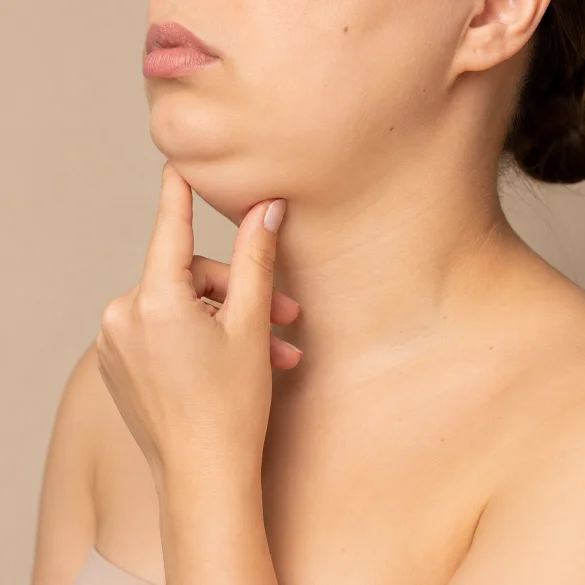
A double chin is an excess of tissues located in the submental and submandibular area, leading to the blurring of the distinct angle between the chin and the neck. This phenomenon can result both from the accumulation of adipose tissue and skin laxity, muscle weakness, or changes associated with aging. A double chin occurs in overweight individuals, but also in slim patients, in whom genetic predisposition or the anatomy of the face and neck play a dominant role. In aesthetic medicine, this problem is considered to be one of the significant factors influencing the proportions of the lower face and the visual perception of age. The severity of the changes usually increases with age, loss of skin elasticity, and volumetric changes within the face.
Double chin - what it is
A double chin, also referred to as excess submental tissue, is a change in the contour of the lower part of the face involving the bulging of the area between the chin and the neck. In clinical practice, the problem can be of a:
- fatty,
- cutaneous,
- muscular,
- mixed nature.
Most often, the coexistence of several mechanisms is observed simultaneously. In some patients, a local accumulation of adipocytes, i.e. fat cells, dominates, while in others, the main role is played by skin laxity and weakness of the platysma muscle.
Under normal conditions, the jawline remains clearly separated from the neck. In the case of a double chin, this angle is gradually blurred, which causes optical shortening of the neck and a heavier appearance of the lower part of the face.
The development of the problem is also influenced by:
- structure of the jawbone,
- receding chin,
- position of the hyoid bone,
- amount of visceral and subcutaneous fat tissue,
- aging process.
A double chin is not only an aesthetic problem. In some cases, it may indicate metabolic disorders associated with excess fat tissue and abnormal fat distribution in the body.
Double chin - what it looks like
A double chin manifests as a visible bulge or fold of tissue below the chin. The change can be mild and visible only when tilting the head, but in some people, it also becomes present in a neutral position.
Typical features of a double chin include:
- loss of a distinct jaw-neck angle,
- optical “merging” of the neck with the face,
- thickening of the lower part of the face,
- decreased definition of the jawline,
- the effect of tissue heaviness.
Depending on the dominant mechanism, a double chin can take on different appearances:
| Type of change | Characteristics |
|---|---|
| Fatty | Soft bulge associated with excess fat tissue |
| Skin | Loose, sagging skin forming folds |
| Muscular | Visible vertical platysmal bands and tissue sagging |
| Mixed | Simultaneous excess of fat and skin laxity |
With age, the problem usually worsens. There is a decrease in the amount of collagen and elastin, weakening of the supporting ligaments, and downward displacement of soft tissues under the influence of gravity.
Body posture also affects the appearance of a double chin. Chronic forward head posture, characteristic of working at a computer and using smartphones, can contribute to the deterioration of neck tissue tone.
Double chin - causes
The formation of a double chin is a multifactorial process. One of the most common causes remains the excessive deposition of adipose tissue in the submandibular area. Fat cells in this area show a high tendency to store energy, especially with a positive caloric balance.
Aging processes are also of significant importance. With age, the following are observed:
- decrease in collagen production,
- loss of skin elasticity,
- weakening of the neck muscles,
- atrophy of the facial support structure,
- drooping of soft tissues.
Facial anatomy plays a major role. A receding chin or a weakly defined jawline results in lower tissue tension and a greater tendency for them to accumulate in the chin area.
Factors that increase the risk of a double chin occurring also include:
- rapid weight fluctuations,
- obesity,
- lack of physical activity,
- chronic stress,
- hormonal disorders,
- tobacco smoking,
- skin photoaging.
In some people, a double chin appears despite normal body weight. In such cases, genetic predisposition and individual anatomical structure play a dominant role.
In aesthetic medicine, skin quality is also important. Thin, dehydrated skin poor in supportive fibers sags more quickly, making the chin area more susceptible to deformation.
Double chin and genetics and weight - the connection
Genetics plays a very significant role in the development of a double chin. Both facial structure features and the distribution of adipose tissue can be inherited. In some people, even a small weight gain leads to a clear deposition of fat precisely in the submandibular area.
Genetic predispositions may include:
- a receding chin,
- a less defined jawline,
- an increased tendency to deposit subcutaneous fat,
- reduced skin elasticity,
- faster tissue aging.
Body weight, however, remains one of the most important factors influencing the severity of the problem. An increase in the amount of adipose tissue leads to an increase in the volume of the submental area and deepening the blurring of the facial contour.
It is worth emphasizing that weight reduction does not always completely eliminate a double chin. In patients after intensive weight loss, there may be:
- loss of skin firmness,
- formation of excess loose tissue,
- increased neck laxity,
- deterioration of skin quality.
For this reason, in some people after losing weight, the double chin remains visible, although its character changes from fatty to skin-laxity.
Double chin vs. sagging jawline - the difference
A double chin and a sagging jawline are related phenomena, but they do not mean the same anatomical problem. A double chin primarily concerns excess tissue in the submental area, while a sagging jawline refers to the loss of a clear contour of the lower face due to the downward displacement of tissues.
In the case of a sagging jawline, the following dominate:
- aging processes,
- loss of facial volume,
- weakening of the supporting ligaments,
- gravitational displacement of tissues.
The following become characteristic:
- jowls,
- blurring of the jawline,
- deterioration of the facial oval,
- sagging cheeks.
A double chin can coexist with a sagging jawline, but it can also occur independently, especially in younger people with genetic predispositions or excess fat tissue.
In aesthetic diagnostics, it is very important to distinguish between these two problems because they require a different therapeutic approach. In the case of the dominance of fat tissue, procedures that reduce adipocytes and model the chin contour are used. When tissue laxity and sagging play the main role, procedures that stimulate collagen, lift, and improve skin tension are of greater importance.
Among the treatments used in the therapy of the submental area are, among others:

