Facial volume
back to main page
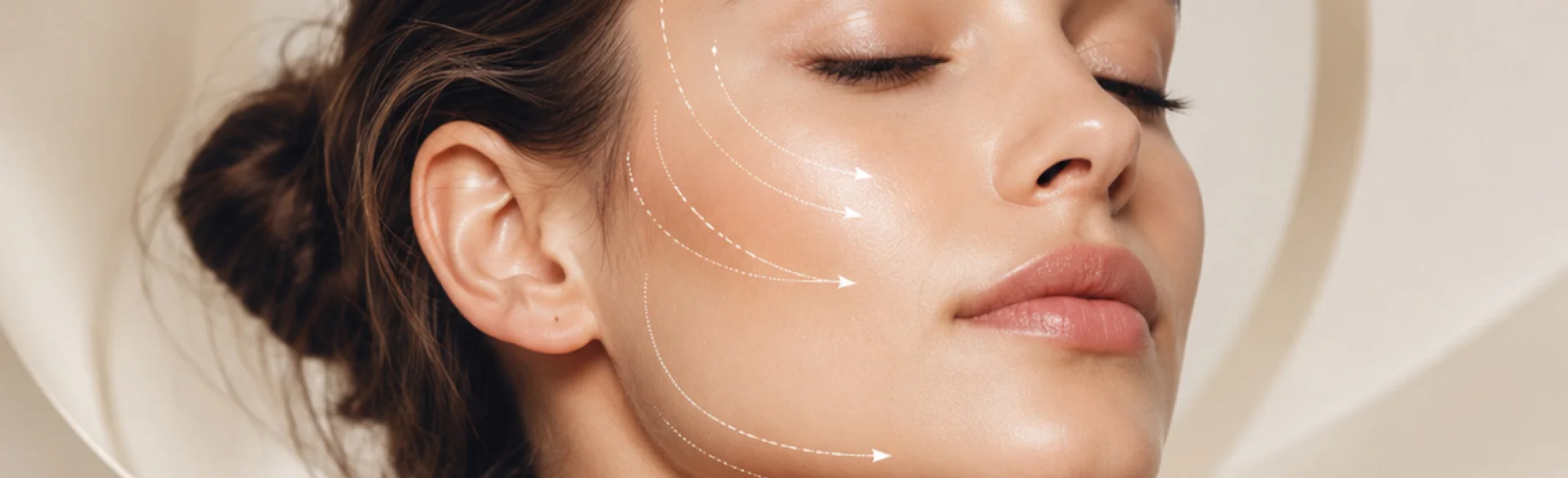
Facial volume is a concept referring to the spatial configuration of facial tissues, which are responsible for its full, harmonious, and youthful appearance. Volume is influenced by both the amount of fat tissue and skin quality, muscle tone, bone structure, and the distribution of individual fat compartments. Properly preserved volume gives the face proportions, softness of features, and adequate support for the skin. Changes in volume are one of the most important elements of the aging process. The loss of supporting tissues leads to the hollowing of cheeks, deepening of furrows, and disruption of the facial oval. Modern aesthetic medicine treats facial volume as one of the key parameters for assessing biological age and tissue quality.
Facial volume - what is it
Facial volume refers to the amount and distribution of tissues forming the three-dimensional structure of the face. It does not refer solely to the amount of adipose tissue, but to the entire anatomical system responsible for contours, proportions, and skin tension.
In aesthetic anatomy, the face is perceived as a multi-layered structure. Each of the layers affects the final appearance:
- facial bones form the scaffolding,
- muscles are responsible for facial expressions and tissue support,
- fat compartments give the face softness and convexity,
- the skin is the outer covering of the entire system.
A youthful face is characterized by an even distribution of volume, especially in the mid-cheek area, the temple region, and under the eyes. With age, there is a gradual loss of this volume, which changes the proportions of the face from an inverted triangle to a more square or heavier lower shape.
The assessment of facial volume currently forms the basis of modern planning for aesthetic procedures. The contemporary approach is moving away from solely smoothing wrinkles towards rebuilding the lost supporting structures.
Facial volume - what it consists of
Facial volume is influenced by many interacting anatomical structures. Adipose tissue, the skeletal system, muscles, and skin quality are of the greatest importance.
A crucial role is played by the so-called facial fat pads, i.e., specialized fat compartments distributed in various areas:
- cheeks,
- temples,
- the zygomatic area,
- the tear trough,
- the jawline.
Not all fat compartments age at the same rate. Some undergo atrophy, while others shift under the influence of gravity. It is this uneven loss of volume that is responsible for the characteristic signs of facial aging.
The skeleton is also of significant importance. With age, physiological resorption of the facial bones occurs, especially of the:
- orbits,
- maxilla,
- mandible,
- temporal area.
The reduction of bony support exacerbates the sagging of soft tissues. This process often goes unnoticed, although it is one of the main mechanisms of aging.
Volume is also affected by the condition of the skin and connective tissue. Collagen and elastin fibers are responsible for elasticity and the ability to maintain proper tissue tension. When their amount decreases, the face begins to look thinner, less firm, and more tired.
Facial volume - role in aesthetics and proportions
Facial volume is of fundamental importance for the perception of attractiveness, youthfulness, and harmony of features. Properly distributed volume ensures smooth transitions between individual areas of the face and appropriate proportions.
In facial aesthetics, the following are particularly valued:
- distinct cheek projection,
- a gentle transition from the eyelid to the cheek,
- a well-supported temple area,
- a defined, but not overloaded facial oval.
A youthful face usually resembles an inverted triangle, where the greatest volume is located in the mid-face. As tissue is lost, the weight shifts downwards, causing:
- sagging cheeks,
- the formation of jowls,
- deepening of the nasolabial folds,
- loss of a defined jawline.
The importance of volume is not limited to aesthetics alone. Supporting tissues also affect the quality of facial expressions and the way light refracts on the skin surface. A face with proper volume looks fresher, healthier, and more rested.
In aesthetic medicine, increasing attention is paid to preserving natural proportions. Excessive or incorrectly restored volume can lead to disruption of facial anatomy, an overloaded effect, and the loss of natural features.
Facial volume - how it changes with age
The facial aging process involves a gradual loss of volume at multiple anatomical levels. Changes begin as early as after the age of 30 and progress with age.
The most important mechanisms include:
- loss of adipose tissue,
- displacement of fat compartments,
- bone resorption,
- decrease in collagen production,
- weakening of the ligaments supporting the tissues.
First, the volume of the middle part of the face decreases. The cheeks lose their fullness, the under-eye area begins to hollow, and the temples become more prominent. Then, tissues sag downwards under the influence of gravity.
Changes in volume affect the entire appearance of the face:
- features become sharper,
- the face looks tired,
- the skin appears thinner,
- the visibility of folds and depressions increases.
The rate of volume loss depends on many factors:
- genetics,
- hormonal balance,
- exposure to UV radiation,
- tobacco smoking,
- diet quality,
- rapid changes in body weight.
In modern aesthetic medicine, volume restoration is one of the fundamental pillars of anti-aging therapy. Among others, the following are used:
- hyaluronic acid preparations,
- tissue biostimulators,
- autologous fat transfer,
- technologies stimulating collagen production,
- skin lifting and tightening treatments.
Facial volume and weight loss - mechanism
Weight loss affects not only the silhouette but also the appearance of the face. Particularly rapid or significant loss of fat tissue can lead to a noticeable reduction in facial volume.
Facial fat tissue is metabolically active and responds to a caloric deficit similarly to fat in other parts of the body. However, the problem is that the face has a limited number of natural fat compartments. Their loss quickly becomes visible.
The most commonly observed changes are:
- sunken cheeks,
- deepening of the tear trough,
- prominent cheekbones,
- skin laxity,
- a more “skeletal” appearance of the face.
Particularly pronounced changes can occur during:
- rapid weight loss,
- very low-calorie diets,
- GLP-1 analog therapies,
- loss of a large amount of fat tissue in a short time.
The phenomenon colloquially referred to as “Ozempic face” results precisely from the loss of volume and the weakening of support for the skin. The problem especially affects people with a naturally slim face or a low level of fat tissue before starting weight loss.
To improve tissue quality and rebuild volume, aesthetic medicine treatments are used, such as:
- facial volumetry,
- collagen biostimulation,
- lipotransfer,
- tissue stimulators,
- regenerative facelifts,
- radiofrequency and ultrasound technologies supporting skin tightness.
However, an individual analysis of facial proportions is of key importance. Excessive replenishment of volume can lead to a disruption of anatomy and an artificial aesthetic effect.

