Gravitational aging of the face
back to main page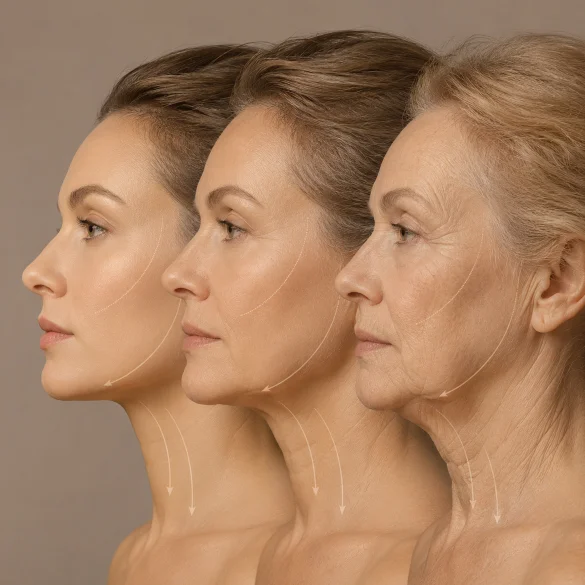
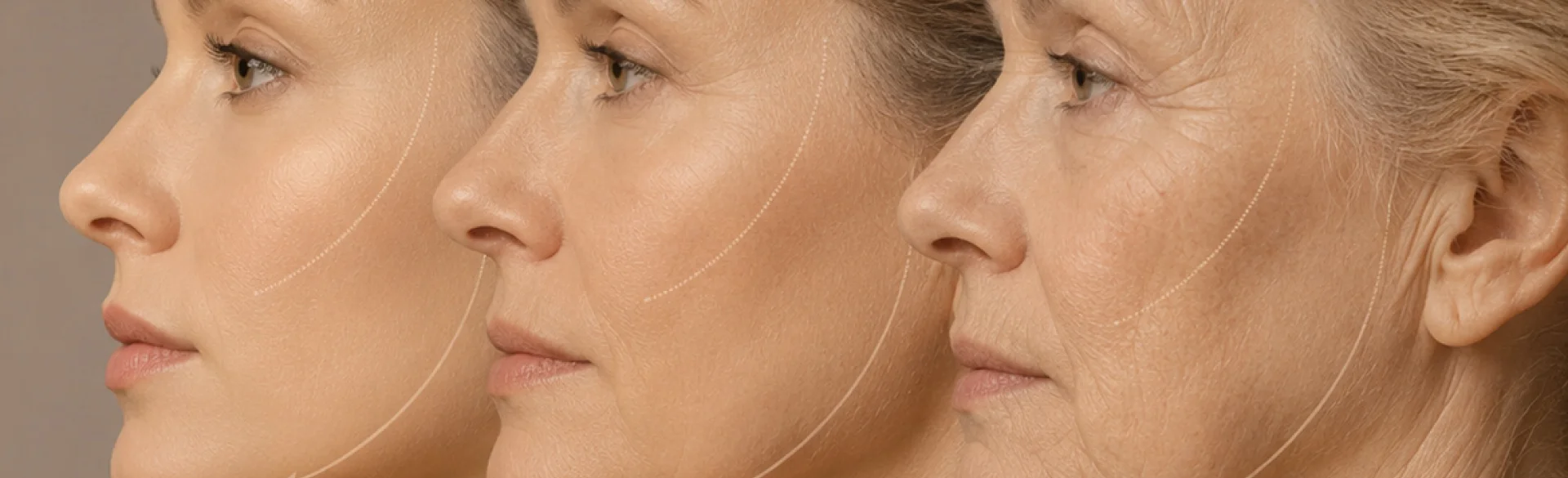
Gravitational facial aging is one of the main mechanisms of soft tissue aging, associated with the action of the force of gravity on the supportive structures of the face. This process involves the gradual downward displacement of tissues, loss of skin tension, weakening of the retaining ligaments, and changes within the adipose tissue, muscles, and craniofacial bones. As a result, there is a disruption of facial proportions, blurring of the facial oval, deepening of furrows, and the appearance of characteristic deformations of the lower face. Gravitational aging is not solely an aesthetic problem, but a multi-level biological process encompassing all anatomical layers of the face. Its dynamics depend on genetics, skin quality, facial structure, lifestyle, and the rate of tissue volume loss.
Gravitational aging of the face - what it is
Gravitational facial aging means the progressive lowering and displacement of soft tissues under the influence of gravity and the weakening of the supporting structures of the face. This mechanism affects both the skin and adipose tissue, mimetic muscles, retaining ligaments, and the bony scaffold.
A young face is characterized by an even distribution of volume, a well-defined oval, and tight skin. With age, the following occurs:
- stretching of the ligaments supporting the tissues,
- loss of collagen and elastin,
- weakening of myofascial tone,
- displacement of fat pads,
- resorption of facial bones.
This process becomes particularly visible in the middle and lower parts of the face. Characteristic symptoms include:
- sagging cheeks,
- deepening of nasolabial folds,
- loss of the jawline,
- formation of jowls,
- drooping of the corners of the mouth,
- sagging of the neck.
Gravitational aging proceeds differently than fine-wrinkle aging, which mainly concerns skin quality and superficial wrinkles. In the case of the gravitational component, changes related to the weight and displacement of tissues dominate.
The most predisposed are people with:
- heavier facial structure,
- thicker subcutaneous tissue,
- a greater amount of adipose tissue,
- weaker skin tension,
- a tendency to swelling.
Gravitational aging of the face - how it progresses
The process of gravitational aging develops gradually over many years and affects all anatomical tiers of the face. Initially, the changes are subtle, but over time they lead to a distinct deformation of proportions.
In the first stage, there is a decline in skin quality and a decrease in the production of type I and III collagen. Fibroblasts produce fewer supporting fibers, and the skin becomes less resistant to stretching.
The next stage is the destabilization of the facial ligamentous system. The retaining ligaments are responsible for keeping tissues in a specific position. With age, they lose tension, which allows fat pads to shift downwards.
Changes also occur within:
- superficial fat compartments – superficial fat compartments,
- deep fat compartments – deep fat compartments,
- the SMAS (superficial musculoaponeurotic system) system,
- bony structures.
In the middle third of the face, flattening of the cheeks and loss of zygomatic bone projection appear. In the lower third, the following develop:
- jowls,
- disruption of the jawline,
- excess tissue near the chin,
- submental laxity.
Gravitational aging often coexists with chronic lymphatic edema of the tissues. Microcirculation and lymphatic drainage disorders increase the weight of the tissues, accelerating their descent.
This process is progressive and multifactorial. It does not result solely from chronological age, but from the sum of structural changes occurring in the skin and deep tissues.
Gravitational facial aging - what accelerates it
The rate of gravitational aging depends on many biological and environmental factors. Some people show clear symptoms already after the age of 35–40, while in others the process progresses much more slowly.
The most important accelerating factors include:
Excessive exposure to UV radiation
Photoaging leads to collagen degradation, elastin damage, and chronic skin inflammation. Weakened skin loses the ability to support tissues.
Weight fluctuations
Alternating weight gain and loss causes stretching of the skin and destabilization of fat tissue. Rapid weight loss is particularly unfavorable.
Tobacco smoking
Tobacco smoke increases oxidative stress, impairs microcirculation and accelerates the degradation of supporting fibers.
Anatomical predispositions
Faces that age faster:
- heavy,
- round,
- with a large amount of fat tissue,
- with a thin bony framework.
Hormonal disorders
The decline in estrogen after menopause reduces collagen synthesis and worsens skin firmness.
Chronic edema
Lymph retention and venous circulation disorders increase tissue weight and exacerbate their sagging.
Lifestyle
A negative impact is shown by:
- chronic stress,
- lack of sleep,
- a diet poor in protein and antioxidants,
- alcohol abuse,
- lack of physical activity.
In aesthetic medicine, preventive measures focus on improving skin quality, stimulating collagen, reducing swelling, and rebuilding the supportive structures of the face. The following are used, among others:
- tissue biostimulators,
- microneedle radiofrequency,
- HIFU ultrasound,
- lifting PDO threads,
- SMAS-stimulating technologies,
- treatments improving microcirculation and lymphatic drainage.
Gravitational aging and volume loss - the relationship
Gravitational aging is very strongly associated with the loss of facial volume. Both processes occur in parallel and mutually reinforce each other. In clinical practice, they rarely occur separately.
In a young face, volume is distributed mainly in the midface:
- in the cheek area,
- zygomatic bones,
- temples,
- infraorbital area.
With age, atrophy of deep fat compartments and bone resorption occur. Tissues lose support and begin to sag under the influence of gravity. As a result, the face:
- becomes flatter,
- elongates vertically,
- loses projection,
- acquires a tired appearance.
Volume loss intensifies:
- nasolabial folds,
- tear trough,
- jowls,
- sunken cheeks,
- deformation of the facial oval.
Particularly pronounced changes are observed after rapid weight loss, also during GLP-1 agonist therapy. Reducing the amount of facial adipose tissue reduces support for the skin, which can lead to accelerated gravitational aging.
Modern aesthetic medicine treats facial aging as a three-dimensional process. Therapies focus simultaneously on:
- volume restoration,
- improving skin quality,
- tissue lifting,
- collagen stimulation,
- improving the tension of ligaments and the SMAS system.
Depending on the needs, the following are used:
- volumetric hyaluronic acid,
- autologous fat transfer,
- collagen biostimulators,
- ultrasound lifting,
- radiofrequency,
- surgical facelift procedures.

