Hormonal discoloration
back to main page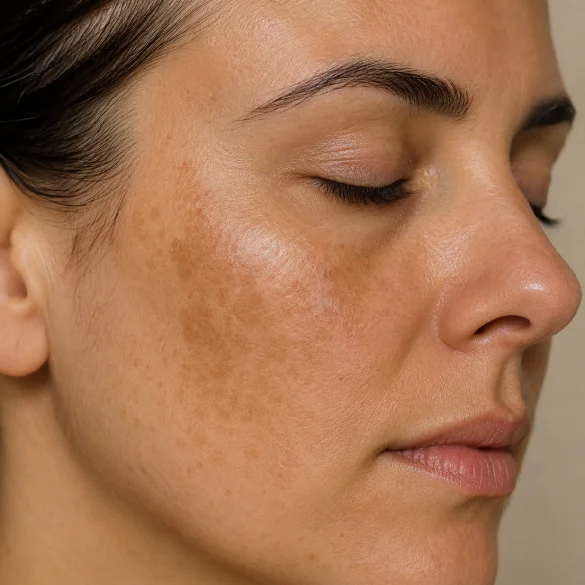
Hormonal discolorations are among the most difficult to treat skin pigmentation disorders. They develop as a result of increased melanocyte activity under the influence of hormonal changes, and their development is further exacerbated by UV radiation, visible light (HEV), high temperature, and genetic predisposition. A characteristic feature of this type of discoloration is a tendency to recur even after successful treatment, which is why therapy requires a comprehensive approach and long-term prevention.
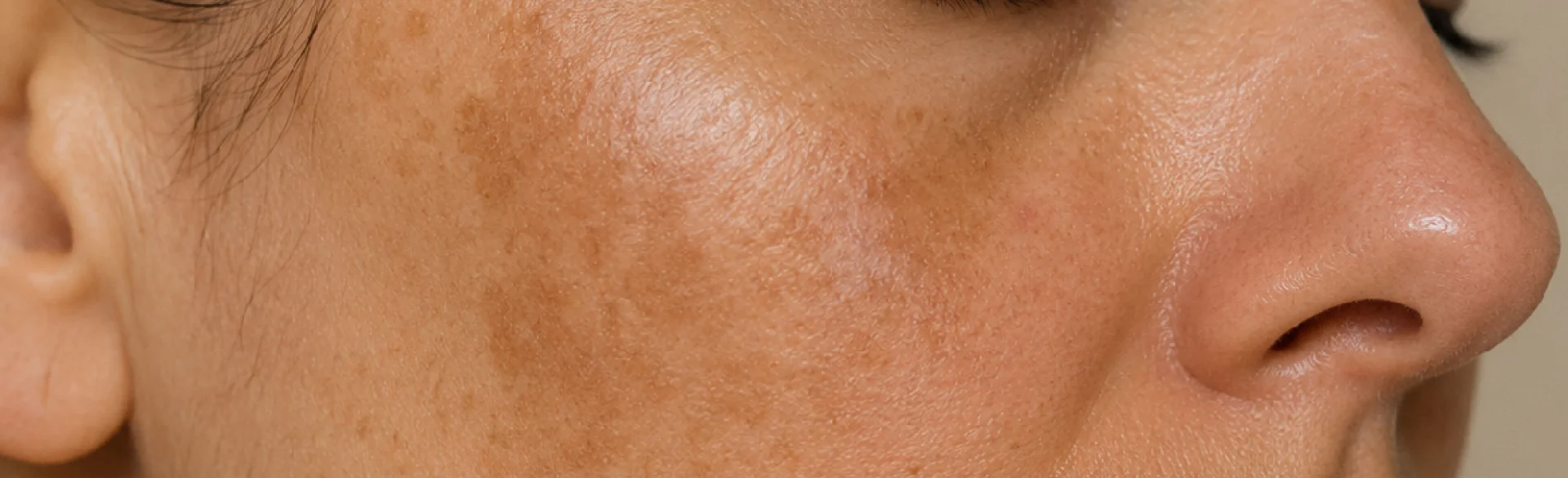
They most often appear on the face, especially on the cheeks, forehead, nose, upper lip, and chin. They can take the form of diffuse, irregular patches of light brown, dark brown, or grey-brown coloration. In many cases, they develop gradually over months or even years.
The mechanism of their formation is complex. Sex hormones, primarily estrogens and progesterone, increase the sensitivity of melanocytes to the effects of solar radiation. Even minimal exposure to the sun can then trigger intense melanin production. At the same time, chronic micro-inflammation, increased blood vessel activity, and impaired functioning of the epidermal barrier occur in the skin, which perpetuate the discoloration.
Effective treatment includes the simultaneous limitation of triggering factors, appropriately selected aesthetic medicine treatments, and daily photoprotection throughout the year. Only the combination of these elements makes it possible to achieve a lasting improvement in the skin's appearance and reduce the risk of recurrence.
Hormonal discoloration - the difference between hormonal discoloration and melasma
The terms “hormonal discoloration” and “melasma” are very often used interchangeably, but they do not mean exactly the same thing. Melasma is a specific disease entity, while hormonal discoloration constitutes a broader group of pigmentation changes associated with the influence of hormones.
What are hormonal discolorations?
Hormonal discolorations are all pigmentary changes developing under the influence of changes in hormonal balance. They can appear:
- during pregnancy,
- during the use of hormonal contraception,
- during hormone replacement therapy,
- in the course of hormonal disorders,
- during the perimenopausal period,
- with certain endocrine diseases.
The changes can have a different appearance, location, and depth of melanin deposition.
What is melasma?
Melasma is a chronic, recurrent hyperpigmentation disorder of the skin, in which a key role is played by the interaction of:
- hormones,
- UV radiation,
- visible light,
- genetic predisposition,
- chronic inflammation,
- vascular changes of the skin.
It most commonly occurs symmetrically on the face and is characterized by irregular brown patches.
The most important differences
Hormonal discolorations
- include various types of pigmentation changes associated with hormones,
- can have a varied course,
- sometimes resolve after removing the triggering factor.
- is a chronic skin disease,
- recurs very often,
- requires multidirectional treatment,
- usually requires long-term maintenance care.
Correct diagnosis of the type of discoloration allows choosing the most effective therapy and reducing the risk of recurrence.
Hormonal discoloration - contraception and pregnancy as risk factors
Sex hormones have a direct effect on melanocyte activity. The greater the skin's sensitivity to estrogens and progesterone, the more easily melanin overproduction occurs.
Pregnancy
The most characteristic form of hormonal hyperpigmentation is chloasma of pregnancy (chloasma gravidarum).
Its development occurs as a result of:
- a rapid increase in estrogen levels,
- an increased concentration of progesterone,
- the action of the MSH hormone (melanotropin),
- increased reactivity of melanocytes.
Hyperpigmentation most often develops in the second and third trimesters of pregnancy and affects up to several dozen percent of women. In some patients, it gradually fades after childbirth, but in many, it persists for years.
Hormonal contraception
Oral contraceptives also increase the risk of discoloration.
The most important are:
- duration of use of the preparation,
- individual skin sensitivity,
- sun exposure,
- previous occurrence of melasma,
- positive family history.
Not every woman using contraception will develop discoloration, however, in predisposed individuals, even slight exposure to UV radiation can trigger the pigmentation process.
Hormone replacement therapy
The risk is also increased by hormone replacement therapy used during menopause. The changes usually appear more slowly, but can persist for many years.
Awareness of risk factors allows for earlier implementation of effective prevention before discolorations become permanent.
Hormonal discolorations - why they recur after treatment
One of the greatest therapeutic challenges is the very high tendency of hormonal discoloration to recur.
This does not result from the ineffectiveness of the treatment, but from the biology of the disease itself.
Hyperreactive melanocytes
After the lesions have healed, melanocytes remain more sensitive to:
- UV radiation,
- visible light,
- high temperature,
- inflammation,
- hormonal fluctuations.
This means that even a minor stimulus can restart melanin production.
Chronic disease process
It is currently known that melasma and many hormonal hyperpigmentations do not exclusively affect melanocytes.
The following are also observed in the skin:
- chronic micro-inflammation,
- an increased number of blood vessels,
- damage to the basement membrane,
- disruption of the epidermal barrier,
- abnormal communication between skin cells.
Therefore, removing the pigment alone does not eliminate the cause of the problem.
Lack of adequate photoprotection
The most common cause of recurrences remains insufficient sun protection.
Recurrences can be triggered by:
- a few days of intense sunlight,
- a holiday in a warm climate,
- driving a car without UV protection,
- daily exposure to visible light,
- using a solarium.
Therefore, the treatment of hormonal hyperpigmentation should be considered a long-term process comprising therapy and constant prevention.
Hormonal discoloration - treatments and proper sun protection
Modern treatment of hormonal hyperpigmentation is based on combination therapy. Combining different methods allows for simultaneous action on melanin, inflammation, skin remodeling, and the functioning of melanocytes.
Treatments used in therapy
Depending on the type of discoloration, a specialist may recommend:
- depigmenting peels regulating the process of melanogenesis,
- chemical peels stimulating epidermal renewal,
- laser therapy tailored to the type of lesions,
- IPL treatments for appropriate indications,
- mesotherapy with brightening and antioxidant substances,
- therapies restoring the hydrolipid barrier,
- procedures reducing chronic skin inflammation.
The treatment plan should always be individualized and take into account the depth of discoloration, skin phototype, the season, and hormonal factors.
Home care
An equally important element of therapy is daily skincare.
Most commonly, it includes products containing:
- azelaic acid,
- tranexamic acid,
- niacinamide,
- vitamin C,
- retinoids,
- tyrosinase inhibitors,
- antioxidants.
Regular use of appropriately selected products prolongs the effects of in-office therapy and reduces the risk of recurrence.
Sun protection
Photoprotection is the foundation of effective treatment.
The most important rules include:
- using SPF 50+ creams every day all year round,
- choosing products that provide high UVA and UVB protection,
- using filters containing pigments that also protect against visible light,
- reapplying the product every 2–3 hours while outdoors,
- wearing wide-brimmed hats and sunglasses,
- limiting sun exposure during peak sunlight hours.
Hormonal discolorations are among the conditions requiring patience and consistency. Properly planned therapy, combined with professional treatments and daily sun protection, makes it possible to significantly lighten the lesions, improve the evenness of skin tone, and maintain the effects of the treatment for a long time.

