Sagging breasts
back to main page
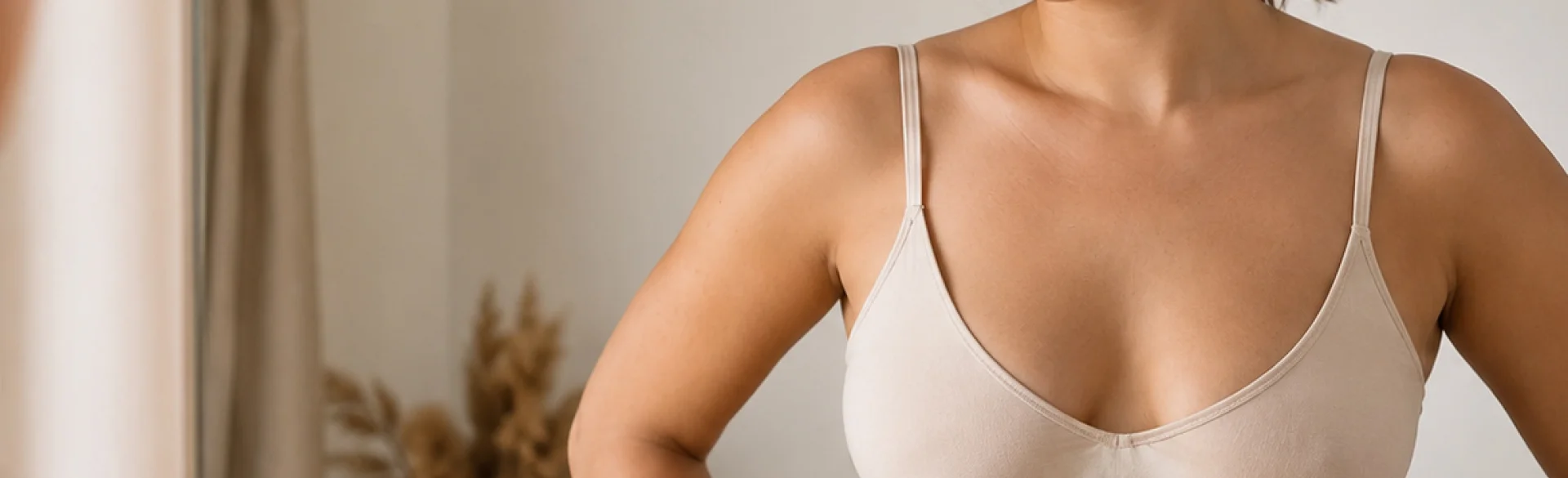
Sagging breasts, medically referred to as breast ptosis, signify the gradual descent of the mammary gland and the nipple-areola complex relative to the inframammary fold. This phenomenon results from the stretching of the breast's skin envelope, changes in the volume of glandular and fatty tissue, and the weakening of supporting structures. Ptosis is neither a disease nor a factor that increases the risk of breast cancer. It is an anatomical change whose severity depends, among other factors, on age, breast size, the number of previous pregnancies, connective tissue properties, smoking, and significant fluctuations in body weight. Non-surgical treatments can improve skin firmness and quality, but they do not replace mastopexy when the nipple is positioned distinctly below the inframammary fold.
Sagging breasts - why breasts sag
The breast contains no muscle that could actively hold it in a higher position. Its shape depends primarily on the proportions of glandular and adipose tissue, skin properties, the superficial fascial system, and the suspensory ligaments of the breast, known as Cooper's ligaments. Ptosis develops when breast mass and long-term mechanical stress exceed the ability of these structures to maintain their original tension.
The most important factors contributing to breast sagging include:
- skin aging, associated with quantitative and qualitative changes in collagen, elastin, and the extracellular matrix;
- larger breast size and weight, increasing tension on the skin and supporting structures;
- pregnancies, especially multiple, during which periodic enlargement of the gland and stretching of its skin envelope occur;
- significant weight loss, leaving excess skin after the reduction of adipose tissue volume;
- tobacco smoking, which intensifies oxidative stress, impairs microcirculation, and accelerates the degradation of supporting fibers;
- genetic predisposition, including skin quality, breast structure, and the susceptibility of connective tissue to stretching;
- photoaging, as chronic exposure to ultraviolet radiation damages collagen and elastic fibers of the décolletage skin;
- hormonal changes and menopause, during which the proportion of glandular tissue decreases, and the skin becomes thinner and less elastic.
Ptosis may coexist with upper pole volume loss, breast hypertrophy, asymmetry, or pseudoptosis. These are distinct anatomical features and therefore require individual evaluation.
Sagging breasts - how the degree of sagging is assessed
The degree of ptosis is assessed in a standing position, without lifting the breasts. The primary reference point is the inframammary fold, which is the natural boundary between the lower part of the breast and the chest wall. The most commonly used system remains the Regnault classification:
Grade | Nipple position and breast appearance |
Pseudoptosis | The nipple is at or above the level of the inframammary fold, but a significant portion of the breast parenchyma sags below the fold. |
Grade I ptosis | The nipple is at the level of the inframammary fold or slightly below it, but remains above the lowest point of the breast. |
Grade II ptosis | The nipple lies clearly below the inframammary fold, but is still above the lower contour of the breast. |
Grade III ptosis | The nipple is located at the lowest point of the breast and is usually directed downwards. |
During the examination, the specialist also takes into account the sternal notch-to-nipple distance, the nipple-to-inframammary fold distance, the length of the lower pole, skin quality, stretch marks, glandular volume, and the position of the nipple relative to the most projected part of the breast. Asymmetry, breast base width, the condition of the chest wall, and any previous surgeries are also evaluated.
The Regnault classification facilitates the description of morphology, but alone is not sufficient to determine the choice of treatment. Two individuals with the same grade of ptosis may require different approaches due to differences in breast volume, skin quality, or expectations regarding the outcome.
Sagging breasts - is breastfeeding responsible for this
Available studies do not confirm that breastfeeding alone is an independent, primary cause of ptosis. The frequent association of breastfeeding with breast sagging stems from the fact that changes in their appearance become noticeable after the end of lactation. However, significant transformations already begin during pregnancy.
Under the influence of hormones, glandular tissue proliferation, breast volume increase, and skin stretching occur. After childbirth, and subsequently after the end of lactation, glandular involution takes place, which is the partial reversal of functional changes. If the previously expanded skin does not contract proportionally to the lost volume, laxity, flattening of the upper pole, and ptosis may appear.
In a study involving women presenting for breast surgery, sagging was significantly associated with: age, higher body mass index, larger cup size, number of pregnancies, cigarette smoking, and significant weight loss. In contrast, no independent association was demonstrated between breastfeeding and ptosis. These results come from an observational study, so they do not resolve all causal relationships, but they do not justify giving up breastfeeding out of fear of breast sagging.
The final appearance of the breasts after pregnancy depends on the interaction of hormonal changes, baseline anatomy, number of pregnancies, degree of breast enlargement, skin quality, age, and weight changes.
Sagging breasts - can exercises lift them
Exercises cannot directly lift the mammary gland, shorten stretched skin, or reposition the nipple-areola complex. Breast tissue is not a muscle. It lies on the pectoralis major muscle, but is not part of it.
However, training the chest, shoulder girdle, and back muscles can:
- increase the volume and tone of the pectoralis major muscle;
- improve body posture and shoulder girdle alignment;
- accentuate the upper part of the chest;
- optically improve the projection and contour of the bust;
- support body weight stabilization and overall fitness.
Push-ups, presses, chest flyes, or resistance band exercises can therefore change the appearance of the chest, but are not a treatment for anatomical ptosis. There is also no reliable evidence that creams, massage, or contrast showers alone reposition a sagging gland.
During running and other activities that cause significant breast movement, a properly fitted sports bra is recommended. It limits breast displacement and pain. Its use improves workout comfort, but does not correct existing ptosis. Maintaining a stable body weight, not smoking, and protecting the décolletage from UV radiation are also important for preserving skin quality.
Sagging breasts - what treatments firm them up
A distinction must be made between improving skin quality and an actual surgical breast lift. Non-surgical procedures can increase skin tension, density, and smoothness, which is why they are best suited for mild laxity or serve as supportive therapy. They do not remove excess skin and do not provide predictable correction of grade II-III ptosis.
Ambasada Urody's offer includes treatments designed primarily to improve the tension, density, and appearance of the breast skin:
- Beautytek - breast biolifting supports tissue tension and breast contour shaping using microcurrents and biofeedback technology. It can provide a subtle visual lifting effect and improve skin elasticity.
- INDIBA for the breast improves skin firmness, elasticity, and quality through the controlled action of 448 kHz radiofrequency. The treatment supports regenerative processes and the gradual remodeling of collagen fibers.
- Lifting threads for the breast enable mechanical tissue support, breast contour improvement, and stimulation of collagen production. The best results can be expected with mild to moderate sagging of a small or medium bust.
- Dermapen 4.0 for the breast stimulates the skin's natural repair processes, helping to increase its density, elasticity, and smoothness. It can also reduce the visibility of minor irregularities and stretch marks.
- Calcium hydroxyapatite for the breast has a biostimulatory effect, leading to gradual thickening, firming, and smoothing of the skin. The result can be more taut skin on the upper breast and décolletage, without increasing the volume of the gland itself.
- LPG Endermologie for the breast uses mechanical vacuum stimulation to improve microcirculation, elasticity, and skin appearance. A series of treatments can help smooth the skin and gently shape the breast contour.
- ICOONE for the breast improves skin tension, softness, and smoothness through precise vacuum microstimulation. The treatment can be particularly useful for mild skin laxity following weight changes or periods of pregnancy and lactation.
- 3D microneedle radiofrequency for the breast combines collagen remodeling with controlled microneedling. It helps thicken and firm the skin, even out its texture, and reduce the visibility of stretch marks and minor irregularities.
- Zaffiro thermolifting for the breast uses the controlled action of infrared radiation to improve skin tension and elasticity. Gradual collagen remodeling can result in smoother, firmer skin on the breasts and décolletage.
The choice of method depends on the degree of skin laxity, breast size, nipple position, and the expected outcome. Non-surgical treatments can improve skin quality and visually contour the bust, but they do not remove significant excess skin and do not replace mastopexy in cases of advanced breast sagging.
The strongest evidence supports the ability of thermal methods, microneedling, and biostimulators to remodel the skin, whereas evidence for permanent lifting of the entire breast using non-surgical methods is limited. The effect depends on the indication, treatment parameters, and the patient's anatomy.
The standard for correcting pronounced ptosis remains mastopexy, which involves surgical removal of excess skin, reshaping of the parenchyma, and repositioning of the nipple. In cases of volume deficiency, it can be combined with an implant or autologous fat grafting, and in cases of breast hypertrophy, with reduction mammoplasty. Procedures are preceded by a medical consultation and up-to-date breast diagnostics appropriate to age and individual risk.

