How many laser hair removal treatments are needed to forget about shaving for good?
Laser hair removal in numbers:
- Usually 6-8 sessions - a full treatment is spread over 9-14 months because hair is removed in phases.
- Part of the hair per visit - the laser only works on follicles that are currently growing.
- Intervals from 4 to 12 weeks - the length of the break depends on the body area and the regrowth rate.
- Permanent, noticeable reduction - after a full series, a maintenance treatment once every year or two is sufficient.
Table of contents
- How many laser sessions are needed for a lasting effect?
- Why does the hair growth cycle require several treatments?
- What affects the number of sessions needed?
- Which body parts require more treatments?
- What intervals should be kept between sessions?
- Longevity of effects and touch-up treatment
- Procedure between sessions: is shaving allowed?
- Frequently asked questions about laser hair removal
How many laser sessions are needed for a lasting effect?
A full treatment usually includes from 6 to 10 visits, and even the first session removes some of the unwanted hair. Although the process takes from 9 to 14 months, a lasting and visible hair reduction rewards patience. The laser works well on most areas of the body - from legs, armpits, and the bikini area to the face, arms, and back.
A lasting effect is determined by the consistency of the entire series, not the power of a single treatment.
Why does the hair growth cycle require several treatments?
The laser effectively targets only the bulbs that are in the growth phase, i.e., in anagen - at this stage, the pigment in the hair absorbs light energy best and permanently destroys the follicle. However, hair does not grow evenly: each follicle is at a different stage of the cycle, and some remain dormant (the catagen and telogen phases), to which light does not react.
Therefore, a single visit removes only currently active hair, while the rest is caught during subsequent sessions when they enter anagen on their own. It is this growth rhythm, spread over time, that necessitates repeating the treatment.
What affects the number of sessions needed?
The number of visits depends on individual characteristics of the body, and even people with similar hair may need a different number of treatments.
The course of treatment is primarily influenced by:
- Genetic predispositions and hormonal balance - determine the thickness, density, and rate of hair regrowth.
- Conditions such as hirsutism - excessive hair growth can be resistant and requires a greater number of repetitions.
- Contrast between hair and skin - dark hair on fair skin absorbs light energy best.
- Type of laser - diode, alexandrite, and Nd:YAG devices are selected based on skin phototype and hair color.
- Photosensitizing medications - the specialist must be strictly informed about taking them.
All these variables are assessed during the first consultation. Here, specialists analyze skin condition, hair density and color, as well as contraindications, and then prepare a plan for the number of sessions for a specific person. A thorough consultation translates not only to effectiveness, but above all to treatment safety.
Which body parts require more treatments?
The frequency of visits depends on the specific area and the rate of hair regrowth. The bikini area with dense hair requires the most patience, while the face and neck are treated faster.
An approximate session plan for individual areas is as follows:
- Bikini area - from 6 to 10 sessions due to dense hair.
- Face and neck - usually 4-6 treatments, strongly dependent on hormonal balance.
- Underarms - most often from 4 to 8 sessions.
- Back - from 5 to 8 visits with a larger skin surface area.
- Legs - typically 6-8 sessions.
These differences stem directly from the hair growth cycle, which progresses differently on each part of the body.
What intervals should be kept between sessions?
Intervals between treatments are adjusted to the rate of hair growth in a given area, not to the calendar. The face requires repetition roughly every 4 weeks, armpits and the bikini area every 6-8 weeks, while the legs, back, and chest need longer regeneration - from 8 to 12 weeks.
Artificially increasing the frequency of visits speeds nothing up, because the hair must first enter the growth phase. Excessively long breaks, in turn, weaken the achieved effect, which is why consistency provides the shortest path to permanently smooth skin.
Longevity of effects and touch-up treatment
A full series provides smoothness for years, although the body retains its regenerative abilities, and hormonal changes can sometimes activate dormant follicles. To maintain the effect, a maintenance treatment is usually performed once every six months or a year - it quickly removes individual regrowing hairs.
Since the laser works only on an intact bulb, several preparation rules apply during the treatment:
- Completely stopping the use of tweezers - plucking the hair with the root deprives the laser of its target.
- Giving up waxing - wax also removes the bulb along with the hair.
- Stopping the use of an electric epilator - it works the same way as tweezers.
- Shaving exclusively with a razor - only this leaves the follicle intact.
- Shaving the skin the day before the appointment - short hair makes it easier to precisely reach the bulb.
Procedure between sessions: is shaving allowed?
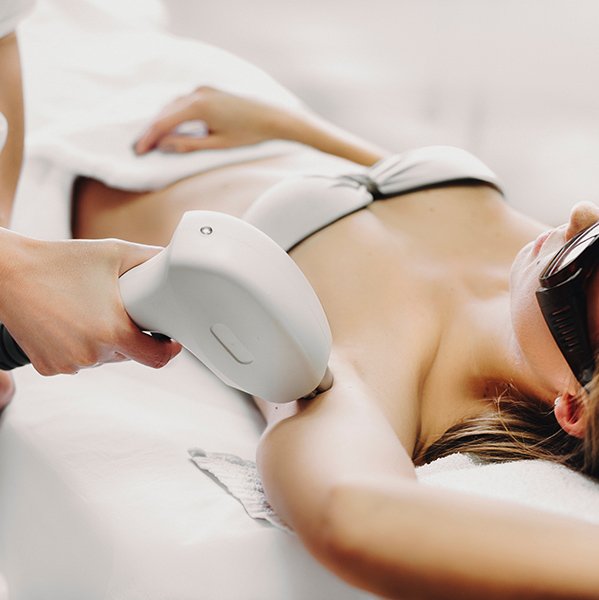
Between visits, the skin can only be cared for using a traditional razor. Leaving the roots intact allows the light beam to precisely reach its target and reduces the problem of ingrown hairs and folliculitis. The treatment itself is performed using a precise stamping technique, and comfort is enhanced by a soothing cooling gel. Slight redness after the visit is a natural, temporary skin reaction.
During the recovery phase, the skin needs gentle treatment:
- Avoiding saunas - high temperatures irritate freshly treated skin.
- Giving up hot baths - heat intensifies redness.
- Limiting UV radiation - skin is more sensitive to the sun after the procedure.
- Gentle moisturizing products - support the rebuilding of the epidermis.
- Mild cosmetics - accelerate renewal without irritation.
Regular, soothing care ensures that the skin quickly returns to a healthy appearance.
Instead of reaching for a razor every morning, plan a full series and let the hair disappear area by area - start with a consultation that will determine the number of sessions and intervals tailored to you, and you will forget about shaving for long months!
Frequently asked questions about laser hair removal
How long does a single laser hair removal treatment take?
The duration of a single session depends on the size of the treated area – small areas, like the armpits or upper lip, take just a few minutes, while extensive areas, for example legs or the back, even up to an hour. Modern heads with a large treatment area shorten the procedure, making it easy to fit the entire series into daily duties. The specialist provides the exact duration after assessing the scope of the hair removal.
Does laser treatment hurt?
Modern epilation lasers are well tolerated and most often described as a sensation of warmth and gentle pricks. Discomfort is limited by the skin cooling system and a soothing gel applied during the session. Sensations can be stronger in areas with thin skin, like the bikini area, but are short-lived and usually well tolerated.
At what age can you start laser hair removal?
The treatment works best after puberty, when the hormonal balance is already relatively stable and the hair is fully developed. In minors, therapy is considered individually and after consultation, usually with a guardian's consent. Starting too early can be less permanent, as hormones continue to stimulate new follicles to grow.
Does laser work on light or gray hair?
The laser reacts primarily to melanin, a pigment that gives hair its dark color, which is why it yields the best results on dark hair and light skin. Light blonde, grey, and red hair contains little or none of it, so it reacts weakly or not at all. Then, a specialist assesses during a consultation whether the treatment makes sense in a given case.

