Postpartum physiotherapy - when to start and what to expect
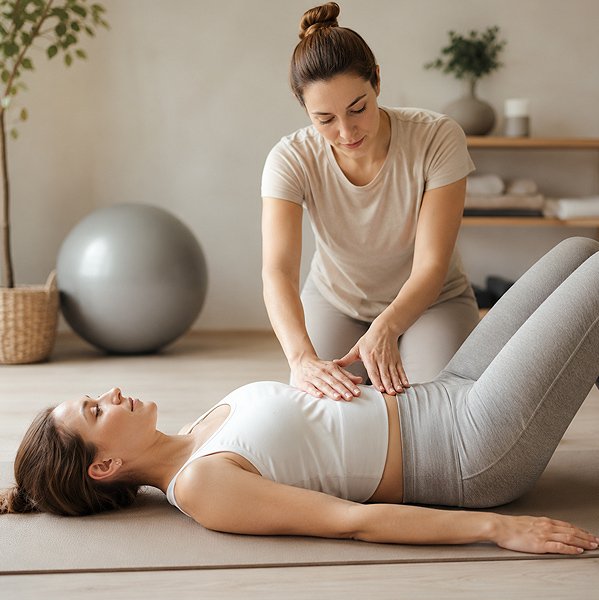
Postpartum physiotherapy – key facts to get started:
- Two starting levels – gentle activity early, more intensive therapy usually after a check-up at around 6 weeks.
- Natural birth vs. C-section – after a C-section, the rehabilitation path is longer.
- Pelvic floor training – a supervised program reduces the risk of urinary incontinence in the first year after childbirth.
- Ambasada Urody provides postpartum urogynecological physiotherapy at Wilcza and in Wilanów, after consultation with the attending physician.
Table of Contents
- When to start physiotherapy after childbirth?
- Rehabilitation after natural childbirth - the first days
- When to start physiotherapy after a cesarean section?
- What does the first visit to a urogynecological physiotherapist look like?
- What pelvic ailments does postpartum physiotherapy treat?
- Scar work and tissue regeneration after childbirth
- How to safely return to physical activity after the postpartum period?
- FAQ: most frequently asked questions about postpartum physiotherapy
When to start physiotherapy after childbirth?
After an uncomplicated birth, gentle movement, walking, and gentle work on pelvic floor awareness can start early, when the woman feels ready, and a fuller urogynecological assessment is safer after the check-up at around 6 weeks. The postpartum period lasts about 6 weeks, but this is not the date of a full return to fitness – it is a checkpoint, not permission for intense sports.
Earlier contact with a specialist makes sense in the case of symptoms: urinary leakage, a feeling of heaviness in the vagina, or a problem with the scar. Warning signs – heavy bleeding, fever, increasing pain, calf swelling – require, however, not physiotherapy but urgent medical consultation.
Rehabilitation after natural childbirth - the first days
The process of returning to fitness can be initiated as early as the first day after childbirth, to the extent permitted by the body's condition. Gentle activity helps to regain strength faster.
Gentle support in the first days includes:
- Anti-thrombosis exercises – basic in the first days after childbirth,
- Diaphragmatic breathing work – stimulation through conscious breathing,
- Uterine contraction – supporting this process,
- Urogynecological consultation – a physiotherapy visit after the postpartum period,
- Ergonomics of care – principles of working with the child.
At this stage, the priority remains healing, rest, and observing the body, rather than a home exercise protocol.
When to start physiotherapy after a cesarean section?
After a cesarean section, the first contact with a urogynecological physiotherapist is usually planned around the second week. Cesarean section is a major surgical procedure, which is why the body regenerates many layers of tissue and the rehabilitation path is more spread out over time than after a natural birth.
A more comprehensive urogynecological assessment usually falls within the postpartum check-up window, and the work focuses on several areas:
- Postoperative scar – assessment and gradual restoration of flexibility,
- Restoring sensation – gradual work in the lower abdomen area,
- Deep stabilization – work on the deep muscles of the trunk,
- Movement patterns – learning correct posture and safe movements,
- Pain prevention – reducing the risk of chronic pelvic pain.
The scar after the C-section may require an assessment of mobility, tenderness, and sensation. Manual scar work helps some patients, but it does not “remove adhesions” – it is healing support, selected individually.
What does the first visit to a urogynecological physiotherapist look like?
The first visit is primarily a functional assessment, not a ready-made list of exercises in the dark. The specialist identifies the causes of the ailments and plans a recovery tailored to your situation.
Diagnostics during the first visit usually include:
- Medical history and documentation – a detailed interview and analysis of documentation,
- Posture assessment – observation of posture and movement patterns,
- Manual assessment – examination of tissues within the abdomen,
- Functional tests – assessment of response to exertion,
- Pelvic floor examination – most often vaginally, with your consent,
- Therapy plan – development of an individual plan.
The pelvic floor examination is performed with the patient's consent, with the right to refuse or stop at any moment. For postpartum women, a home visit is also possible, which ensures comfort in familiar surroundings.
What pelvic ailments does postpartum physiotherapy treat?
Postpartum physiotherapy supports working with urinary incontinence, urinary urgency, and pelvic discomfort, although this is not a promise of a complete cure for every patient. Pregnancy and childbirth are a huge effort for the body. Thanks to the assessment of pelvic floor function, many women regain control and confidence.
Urogynecological rehabilitation helps, among other things, with problems such as:
- Prolapse of reproductive organs,
- Separation of the pubic symphysis,
- Painful periods,
- Piriformis muscle tension,
- Linea alba hernia,
- Pain during intimacy.
For stress or mixed urinary incontinence, the standard is supervised pelvic floor training spread over several months. The lasting effect is based on combining in-office therapy with home exercises.
Scar work and tissue regeneration after childbirth
Working with a postpartum scar supports the recovery of tissue elasticity. Thanks to massage and manual therapy, specialists support the body's repair processes. Care at this stage restores tissue mobility and reduces discomfort in the perineal area, while visceral techniques support bowel function. Gradually, intimate fitness and pre-pregnancy shape also return.
Visceral techniques can be particularly helpful after a cesarean section. Systematic support from a specialist helps the body regain freedom of movement.
How to safely return to physical activity after the postpartum period?
A safe return to activity begins with a functional assessment, not immediately with intense training. A specialist checks the condition of the linea alba and potential diastasis recti. The starting point is the activation of deep muscles: it begins with learning conscious breathing and working with the pelvic floor, often with the help of biofeedback. Only later are core stabilizing exercises and the PNF method, which improves coordination, added.
The body under the influence of relaxin has relaxed joints, which increases the risk of injury. Instead of reaching for heavy weights right away, it is better to focus on training centered on core stabilization, and introduce heavier loads only after a few months, if there are no symptoms. Patience remains a prerequisite for a safe return to fitness.
Do not plan your return to shape after childbirth by guesswork or according to an online list of exercises - schedule a functional pelvic floor assessment, establish a plan with a physiotherapist tailored to how you gave birth and how your body is healing, and return to activity calmly, in stages!
FAQ: most frequently asked questions about postpartum physiotherapy
When to start physiotherapy after natural childbirth?
Gentle movement and working on pelvic floor awareness can start early, when you feel ready. A more comprehensive urogynecological assessment is usually safer after the check-up at around 6 weeks.
Does rehabilitation look different after a cesarean section?
After a cesarean section, the rehabilitation path is more spread out over time – the first contact with a physiotherapist is usually planned around the second week, and a fuller urogynecological assessment falls within the postpartum check-up window.
Will physiotherapy close diastasis recti?
Programs engaging deep and superficial abdominal muscles can be more effective than passive methods, but one should not expect “closure of the separation”.
When can you return to running after giving birth?
Running is usually introduced only after a few months, if there are no symptoms. A check-up at around 6 weeks is a checkpoint, and not clearance for intense sports.
Where to consult urogynecological physiotherapy after childbirth?
The consultation can take place at the Warsaw offices on Wilcza and in Wilanów, after prior consultation with the attending physician.

