Sun discoloration
back to main page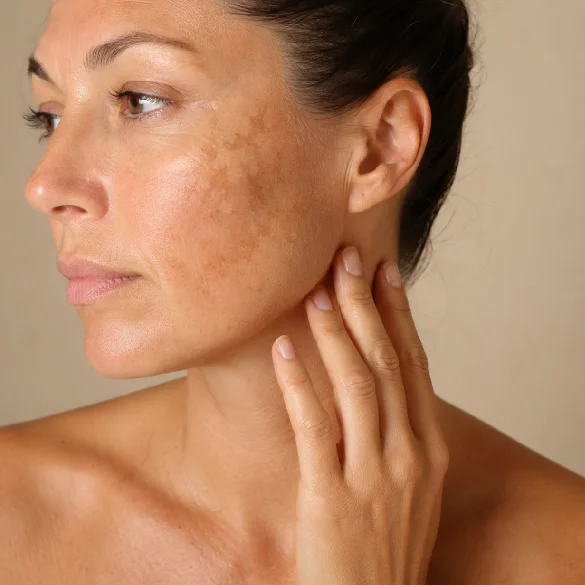
Dark spots on the hands, decolletage, or face, which become increasingly visible from year to year - these are the most common effect of many years of UV radiation on the skin. Contrary to popular belief, they do not disappear on their own after summer. Below, we explain how they differ from age spots, why winter is the best time to start therapy, and which treatments - laser and IPL - yield the most effective results.
Sun discolorations – why do they appear on the hands and décolletage?
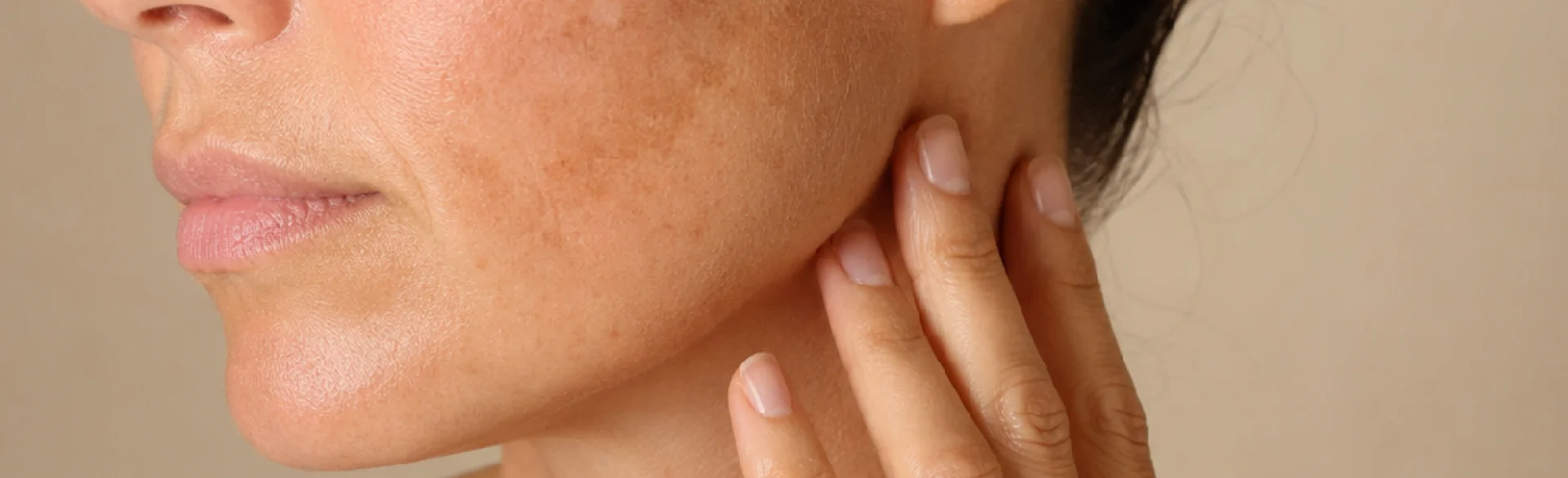
Sun-induced discolorations are among the most common skin pigmentation changes, arising from long-term or intense exposure to UV radiation. They most often appear on the face, hands, décolleté, and shoulders, i.e., in places regularly exposed to the sun. Although initially aesthetic in nature, they are a clear signal of chronic skin photodamage and indicate disorders in the functioning of melanocytes.
The hands and décolleté are among the areas that often receive less sun protection than the face. As a result, over many years, they accumulate damage caused by UVA and UVB radiation, which leads to abnormal distribution of melanin.
Discoloration occurs when:
- UV radiation activates melanocytes responsible for melanin production,
- excessive synthesis of pigment occurs in selected areas of the skin,
- melanin accumulates unevenly in the epidermis or dermis,
- repeated damage to skin cells perpetuates pigmentation disorders,
- the skin aging process reduces the ability for even regeneration.
The risk of developing discoloration is also increased by:
- fair skin phototype,
- many years of sun exposure without proper photoprotection,
- frequent use of tanning beds,
- age,
- chronic oxidative stress,
- certain medications and cosmetics that increase sensitivity to light.
Discoloration on the hands and décolleté usually appears gradually. Initially, they take the form of small spots, which over time become darker, more numerous, and more visible. The earlier appropriate therapy and daily sun protection are implemented, the greater the chance of effectively lightening the lesions and inhibiting the formation of new ones.
Sun discoloration – the difference between sun discoloration and age spots
The terms “sun discoloration” and “age spots” are very often used interchangeably. In dermatological practice, most so-called age spots are actually discoloration caused by long-term exposure to UV radiation.
The most important difference is the cause of their formation.
Sun discoloration develops primarily as a result of:
- chronic exposure to UVA and UVB radiation,
- skin photodamage,
- excessive melanocyte activity.
Age spots (lentigo solaris), on the other hand, are a specific type of sun discoloration that most often appear after the age of 40-50 as a result of years of cumulative sun damage.
Characteristic features of age spots:
- have clearly defined borders,
- are flat,
- have a color from light brown to dark brown,
- occur mainly on the hands, face, décolletage, and forearms,
- do not disappear spontaneously.
However, not every dark spot on the skin is sun discoloration. Pigmentation changes can also have a hormonal, post-inflammatory, or drug-induced basis, or result from other skin diseases.
Therefore, before starting therapy, professional diagnostics are recommended to determine:
- the type of discoloration,
- the depth of melanin deposition,
- the degree of skin photodamage,
- the optimal treatment method.
Correct diagnosis is crucial for the effectiveness of therapy, as different types of discoloration require different treatment methods.
Sun spots – do they disappear after winter?
One of the most frequently repeated myths is the belief that sun discoloration disappears on its own after the end of summer. In reality, this happens very rarely.
In autumn and winter, the amount of UV radiation decreases, which is why the skin stops intensively producing melanin. This causes a slight lightening of some of the lesions, but the previously accumulated pigment remains in the skin.
Most commonly observed are:
- slight fading of the discoloration,
- reduction of contrast between the lesion and the surrounding skin,
- lack of complete disappearance of the spots.
The deeper the melanin is located in the skin, the lower the probability of its spontaneous removal.
In winter, it is worth starting therapy because:
- exposure to UV radiation is lower,
- the risk of discoloration recurrence during treatment is lower,
- the skin regenerates more easily after treatments,
- it is possible to perform more intensive laser procedures and medical peels.
It should be remembered that even in winter, UVA radiation reaches the skin and can sustain the process of new discoloration formation. Therefore, year-round sun protection using SPF creams is a fundamental element of prevention.
Sun discoloration – laser removal and IPL photorejuvenation
Modern aesthetic medicine offers effective methods of reducing sun-induced discoloration, which act directly on the accumulated melanin and simultaneously improve skin quality.
The choice of technology depends on:
- type of discoloration,
- depth of the changes,
- skin phototype,
- location,
- degree of photoaging.
Laser discoloration removal
Lasers utilize the phenomenon of selective photothermolysis. Light energy is absorbed by melanin, causing it to break down into tiny particles, which are then removed by the body's natural regenerative processes.
Laser therapy allows you to:
- precisely remove individual discolorations,
- lighten extensive pigmentation changes,
- improve even skin tone,
- stimulate skin remodeling and collagen synthesis.
Depending on the type of changes, the therapy usually includes from 1 to 5 treatments.
IPL photorejuvenation
IPL technology uses broadband light pulses that simultaneously affect melanin, hemoglobin, and structures responsible for skin quality.
IPL photorejuvenation enables simultaneous:
- reduction of discoloration,
- improvement of skin tone,
- reduction of redness,
- constriction of dilated vessels,
- stimulation of collagen production,
- improvement of skin smoothness and firmness.
This method works particularly well for people with numerous small discolorations and signs of photoaging covering larger areas of the face, neck, decolletage, and hands.
The best results are achieved through a comprehensive approach that combines appropriately selected treatments with professional depigmenting care and daily sun protection. This approach not only effectively lightens existing discoloration, but also significantly reduces the risk of new discolorations appearing in the future.

