Birthmark on the face
back to main page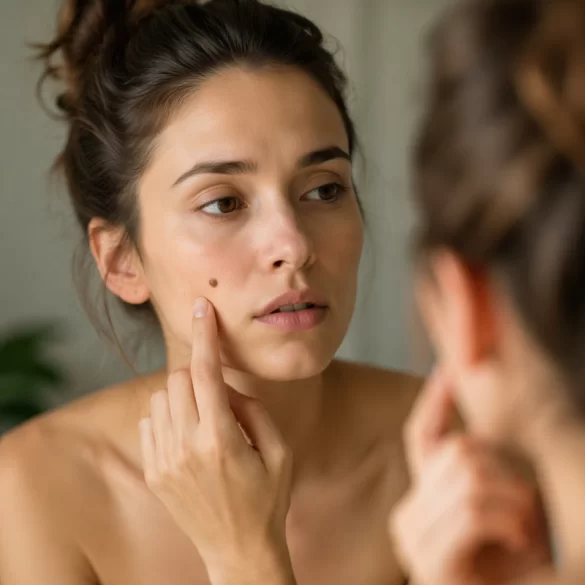

A facial nevus is a circumscribed skin lesion of a congenital or acquired nature, arising as a result of proliferation disorders of pigment cells (melanocytes), blood vessels, or other skin structures. These lesions can take various forms – from flat discolorations to raised nodules – and differ in color, size, and growth dynamics. Most nevi are benign, however, their location on the face is associated with significant aesthetic importance and the necessity of differentiation from potentially malignant skin cancers, including melanoma. Dermatological and dermoscopic assessment forms the basis for proper qualification and further management.
Birthmark on the face – types
Facial skin nevi constitute a heterogeneous group of lesions classified according to their histological origin and clinical presentation. The most common are melanocytic nevi, i.e., clusters of melanocytes producing melanin – the pigment responsible for skin color.
The most important types of nevi include:
1. Melanocytic (pigmented) nevi:
- congenital nevi – present from birth, can reach significant sizes,
- acquired nevi – appear during life, most often in childhood and adolescence,
- atypical (dysplastic) nevi – with irregular borders and varied coloring, requiring monitoring.
2. Vascular nevi:
- flat hemangiomas (e.g., „port-wine stain” type),
- cavernous hemangiomas,
- telangiectasias – dilated capillaries visible superficially.
3. Epidermal nevi:
- seborrheic keratoses,
- verrucous nevi (with a warty surface).
4. Other benign lesions:
- soft fibromas,
- sebaceous cysts (epidermal cysts),
- milia.
Clinical assessment of nevi is based on the so-called ABCDE criteria:
- A (asymmetry) – asymmetry,
- B (border) – irregular borders,
- C (color) – uneven color,
- D (diameter) – diameter over 6 mm,
- E (evolution) – changes over time.
The occurrence of the above features requires in-depth diagnostics, most often using dermoscopy or videodermoscopy. In selected cases, a histopathological examination is performed after surgical removal of the lesion.
Birthmark on the face – laser removal
Laser mole removal is one of the most modern therapeutic methods used in dermatology and aesthetic medicine, especially in areas requiring high precision, such as the face. This technology is based on selective photothermolysis - a phenomenon involving the selective absorption of light energy by specific skin structures (e.g., melanin or hemoglobin), leading to their controlled destruction without damaging surrounding tissues.
Depending on the type of lesion, different types of lasers are used:
- ablative lasers (e.g., CO₂, Er:YAG) - cause tissue evaporation,
- non-ablative lasers - act deeper without disrupting epidermal integrity,
- dye lasers - used for vascular lesions,
- Q-switched lasers - used in the treatment of pigmented lesions.
Indications for laser mole removal include:
- benign lesions of confirmed nature,
- aesthetic defects affecting the patient's quality of life,
- superficial lesions that do not require surgical excision.
Course of the procedure:
The procedure is performed in outpatient conditions, often after the application of local anesthesia. The laser energy precisely affects the lesion, leading to its gradual removal. Depending on the depth and nature of the lesion, a series of treatments may be necessary.
Advantages of the laser method:
- high precision of action,
- minimal risk of scarring,
- short recovery period,
- possibility of treating difficult-to-reach locations.
Limitations and contraindications:
- suspicion of a neoplastic lesion (requires surgical excision and histopathological examination),
- active skin infections,
- tendency for keloids,
- fresh tan.
After the procedure, temporary erythema, swelling, or scabbing are observed, which subside within a few to several days. Proper post-treatment care is of key importance, including sun protection and the use of preparations supporting skin regeneration.
In clinical practice, other methods of mole removal are also used, depending on medical indications:
- surgical excision of the lesion (with a safety margin),
- electrocoagulation,
- cryotherapy (freezing with liquid nitrogen),
- radiosurgery.
Within modern aesthetic dermatology, laser procedures often constitute an element of a comprehensive approach to improving skin quality, which also includes regenerative therapies that stimulate repair processes and tissue remodeling.

