Drooping shoulders
back to main page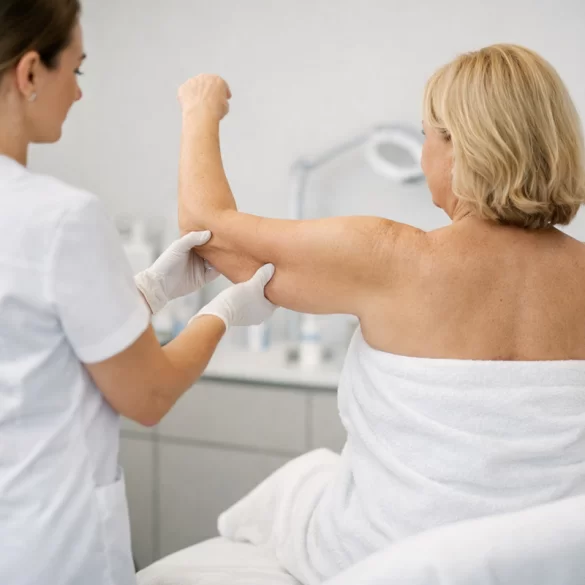
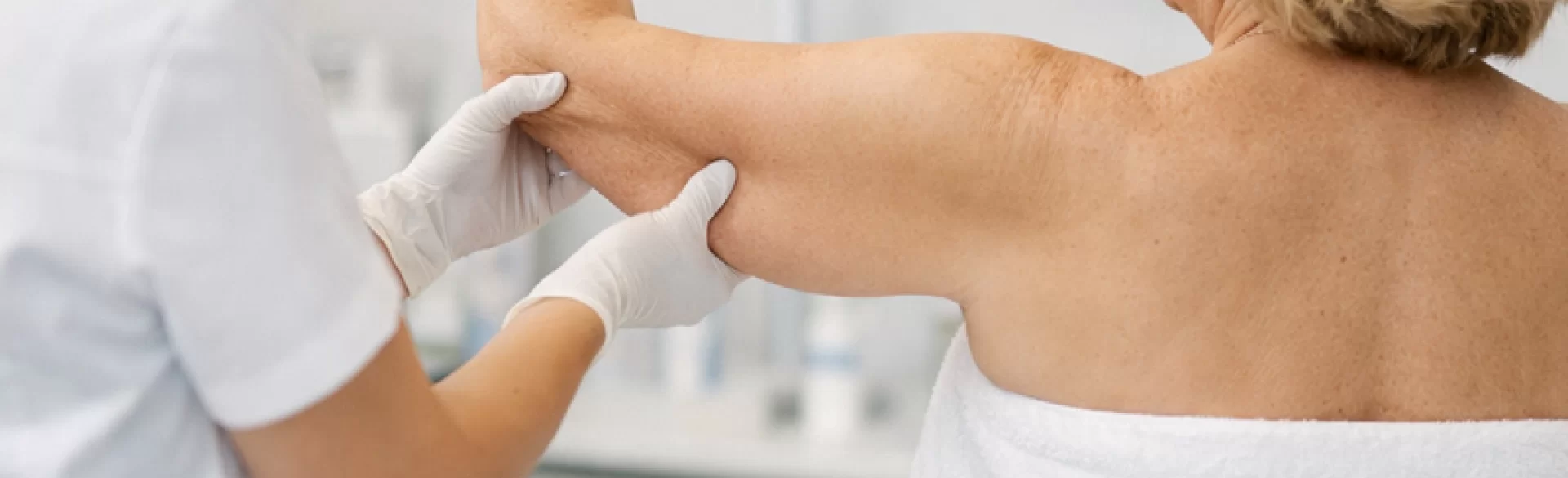
Sagging arms is a colloquial term for the laxity of the skin and soft tissues in the posterior-medial part of the arm, leading to a loss of tension and the characteristic "drooping" of the skin. This issue affects both women and men, but it is more commonly observed in women due to hormonal differences, a higher physiological proportion of fatty tissue, and a different structure of collagen fibers. Arm sagging can result from aging processes, rapid weight loss, lack of physical activity, or hormonal changes. In advanced cases, it is accompanied by excess skin, loss of firmness, and localized accumulation of fatty tissue.
Sagging arms – where does this problem come from
The pathogenesis of arm skin laxity is multifactorial and involves both structural changes in the dermis and changes in subcutaneous tissue and muscles.
1. Skin aging (chronological and photoaging)
With age, there is:
- a decrease in the synthesis of collagen types I and III,
- degradation of elastin and disruption of the elastic fiber architecture,
- a reduction in the number of fibroblasts,
- a reduction in hyaluronic acid content in the extracellular matrix.
The result is a loss of tension, elasticity, and the skin's ability to contract after stretching.
2. Rapid weight loss
After significant reduction of adipose tissue (e.g., after bariatric surgery or intensive diets):
- the skin, previously stretched, does not always undergo complete retraction,
- there is an excess of loose skin,
- the quality of supporting fibers deteriorates.
The longer the obesity persisted and the greater the degree of skin stretching, the higher the risk of permanent laxity.
3. Insufficient muscle mass and tension
The triceps brachii muscle is responsible for the tension of the posterior part of the arm. Its weakening leads to:
- loss of "support" for the skin,
- exposure of excess subcutaneous tissue,
- enhancement of the sagging effect.
4. Hormonal and genetic factors
- A decrease in estrogens (e.g., during the perimenopausal period) accelerates collagen degradation.
- Genetic predispositions affect the quality of connective tissue.
In clinical practice, the problem of sagging arms often has a mixed character: coexisting skin laxity, local excess adipose tissue, and reduced muscle tension.
Sagging Arms - Exercises
Physical activity is a fundamental element of prevention and therapy support. However, it should be clearly emphasized: exercises improve muscle tone, but will not remove excess skin in the case of significant flaccidity.
Training Goals
- increase in the mass and tone of the triceps muscle,
- improvement of overall body composition,
- reduction of local adipose tissue (in combination with a calorie deficit).
Triceps strengthening exercises:
- bench dips,
- overhead dumbbell extensions,
- bent-over arm extensions,
- French presses,
- classic and narrow push-ups.
General exercises supporting fat tissue reduction:
- high-intensity interval training (HIIT),
- full-body strength training,
- metabolic training.
Principles of Effectiveness
- a minimum of 2–3 strength training sessions per week,
- progressive increase in load,
- combination with a reduction diet in case of excess adipose tissue.
Research has shown that resistance training increases collagen synthesis in muscles and improves the quality of connective tissue, but its impact on significantly stretched skin is limited. Therefore, in moderate and advanced cases, support with medical procedures is necessary.
Sagging Arms - Treatments
The procedural treatment depends on the degree of skin laxity, the amount of adipose tissue, and the patient's expectations. In clinical practice, therapies that stimulate neocollagenesis (the formation of new collagen), reduce adipose tissue, and improve skin tension are used.
1. Radiofrequency (RF) Treatments
Radiofrequency technologies cause controlled heating of the dermis to a temperature that induces:
- an immediate contraction effect of collagen fibers,
- stimulation of fibroblasts,
- long-term collagen remodeling.
In clinical practice, the following are used:
- microneedle radiofrequency,
- monopolar and bipolar RF systems,
- technologies combining RF with infrared and vacuum (e.g., VelaShape).
2. HIFU (High-Intensity Focused Ultrasound)
High-energy ultrasound technology works at a specified depth (e.g., 3–4.5 mm), causing:
- localized thermal damage,
- stimulation of neocollagenesis,
- a lifting effect without affecting the epidermis.
This method is particularly effective for moderate laxity.
3. Fat-Reducing Treatments
In cases of coexisting localized adiposity (accumulation of adipose tissue), the following are used:
- microwave technologies (e.g., Onda Coolwaves),
- acoustic waves,
- carboxytherapy,
- injection lipolysis.
Reducing the volume of adipose tissue often improves the arm contour and reduces the "sagging" effect.
4. Tissue Stimulants and Mesotherapy
The administration of biostimulating preparations can:
- improve skin density,
- increase its tension,
- thicken the structure of the dermis.
5. Surgical Treatment
In cases of significant excess skin, the only effective method may be brachioplasty (arm lift surgery), which involves removing excess skin and tissue modeling.
Effective therapy for sagging arms requires:
- assessment of the degree of skin laxity,
- analysis of fat tissue involvement,
- consideration of age and quality of connective tissue,
- selection of combined therapy (exercises + treatments).
Early intervention yields the best results. In advanced cases, it's important to realistically assess the possibilities of non-surgical therapies and, if necessary, consider a surgical consultation.

