Hernia in men
back to main page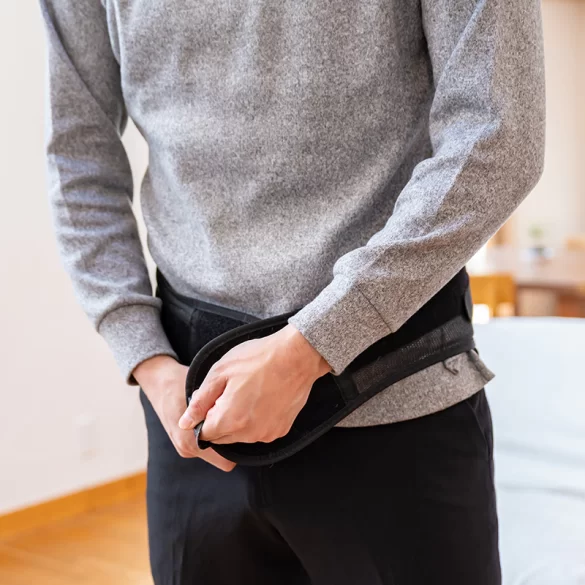

A hernia in men is the pathological displacement of an abdominal organ (most commonly a fragment of the small intestine or greater omentum) through a weakened spot in the abdominal wall. This leads to the formation of a protrusion, which may be visible or palpable. Hernias occur significantly more frequently in men than in women, due to anatomical differences—particularly the presence of the inguinal canal, through which the testes descend during fetal development. The condition can be asymptomatic or cause pain, and in extreme cases, it can lead to serious complications such as incarceration or intestinal necrosis. Diagnosis is based on clinical examination, and treatment is surgical in nature.
Hernia in Men – Types
In men, abdominal wall hernias are the most common, among which the following are distinguished:
1. Inguinal hernia (most common)
It accounts for about 75–80% of all hernias in men. It is divided into:
- Indirect inguinal hernia – passes through the inguinal canal; often congenital or associated with a persistent processus vaginalis.
- Direct inguinal hernia – occurs due to the weakening of the posterior wall of the inguinal canal; typically acquired.
It more frequently affects men of working age and older.
2. Femoral hernia
Less common in men, more common in women. It is located below the inguinal ligament. It carries a higher risk of incarceration.
3. Umbilical hernia
It can be:
- congenital (rarely diagnosed in adulthood),
- acquired – associated with obesity, ascites, chronic increase in intra-abdominal pressure.
4. Incisional hernia (scar hernia)
Develops at the site of a previous surgical incision. The risk increases with:
- obesity,
- diabetes,
- wound infection,
- connective tissue insufficiency.
Hernia in Men - Causes
The primary mechanism for hernia formation is increased intra-abdominal pressure in conjunction with weakened abdominal walls.
1. Anatomical:
- wide inguinal canal,
- congenital fascia defects,
- collagen synthesis disorders (e.g., reduced type I to III collagen ratio).
2. Factors increasing intra-abdominal pressure:
- chronic cough (COPD, smoking),
- chronic constipation,
- prostate hypertrophy causing straining during urination,
- heavy lifting,
- intense strength training without core stabilization,
- ascites,
- visceral obesity.
3. Systemic factors:
- age (connective tissue degeneration),
- smoking,
- protein deficiencies,
- metabolic diseases.
It is worth noting that a single "heavy lifting" incident is rarely the sole cause – it usually acts as a triggering factor in a person with pre-existing abdominal wall weakness.
Hernia in Men – Symptoms
The clinical picture depends on the size of the hernia and its stage of progression.
- palpable or visible bulge in the groin, scrotum, navel, or postoperative scar,
- enlargement of the bulge during coughing, straining, standing,
- sensation of pulling, discomfort, or dull pain,
- feeling of "heaviness" in the groin.
- sudden, severe pain,
- redness and tension of the skin over the hernia,
- inability to reduce the bulge,
- nausea, vomiting,
- symptoms of intestinal obstruction.
Such a condition may indicate a strangulated hernia – a life-threatening situation due to intestinal ischemia.
- physical examination (in standing and lying positions),
- cough test,
- abdominal ultrasound,
- in doubtful cases: computed tomography.
Hernia in men - home treatment
It should be clearly emphasized: a hernia does not resolve spontaneously and cannot be treated with home remedies. The only effective treatment method is surgical intervention.
1. Limiting aggravating factors:
- avoiding heavy lifting,
- treating chronic cough,
- regulating bowel movements (high-fiber diet),
- weight reduction.
2. Hernia belt (in selected cases):
- can reduce discomfort,
- does not treat the cause,
- used temporarily in individuals not qualified for surgery.
3. Deep muscle exercises (core stability):
- strengthen the transverse abdominal muscles,
- do not close the fascial defect,
- may slow progression in individuals with small hernias.
Includes:
- mesh repair using synthetic mesh (Lichtenstein method),
- laparoscopic techniques (TAPP, TEP),
- less frequently non-mesh repair (in selected cases).
Surgery:
- prevents complications,
- has high effectiveness,
- allows for quick return to activity.

