Localized scleroderma
back to main page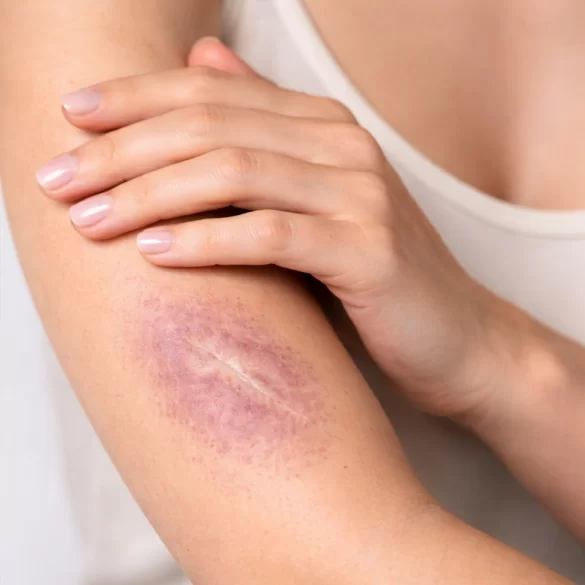
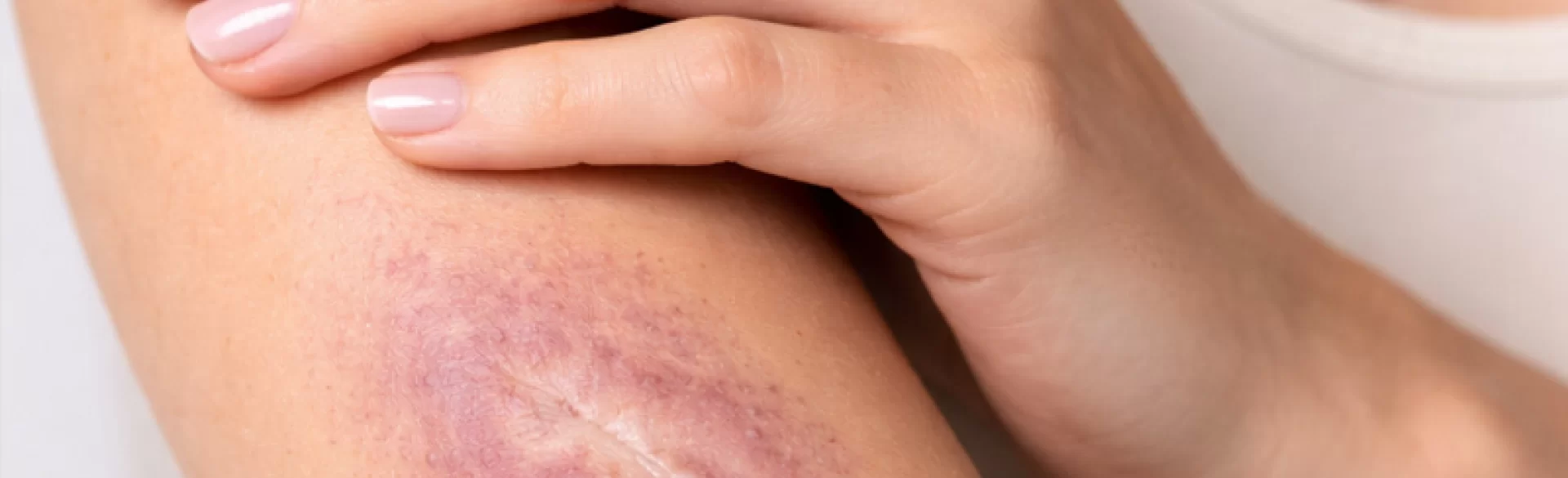
Localized scleroderma (Latin: scleroderma circumscripta, morphea) is a chronic inflammatory connective tissue disease with an autoimmune basis, leading to excessive skin fibrosis and—depending on the form—subcutaneous tissues, muscles, and bones. Unlike systemic scleroderma, the disease process does not involve internal organs, and changes are primarily limited to the skin. The disease is characterized by periods of activity and remission, and its course can be prolonged over many years. Localized scleroderma can occur in both adults and children, with deeper and linear forms being more common in younger individuals. Early diagnosis is crucial for halting the progression of fibrosis and limiting permanent aesthetic and functional consequences.
Localized scleroderma – what is it
Localized scleroderma is a condition in which there is abnormal activation of fibroblasts and excessive production of collagen in the skin. As a result, the skin gradually hardens, thickens, and loses its elasticity.
Characteristic features of the disease include:
- skin changes with well-defined borders,
- initially an inflammatory phase (erythema, swelling),
- followed by a phase of hardening and blanching of the skin,
- in the later stages, possible atrophy of the skin and subcutaneous tissue.
In the histopathological image, the following can be observed:
- inflammatory infiltrate in the dermis,
- thickening of collagen bundles,
- atrophy of skin appendages (sweat glands, hair follicles).
The disease is not contagious and does not spread through contact. Its activity can be variable - in some patients, the process spontaneously subsides, while in others it progresses over many years.
Localized scleroderma – types
Localized scleroderma is not a homogeneous disease entity and includes several distinct clinical forms:
1. Plaque morphea
- the most common form,
- single or multiple indurated plaques,
- location: trunk, limbs,
- relatively mild course.
2. Linear morphea
- band-like lesions,
- common in children,
- may involve muscles and bones,
- risk of limb growth disturbances.
3. Linear scleroderma of the face (en coup de sabre)
- characteristic indentation of the forehead skin,
- possible involvement of deep structures,
- potential neurological and ophthalmological complications.
4. Deep morphea
- involves skin, subcutaneous tissue, fascia,
- leads to significant deformities,
- often resistant to topical treatment.
5. Generalized morphea
- numerous, extensive lesions,
- significant limitation of skin mobility,
- great impact on the patient's quality of life.
Localized Scleroderma – Causes
The exact etiology of localized scleroderma has not been definitively determined. Current knowledge suggests a multifactorial mechanism of disease development.
The most commonly mentioned factors include:
- autoimmune disorders,
- abnormal regulation of pro-inflammatory cytokines,
- hyperactivity of fibroblasts,
- genetic predispositions,
- microtraumas to the skin,
- past infections (e.g., bacterial, viral),
- ionizing radiation,
- hormonal factors.
In some patients, the coexistence of other autoimmune diseases is observed, such as:
- thyroid diseases,
- rheumatoid arthritis,
- lupus erythematosus.
It is important to emphasize that no single factor is responsible for the development of the disease, and its occurrence is the result of complex immunological mechanisms.
Localized scleroderma – is it fatal
Localized scleroderma is not a fatal disease and does not directly shorten lifespan. In contrast to systemic scleroderma:
- there is no involvement of the lungs, heart, or kidneys,
- organ failure is not observed.
However, dismissing the disease is a mistake. Possible consequences of untreated or active scleroderma include:
- permanent skin deformities,
- joint contractures,
- growth disturbances in children,
- chronic pain and discomfort,
- significant reduction in quality of life.
The greatest risk of complications concerns forms that are:
- linear,
- deep,
- localized on the face.
Localized Scleroderma – Treatment
The treatment of localized scleroderma depends on:
- the activity of the disease,
- the clinical type,
- the depth of the lesions,
- the age of the patient.
Therapeutic management includes:
Topical treatment
- anti-inflammatory preparations,
- substances that modulate the fibrosis process,
- emollients to improve skin elasticity.
Systemic treatment
- immunomodulation in active forms,
- anti-inflammatory therapy,
- supportive treatment for regenerative processes.
Rehabilitation and physiotherapy
- prevention of contractures,
- maintenance of range of motion,
- improvement of soft tissue function.
A regular assessment of disease activity is crucial, as well as the early initiation of treatment during the inflammatory phase when the fibrosis process is still potentially reversible.
Treatment procedures for limited scleroderma
The procedural treatment serves as a complementary approach to dermatological and rheumatological treatment. Its aim is not to treat the root cause of the disease but to improve skin quality and tissue function.
The most commonly used procedures include:
- therapies that enhance microcirculation,
- treatments that stimulate cellular metabolism,
- methods that increase skin elasticity and hydration,
- techniques that support the remodeling of collagen fibers.
Treatments are selected individually, taking into account:
- the phase of the disease (active vs. stable),
- the location of the lesions,
- the depth of fibrosis,
- the general condition of the patient.
It should be emphasized that aesthetic procedures do not replace medical treatment, but they can significantly:
- improve the appearance of the skin,
- reduce the feeling of stiffness,
- support regenerative processes,
- increase the comfort of the patient's daily functioning.

