Whiteheads
back to main page
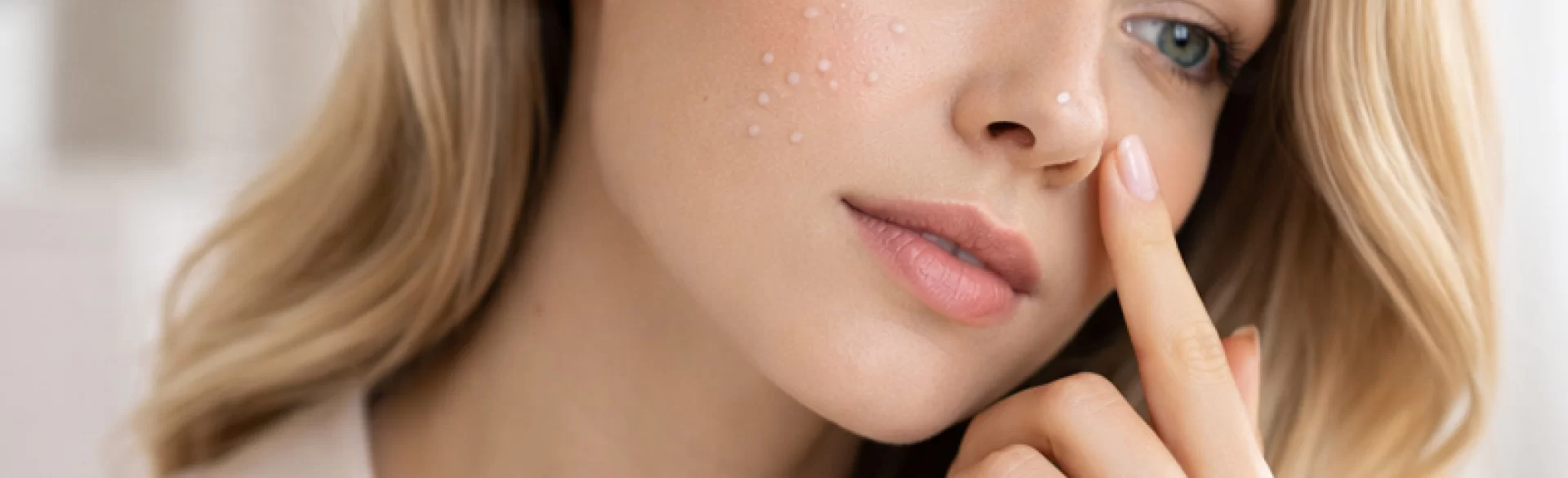
Whiteheads, referred to in dermatology as closed comedones (comedones closed), are small, light bumps resulting from the blockage of a hair follicle opening by excess sebum (skin oil), keratinized skin cells, and skin bacteria. Unlike open comedones (blackheads), their opening remains closed, which is why the lesions are white or flesh-colored and are less visible on the skin's surface. Whiteheads are one of the primary forms of lesions in the course of comedonal acne (acne comedonica). They most commonly appear in individuals with oily or combination skin, but can also occur in those with normal or dehydrated skin. Although not inflammatory lesions themselves, they can be a starting point for the development of acne papules and pustules.
Whiteheads – what are they
Whiteheads are the result of disturbances within the pilosebaceous unit, a structure consisting of a hair follicle, a sebaceous gland, and a duct that transports sebum to the skin's surface. The key mechanism of their formation is excessive keratinization of the hair follicle opening (hyperkeratinization) combined with overproduction of sebum.
Under normal conditions, epidermal cells undergo regular exfoliation and do not block the opening of the sebaceous gland. When this process is disturbed, an accumulation occurs of:
- sebum (skin oil),
- keratinized keratinocytes,
- skin bacteria, mainly Cutibacterium acnes.
The resulting keratin-sebum mass closes the opening of the hair follicle, forming a small, light bump usually 1 to 3 mm in diameter.
Factors contributing to the formation of whiteheads include, among others:
- excessive activity of sebaceous glands (e.g., during puberty),
- hormonal changes (androgens increasing sebum production),
- use of comedogenic cosmetics,
- improper skin care,
- chronic stress and dietary factors with a high glycemic index,
- genetic predisposition.
Whiteheads often represent the first stage of acne development. If bacteria multiply and an inflammatory reaction occurs within the closed hair follicle, the lesion can transform into an acne papule or pustule.
Whiteheads – location
Whiteheads appear primarily in skin areas with a **high number of sebaceous glands**. Their distribution is therefore closely related to the activity of pilosebaceous units.
The most common locations are:
Face:
- forehead,
- nose,
- cheeks,
- chin,
- temple areas.
On the face, lesions often concentrate in the so-called **T-zone** (forehead–nose–chin), where sebum production is highest.
Other possible locations:
- upper back,
- chest,
- shoulders,
- jawline and hairline areas.
In some cases, whiteheads can also appear in areas where the skin is exposed to **friction or occlusion**, e.g.:
- under protective masks,
- around clothing collars,
- in areas of contact with hair or styling products.
A characteristic feature of whiteheads is that they **do not have a visible black opening**, because the hair follicle opening remains closed. For this reason, the lesions are usually palpable under the fingers as small skin irregularities, even if they are not clearly visible.
Whiteheads – how to remove
The removal of whiteheads should be based on normalizing the epidermal keratinization process, regulating sebum secretion, and cleansing hair follicle openings. In dermatological practice, both skincare and treatment methods are used.
The basic therapy methods include:
1. Topical Treatment
The most commonly used active substances are:
- topical retinoids (e.g., adapalene, tretinoin) – regulate the keratinization process and prevent the formation of new comedones,
- salicylic acid (BHA) – has keratolytic properties and penetrates sebaceous gland openings,
- alpha-hydroxy acids (AHA) – accelerate epidermal exfoliation,
- azelaic acid – has anti-inflammatory and antibacterial properties.
2. Cosmetological and Dermatological Treatments
In cases of numerous comedones, cleansing and exfoliating procedures are used to facilitate the emptying of hair follicles.
The most commonly used are:
- chemical peels (e.g., using salicylic, mandelic, or glycolic acid),
- manual skin cleansing performed by a specialist,
- microdermabrasion,
- high-tech skin cleansing.
In aesthetic medicine, laser technologies and high-energy light are also used, which help regulate sebaceous gland activity and improve skin structure.
Treatments used in therapies for comedone-prone skin include:
- chemical peels used in anti-acne therapies,
- laser treatments improving skin quality,
- cleansing and sebum-regulating procedures available in modern aesthetic dermatology clinics.
3. Proper Skin Care
Daily care plays a significant role in preventing the formation of whiteheads:
- using non-comedogenic cosmetics,
- thorough skin cleansing,
- regular exfoliation of dead epidermal cells,
- avoiding heavy, occlusive preparations.
It is not recommended to self-extract whiteheads, as this can lead to skin damage, the development of inflammation, and the formation of post-inflammatory hyperpigmentation.
Effective treatment usually requires systematic therapy and appropriate selection of skincare and treatment methods, tailored to the skin type and severity of changes.

