Drooping corners of the mouth - why does the face look sad and how to change it?
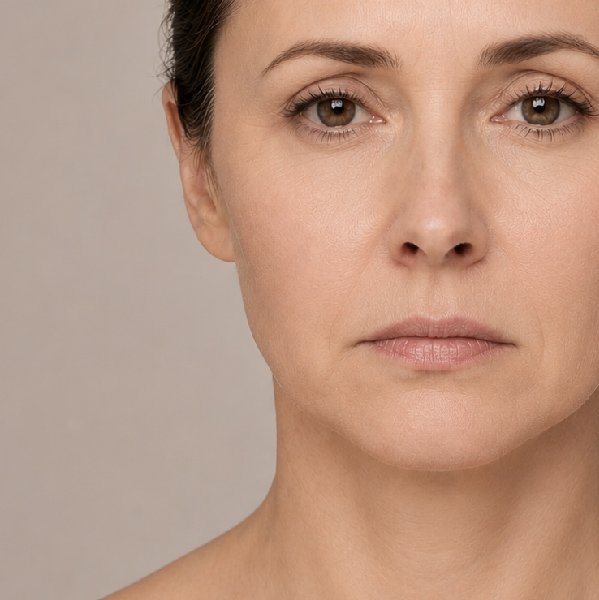
Drooping mouth corners in five points:
- Muscle balance - the lip line is determined by the dominance of depressor muscles over elevator muscles.
- Causes - hormones, collagen loss, adipose tissue loss, facial tension, and sun exposure.
- Sudden asymmetry - sudden drooping of one corner requires urgent medical attention.
- Working on tension - at Ambasada Urody, we relax the muscles acting in the direction of gravity and allow the elevator muscles to work more fully.
- Makeup - concealer, lip liner, and lip gloss optically lift the corners for one day.
Table of contents
- Which muscles are responsible for drooping corners of the mouth?
- Loss of collagen, bruxism and facial expressions - causes of drooping mouth corners
- When is a drooping corner of the mouth a warning sign?
- Will facial muscle exercises lift the corners of the mouth?
- Hyaluronic acid and Botox - treatments for downturned mouth corners
- What does a Corner Lip Lift involve?
- How to optically lift the corners of the mouth with makeup?
- Frequently asked questions about downturned mouth corners
Which muscles are responsible for drooping corners of the mouth?
Drooping corners of the mouth are primarily caused by the depressor anguli oris muscle, known as the DAO depressor. It pulls the edges of the lips downward and is supported by the platysma - a broad neck muscle whose tension transfers to the lower part of the face. On the other side of this same mechanism work the elevator muscles, responsible for smiling and lifting the corners of the mouth.
As long as both groups act with similar force, the lip line remains calm and horizontal. When the depressors work more frequently and harder - through daily facial expressions, jaw clenching, and chronic neck tension - the corners drift downward even at rest. The face then begins to look tired, even though mood has nothing to do with it. This dominance builds up over the years, which is why the change is visible gradually, rather than overnight.
Loss of collagen, bruxism and facial expressions - causes of drooping mouth corners
Over the years, facial features change along with a decrease in estrogen levels and weakened collagen production. The skin loses firmness, subcutaneous fat tissue diminishes, and the effects of gravity become more pronounced - this is how jowls and deepened furrows around the lips are formed. Habitual jaw clenching, or bruxism, adds constant tension in the masseter muscles, which transfers to the jawline.
Several factors work at once on the rate of drooping corners:
- Estrogen decline - hormonal changes weaken the rebuilding of the skin's structural proteins.
- Collagen loss - the skin's scaffolding weakens, and its edges succumb to gravity more easily.
- Loss of fat tissue - the lower part of the face loses support, and the contour becomes soft.
- Tension and bruxism - teeth clenching reinforces the work of the muscles pulling features downward.
- Sun radiation - UV destroys supporting fibers, which is why an SPF 50 sunscreen becomes part of the daily routine.
Genetics sets the starting point, but daily habits determine the pace of changes. Sun protection, conscious work with jaw tension, and collagen-supporting skincare delay the moment when the drooping of the corners becomes visible at rest.
When is a drooping corner of the mouth a warning sign?
A drooping corner of the mouth becomes an alarm signal when it appears suddenly and only on one side of the face. Changes of neurological origin develop within a few minutes, so reaction time counts. Sudden facial asymmetry can be a sign of a stroke, which is an immediate life-threatening condition.
The following symptoms require urgent medical attention:
- Unilateral drooping - the corner of the mouth droops only on one side of the face.
- Slurred speech - speech becomes indistinct and difficult to understand.
- Limb weakness - weakness of an arm or leg, often on one side of the body.
- Loss of control over facial expressions - the face stops responding to motor commands.
- Balance disorders - trouble with coordinating movements and maintaining an upright position.
- Vision problems - sudden deterioration of vision or double vision.
Bell's palsy, resulting from facial nerve dysfunction, causes similar symptoms. In such a situation, the FAST test helps - assessing the patient's face, arms, and speech. If you notice these symptoms, do not delay for a moment and call an ambulance.
Will facial muscle exercises lift the corners of the mouth?
Facial muscle exercises train strength, but with drooping corners of the mouth, the problem is excessive tension in muscles that are already working too hard. Face yoga and face fitness stimulate all groups at once, including the depressors dominating in this system. Training without distinguishing between muscle groups therefore also strengthens the mechanics that pull the corners down.
Manual techniques, gua sha stone massage, and skincare with retinol, peptides, and acids work on a different level - on the quality and surface tension of the skin. They improve the tone and density of the epidermis, although the balance of power between the depressors and the levator muscles remains the same. In the case of established drooping, the decisive factor is whether it is possible to relieve the excess tension from the muscles pulling facial features downward.
Hyaluronic acid and Botox - treatments for downturned mouth corners
Aesthetic medicine approaches downturned corners from two sides: it regulates muscle tension and restores lost volume. Botulinum toxin relies on muscle balance - it relaxes muscles working in the gravitational direction, allowing the elevator muscles to function more fully. Hyaluronic acid works through a different mechanism: it fills sunken corners and the skin creases running downwards from them.
Methods used for downturned mouth corners:
- Feature lifting with toxin - weakens the muscles that depress the corners; the effect is visible after 4-7 days and lasts on average 4-6 months.
- Nefertiti Lift - injections into the platysma bands as well as the muscles depressing the corners and lower lip, providing a lift to the lower face.
- Hyaluronic acid into the corners - fills sunken corners; the final result appears after about 2 weeks, and the longevity ranges from 6 to 18 months.
- Lip Flip - Botox into the orbicularis oris muscle; the procedure takes about a dozen minutes, and the result lasts 4-6 months.
- Microcannula - a thin tube instead of a traditional needle reduces the risk of vascular damage, thereby minimizing swelling and bruising.
Lifting of sagging tissues is also achieved with barbed threads, although their coverage includes a broader area than just the corners of the mouth.
What does a Corner Lip Lift involve?
A Corner Lip Lift is a plastic surgery procedure that involves removing small fragments of tissue just above the corners of the mouth. The surgeon performs it under local anesthesia, and the procedure itself takes about 60 minutes. The result is a permanent lifting of the vermilion border and a change in the contour of the lip line, lasting for years.
Recovery usually takes 7 to 10 days, as healing involves the skin and subcutaneous tissue. A botulinum toxin lift achieves this goal through a different approach - it is recommended for people who expect a noticeable lifting effect without a scalpel and without fillers, as an alternative to a surgical lift. Which direction suits given features is determined during a medical consultation, as the degree of tissue sagging and the patient's expectations are of key importance.
How to optically lift the corners of the mouth with makeup?
The corners of the mouth are visually lifted with makeup in three steps, by working with light and the contour line. This is a one-evening solution, useful when the change needs to be visible immediately.
The order of steps for correcting the corners:
- Light concealer - apply it to the corners of the lower lip and blend towards the temples to brighten the shadow under the lip edge.
- Lip liner - draw a line a millimeter above the natural lip border, slightly lifting its end.
- Lip gloss - apply it to the center of the lips to focus the light in the center of the face.
Makeup alters proportions for a few hours, and the effect disappears after washing it off. Drooping corners and small skin creases running down from them give the face a sad appearance, and even good makeup cannot conceal this.
Methods for the corners of the mouth are combined with each other, and the order really matters here: it is determined by a doctor after discussing expectations and checking contraindications - we invite you for a free consultation, and let's arrange this plan step by step!
Frequently asked questions about downturned mouth corners
Can bruxism worsen the drooping of the corners of the mouth?
Bruxism, or the involuntary clenching and grinding of teeth, keeps the masseter muscles in constant tension, and this tension spreads to the lower part of the face. It is usually caused by stress and strong emotions, malocclusion, and excessive caffeine consumption.
Does smoking cigarettes change the appearance of the mouth area?
Cigarette smoking contributes to the formation of fine wrinkles around the lips, known as smoker's lines. In such cases, a slight lip augmentation combined with filling the corners of the mouth may be indicated, which restores a calmer appearance to the mouth area.
What distinguishes marionette lines from nasolabial folds?
Marionette folds, also called sadness lines, run vertically downward below the corners of the mouth. Nasolabial folds start higher, at the wings of the nose, and only descend to the corners, which is why both lines require a different placement of the product.
Does lip modeling change the position of the corners?
Lip modeling with hyaluronic acid lifts drooping corners, enhances the contour, and smooths fine lines around the lips. The scope of the procedure is determined during a consultation, after discussing expectations and checking for potential contraindications.

