Becker's nevus
back to main page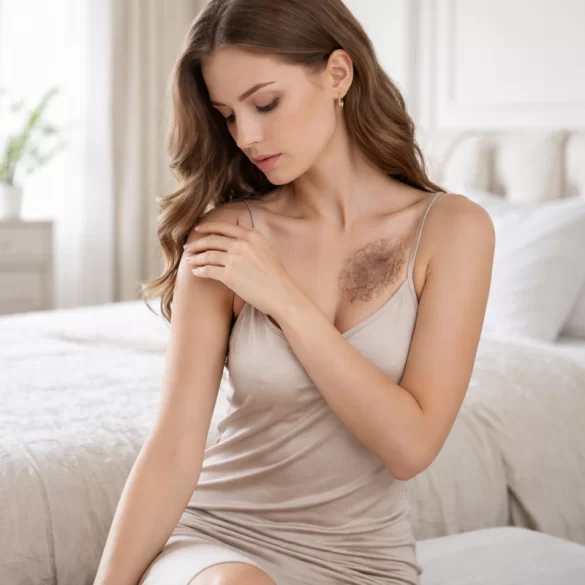

Becker's nevus (Latin: naevus Becker, Becker melanosis) is a benign, non-neoplastic developmental disorder of the skin, classified as one of the so-called epidermal-pigmentary nevi. It is characterized by a unilateral pigmented patch with an irregular outline, often accompanied by excessive hair growth (hypertrichosis). The lesion most commonly appears during adolescence and shows a marked prevalence in males, which is associated with the influence of androgens (male sex hormones) on its development. Becker's nevus is stable in nature, does not show malignant potential, but due to its location and extent can pose a significant aesthetic and psychological problem.
Becker's nevus – what is it
Becker's nevus is considered a hamartoma, which is a focal, congenital, or early-life manifestation of the overgrowth of normal skin elements in an abnormal proportion. Within it, the following can be observed:
- an increased number of melanocytes (pigment cells),
- enhanced melanin production,
- epidermal hyperplasia (acanthosis),
- an increased number of hair follicles and sebaceous glands.
The pathogenesis of the lesion is not fully understood. The most commonly suggested factors include:
- androgen receptor hypersensitivity in the skin,
- local embryological disturbances,
- occasionally – a genetic component (rare familial cases have been described).
The nevus usually develops between the ages of 10 and 20, enlarging with hormonal maturation. Becker nevus syndrome, where the skin lesion is accompanied by developmental abnormalities such as pectoral muscle hypoplasia or breast asymmetry, has also been described.
It is important to emphasize that Becker's nevus is not melanoma nor a precancerous condition and does not increase the risk of malignant transformation.
Becker's nevus – what it looks like
The clinical picture of Becker's nevus is characteristic, although the variable intensity of color and hairiness may make diagnosis difficult in the initial stage.
Typical features include:
- Unilateral, irregular patch of hyperpigmentation (color ranging from light brown to dark brown),
- Commonly located in areas such as:
- Shoulder,
- Upper chest,
- Scapula,
- Back,
- Gradual enlargement of the lesion during puberty,
- Presence of thick, dark hair (hypertrichosis) within the lesion,
- Sometimes thickening of the skin.
In dermoscopic examination, a reticular pigmentary structure is visible without atypical features. Diagnosis is primarily based on the clinical picture; skin biopsy is rarely performed, mainly in diagnostically uncertain cases.
In differential diagnosis, the following should be considered:
- Café-au-lait spots,
- Congenital melanocytic nevus,
- Lentigines,
- Rarely – early forms of atypical melanocytic lesions.
Becker's Nevus – Treatment
Becker's nevus does not require treatment for medical reasons because:
- it does not become malignant,
- it does not pose a systemic threat,
- it usually remains stable after adolescence.
The indication for therapy is almost exclusively the aesthetic aspect and the psychological discomfort of the patient.
Possible therapeutic strategies include:
1. Reduction of hyperpigmentation
- pigment laser therapy (e.g. Q-switched lasers),
- non-ablative fractional lasers,
- combination therapies (laser + depigmentation mesotherapy),
- superficial medical peels (with caution, due to limited efficacy).
Results vary and often require a series of treatments. Patients should be informed that complete removal of the pigmentation can be challenging.
2. Reduction of excessive hair growth
- laser hair removal (the most effective method for permanent hair reduction),
- possibly electrolysis in selected cases.
In clinical practice, a combined therapy is often used – first reducing hair, then gradually lightening the lesion.
Topical treatments (creams with hydroquinone, retinoids) have limited effectiveness and rarely lead to satisfactory improvement.
Becker's Nevus – removal
Complete surgical excision of Becker's nevus is usually not possible due to:
- the large area of the lesion,
- the risk of extensive scarring,
- the lack of oncological indications.
Therefore, the approach focuses on minimally invasive procedures, such as:
- fractional laser therapy to improve skin texture and tone,
- dye and pigment lasers,
- laser hair removal,
- procedures improving skin quality (e.g., microneedle radiofrequency to unify the epidermal structure).
In clinical practice, in aesthetic medicine centers such as Ambasada Urody in Warsaw, laser technologies and combined therapies are individually tailored to:
- skin phototype (Fitzpatrick classification),
- the extent of the lesion,
- the intensity of pigmentation,
- patient expectations.
It should be clearly noted that:
- the therapy is of an improving nature, not always completely eliminating the lesion,
- the risk of pigmentation recurrence exists,
- photoprotection (sun protection) is crucial during and after the therapy.
