Facial overfilling
back to main page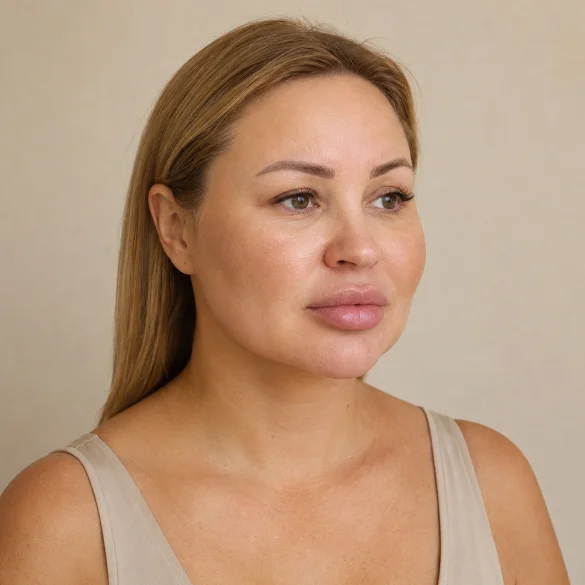

Facial overfilling is an undesirable effect of excessive, too frequent, or improperly planned use of fillers and other tissue-volumizing products. In English-language literature, the phenomenon is referred to as facial overfilled syndrome or overfilled face syndrome. The face may appear swollen, widened, and disproportionate, and its natural contours and facial expressions become blurred. The problem does not depend solely on the number of milliliters administered. Patient anatomy, product properties, the site and depth of its administration, the accumulation of previous deposits, material migration, and the ability of tissues to accommodate additional volume are also important. Furthermore, overfilling is not a diagnosis equivalent to any swelling or unsatisfactory aesthetic outcome. It requires professional clinical assessment, and sometimes also an ultrasound examination.
Facial overfilling - what is it
Facial overfilling means the disruption of its proportions, contours, or dynamics as a result of excessive volume of material or its incorrect placement. It most commonly concerns cross-linked hyaluronic acid, but a similar presentation may occur after fat grafting, permanent fillers, calcium hydroxylapatite, or biostimulatory products, especially when used without considering the cumulative effect of previous procedures [1–3].
There are currently no universally accepted, validated diagnostic criteria nor a single cutoff volume defining overfilling. The same amount of product may be appropriate for extensive volume loss in one patient, yet excessive in a small, low-compliance anatomical space in another person.
The following can lead to overfilling:
- excessive volume administered in a single session;
- frequent touch-up treatments performed before a full assessment of the remaining product;
- overlapping deposits, because the filler can persist in tissues longer than the visible clinical effect suggests;
- improper product selection, particularly regarding its elasticity, cohesivity, and water-binding capacity;
- injection into an inappropriate anatomical plane;
- migration or displacement of the gel under the influence of tissue pressure and muscle activity;
- impaired lymphatic drainage, particularly significant in the infraorbital area;
- treating a single fold without analyzing the entire face, its skeleton, fat compartments, and facial expressions.
Overfilling must be distinguished from short-term post-procedure edema, naturally wide facial structure, weight gain, lymphedema, thyroid, kidney, or heart diseases, inflammatory reactions, infections, late-onset inflammatory nodules, and granulomas. Therefore, not every fuller face is the result of an improperly performed procedure.
Facial overfilling - how to recognize it in yourself
The assessment should include the face both at rest and during smiling, speaking, pursing the lips, and raising the eyebrows. An early sign is often not so much a distinct enlargement of a single area, but rather the loss of individual features and smooth transitions between anatomical regions.
Possible signs of overfilling include:
- unnatural widening of the midface;
- excessively prominent, heavy, or chronically swollen cheeks;
- blurring of the boundary between the lower eyelid and the cheek;
- under-eye swelling, worsening in the morning or after fluid retention;
- bulging of the temporal region, forehead, or zygomatic arch;
- excessive lip projection, an effaced philtrum, or a filler ridge above the vermilion border;
- a disproportionately elongated, wide, or pointy chin;
- a heavy lower face and a less defined jawline;
- asymmetry or visible lumps;
- a bluish-gray translucency of superficially placed hyaluronic acid, known as the Tyndall effect;
- restricted tissue mobility, an unnatural smile, difficulty in fully lifting the upper lip, or a sensation of stiffness;
- a facial appearance that seems acceptable at rest but becomes disharmonious during facial expressions.
Self-assessment can be biased by perspective, lighting, and lens distortion. The most reliable method is comparing standardized photographs taken before the procedures and after the swelling has resolved, maintaining the same head position, focal length, and lighting.
In a medical examination, a history of all previous injections, visual inspection, palpation, and analysis of facial expressions are essential. High-frequency ultrasound can help determine the location and depth of deposits, distinguish filler from swelling or an inflammatory lesion, and plan precise treatment .
Severe pain, sudden pallor, marbled bruising of the skin, visual disturbances, drooping of the eyelid, or neurological symptoms are not typical aesthetic issues. They may indicate a vascular complication and require immediate medical attention.
Facial overfilling - why the patient stops seeing it
Gradual overfilling may go unnoticed due to perceptual adaptation, also referred to as shift in aesthetic baseline (perception drift). The visual system becomes accustomed to a regularly viewed image. After some time, the altered face begins to be perceived as a new point of reference, and a partial reduction of the initial effect may be interpreted as the complete disappearance of the product, even though its deposits are still present in the tissues .
The process may be facilitated by:
- frequent viewing of the face from a very close distance;
- using a front-facing camera, which distorts proportions due to a short focal length;
- digital filters and idealized standards disseminated on social media;
- focusing on a single area instead of the whole face;
- having consecutive procedures performed by different specialists without shared documentation;
- correcting isolated asymmetries, which within a certain range are a normal biological feature;
- gradual volume increase, making each individual change seem minor.
This does not mean that every person requesting another procedure has a psychological disorder. However, if dissatisfaction is extreme, time-consuming, leads to frequent consultations, or remains disproportionate to the visible feature, an evaluation for body dysmorphic disorder should be considered. Body dysmorphic disorder is a distinct clinical entity and should not be diagnosed solely based on a preference for pronounced aesthetic results [6].
It is helpful to establish periodic "checkpoints": photographs without filters, with the same positioning and lighting, and an independent assessment of the entire face by an experienced physician. Sometimes the safest decision is taking a break from volumizing procedures.
Facial overfilling - does the filler need to be dissolved
Not every overfill requires immediate or complete dissolution of the product. The management depends on the type of material, location, time elapsed since the procedure, severity of the deformity, the presence of swelling or inflammation, and the patient's expectations.
Possible strategies include:
- Observation
In the case of minor overcorrection without signs of complications, the decision can be deferred until the swelling subsides and the product partially biodegrades. However, one should not assume that every filler will disappear within the approximate timeframe stated by the manufacturer. - Targeted administration of hyaluronidase
Hyaluronidase enzymatically breaks down hyaluronic acid and is the primary method for correcting excess, migration, and many complications associated with HA fillers . Partial or complete dissolution is possible. At Ambasada Urody, hyaluronic acid dissolution with hyaluronidase is available, preceded by a consultation and, according to the procedure description, ultrasound localization of deposits. This allows limiting the administration of the enzyme to the area requiring correction. - Causal treatment of complications
Edema, infection, biofilm, inflammatory nodule, or granuloma require different management. Simply increasing the dose of hyaluronidase is not a substitute for proper diagnostics.
Hyaluronidase acts on hyaluronic acid fillers. It does not dissolve calcium hydroxyapatite, poly-L-lactic acid, polycaprolactone, PMMA, silicone, or transplanted fat tissue. In such cases, management may include observation, anti-inflammatory treatment, procedural correction, or, less frequently, surgical intervention.
The enzyme may also temporarily affect the natural hyaluronic acid of the extracellular matrix. Furthermore, pain, swelling, bruising, and hypersensitivity reactions have been described. Therefore, hyaluronidase should not be administered prophylactically, without a diagnosis, or self-administered. In the case of a vascular complication, the priority is prompt emergency treatment rather than watchful waiting .
Facial overfilling - how to avoid it
Prevention is based on treating the anatomy and the actual problem, rather than automatically topping up consecutive areas. Prior to the procedure, a complete injection history should be obtained, the face assessed at rest and in motion, photographic documentation performed, and it should be determined whether the predominant issue is volume loss, laxity, tissue displacement, deterioration of skin quality, or muscle activity.
The key safety principles are:
- planning the entire face instead of isolated “wrinkle filling”;
- using the smallest volume necessary to achieve the goal;
- staged treatment with reassessment once the effect has stabilized;
- avoiding “just in case” treatments and replenishing the product solely according to the calendar;
- matching the product rheology and the injection plane to the anatomy of a given area;
- maintaining a single record containing the product name, volume, date, and injection site;
- considering an ultrasound prior to further volumetry if the previous product is palpable, the effect is unclear, or documentation is incomplete;
- refraining from performing another injection in an area of unexplained swelling, pain, or inflammation;
- taking into account natural asymmetry, biological age, gender-specific facial features, and muscle mobility.
Ambasada Urody offers facial contouring with hyaluronic acid; however, in patients at risk of overfilling, it should only be considered after confirming genuine volume loss. When the primary issue is skin quality or laxity, an alternative to adding volume may be the clinic's tissue remodeling procedures: tissue stimulators and profiloplasty, platelet-rich plasma PRP and growth factors CGF, mesotherapy, microneedle radiofrequency, classic radiofrequency, HIFU SonoQueen, Zaffiro thermolifting, Palomar Deep IR, fractional lasers, microneedling, medical peels, and lifting threads. The selection must be individualized. Energy-based treatments, biostimulators, and threads do not remove excess filler and do not replace hyaluronidase when its use is indicated.
The most natural result is not about maximally smoothing out all hollows. The goal should be to preserve the patient's recognizable features, correct proportions, natural facial expressions, and facial harmony in the long term.

