Filler migration
back to main page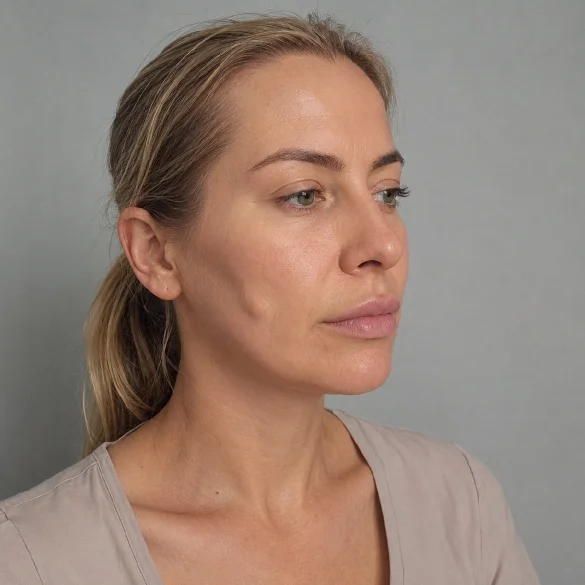

Filler migration is the displacement of the implanted material beyond the area where it was intended to achieve the desired aesthetic or reconstructive effect. The phenomenon primarily affects cross-linked hyaluronic acid, but it can also occur after the use of other products. It is most commonly identified around the lips and perioral tissues, where it can cause blurring of the vermilion border, bulging of the skin above the upper lip, asymmetry, or palpable thickening. However, not every post-treatment irregularity indicates migration. A similar presentation can be caused by swelling, an excessive amount of product, too superficial injection, an inflammatory reaction, or a post-procedure nodule. Therefore, the basis of proper management is a medical examination, and in inconclusive cases, also soft tissue ultrasound.
Filler migration - what is it
In the strict sense, filler migration means a change in the position of the product relative to the site of initial implantation. In clinical practice, however, this term is sometimes used more broadly, also referring to:
- the spread of the gel along tissue layers during the injection itself,
- administration of the product into an incorrect anatomical layer,
- overcorrection resulting in exceeding the natural boundaries of a given area,
- displacement of the filler due to muscle activity,
- long-term persistence of the product after repeatedly performed procedures.
A hyaluronic acid-based filler is a cross-linked, hydrophilic gel, which is a material capable of binding water. Its behavior in tissues depends, among other things, on the degree of cross-linking, elasticity, viscosity, cohesivity, swelling capacity, and resistance to deformation. The volume of the product, depth of administration, injection pressure, and patient tissue characteristics are also important.
The material can move along planes of least resistance, connective tissue septa, fat compartments, or muscle fibers. This is not always active migration occurring after many months. Sometimes the product is located outside the optimal layer from the very beginning, but becomes visible only after the swelling subsides, the gel properties change, or after a subsequent correction.
Migration is not the same as ischemia caused by vascular occlusion. Sudden, severe pain, pallor, mottled bruising of the skin, sensory disturbances, or visual impairment after filler administration are warning signs and require immediate medical intervention.
Filler migration - how to recognize it
The clinical picture depends on the type of product, the injection site, and the direction of displacement. In the lip area, a band-like protrusion of the skin above the vermilion border can be characteristic. The alteration is sometimes colloquially referred to as a „filler ridge” or „filler mustache”. In other facial areas, migration can cause unnatural transitions between anatomical compartments, chronic swelling, or disrupted proportions.
Symptoms suggesting migration or incorrect distribution of the product include:
- blurring of the distinct vermilion border,
- a visible protrusion above the upper or below the lower lip,
- excessive lip projection in profile,
- asymmetry persisting after post-procedure swelling has subsided,
- soft, elastic, or firm lumps,
- irregularities worsening when smiling and speaking,
- chronic swelling,
- a bluish-gray translucency of the product under the skin, known as the Tyndall effect.
A diagnosis should not be made solely on the basis of photographs. The medical examination includes a history regarding the type and amount of previously administered products, the timing of the procedures, the dynamics of the changes, and the presence of pain, redness, and episodes of swelling. The face is assessed at rest, in profile, and during movement, followed by a palpation examination.
High-frequency ultrasound makes it possible to determine the location and extent of filler deposits and their relationship to the skin, subcutaneous tissue, muscles, and vessels. It also helps differentiate the filler material from edema, fibrosis, an abscess, or an inflammatory nodule. At Ambasada Urody, hyaluronic acid dissolution preceded by soft tissue ultrasound diagnostics is available. This allows for planning the targeted administration of hyaluronidase into the misplaced deposit.
Tenderness, increased warmth, redness, periodic severe swelling, or hard nodules may indicate an inflammatory or infectious complication rather than isolated migration. In such cases, management requires separate diagnostics.
Filler migration - why it occurs most often in the lips
The lips are a structure of low volume, very rich vascularization, and exceptionally high mobility. The orbicularis oris muscle participates in speaking, eating, facial expressions, and closing the oral fissure. Repetitive shear forces and pressure exerted on the gel can promote its spread, especially when the product is located intramuscularly or was administered in excessive amounts.
Ultrasound studies indicate that the thin layer of soft tissue in the lips may not provide a distinct, uniform space capable of confining the deposit. The filler may reside between the fibers of the marginal part of the orbicularis oris muscle and spread along the course of the anatomical structures.
The risk of improper distribution is increased primarily by:
- excessive product volume, especially when administered during subsequent procedures before a full assessment of the remaining material;
- too superficial or improper injection layer;
- inadequate rheological properties of the gel, for example, excessive swelling capacity relative to tissue capabilities;
- multiple vertical punctures and deposits crossing the vermilion border;
- high injection pressure or large portions of the product in a single site;
- previous procedures, residual filler, scarring, and altered tissue compliance;
- intense activity of the orbicularis oris muscle;
- individual anatomy and low tissue capacity.
Massage performed immediately after the procedure, if recommended by the physician, can serve to correct minor irregularities. However, intense self-manipulation of the lips is not a method for treating confirmed migration. One should also not attempt to mechanically „shift” a fixed deposit.
Filler migration - will it go away on its own
Hyaluronic acid-based fillers are biodegradable materials. They undergo gradual fragmentation under the influence of enzymatic, oxidative, and mechanical processes. This means that minor displacement may become less visible over time. However, the exact rate of product degradation cannot be predicted based on the date of the procedure alone.
Longevity depends on the gel structure, its degree of cross-linking, volume, location, and the patient's metabolism. Ultrasound and magnetic resonance imaging have shown that the material can remain in the tissues much longer than the duration of the visible aesthetic effect would suggest. Subsequent injections may therefore overlap with the remnants of previous deposits.
Observation can be considered when the change is minor, stable, painless, and does not cause significant contour distortion. On the other hand, persistent deformity, asymmetry, chronic swelling, or discomfort are indications for a medical consultation.
It should not be assumed that every change will resolve spontaneously. Non-hyaluronic fillers, such as calcium hydroxyapatite, poly-L-lactic acid, polymethyl methacrylate, or silicone, are not broken down by hyaluronidase. Their identification is essential for the choice of treatment.
Filler migration - how to remove it
The treatment method depends on the composition of the product, its location, the extent of the lesion, and the presence of inflammation or infection. In the case of cross-linked hyaluronic acid, the primary method is dissolving the product with hyaluronidase. The enzyme hydrolyzes glycosidic bonds in hyaluronic acid molecules, reducing the cohesiveness of the gel and facilitating its elimination from the tissues.
The procedure usually includes:
- a medical interview and evaluation of documentation from previous treatments;
- facial examination at rest and during facial expressions;
- localization of the deposit by palpation or using ultrasound;
- targeted administration of hyaluronidase by a physician;
- assessment of the result after the swelling subsides;
- possible staged administration of a subsequent dose if part of the product remains.
Hyaluronidase doses are not universal. Different fillers exhibit varying susceptibility to the enzyme, depending, among other factors, on the concentration of hyaluronic acid, the cross-linking method, and the cohesion of the gel. Therefore, the dose is tailored to the clinical picture, the area of the lesion, and the response to treatment. Attempting to completely dissolve a large deposit in a single session is not always necessary.
Hyaluronidase may also temporarily affect the physiological hyaluronic acid of the extracellular matrix, which is subsequently regenerated metabolically. Swelling, redness, tenderness, bruising, and short-term volume loss may occur after the procedure. A rare but significant adverse effect is a hypersensitivity reaction, including anaphylaxis. The procedure should be performed in a facility prepared to recognize and treat such complications.
In the Ambasada Urody offer, the services directly related to the issue discussed are:
- soft tissue ultrasound diagnostics, used to confirm the presence and location of the filler;
- hyaluronic acid dissolving with hyaluronidase, performed as a total or partial correction depending on indications.
Re-modeling the lips with hyaluronic acid can only be considered after the tissues have healed and the anatomy has been re-evaluated. It does not constitute a treatment for migration, but rather an optional subsequent stage of correction. Administering additional filler to camouflage a displaced deposit can increase tissue overload and worsen the deformity.

