Sagging belly
back to main page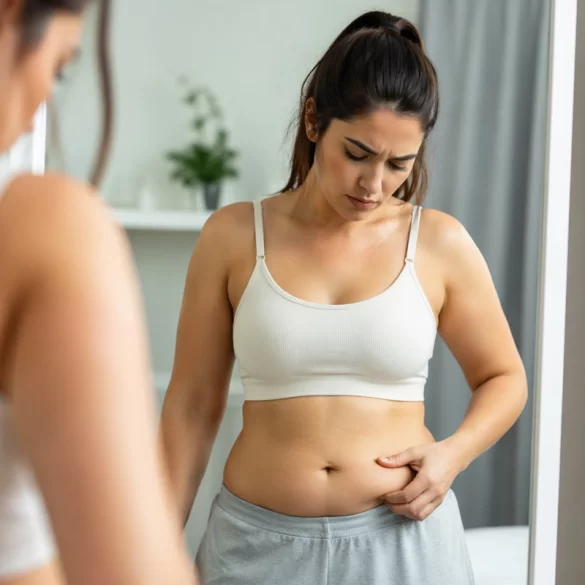

A sagging abdomen is a condition characterized by a loss of tone and elasticity of the abdominal walls, leading to excess skin and often coexisting accumulation of adipose tissue. This problem has a complex etiology and includes both structural changes within the skin (degradation of collagen and elastin) as well as muscle tone disorders and the redistribution of adipose tissue. Abdominal sagging can be aesthetic, functional, or mixed in nature, and its severity depends on age, lifestyle, genetic predisposition, and past body weight changes, including pregnancy. Modern medicine distinguishes several mechanisms leading to this condition, allowing for the selection of precise therapeutic methods.
Sagging belly – causes
The formation of a sagging abdomen is the result of the interaction of many biological and mechanical factors. Skin aging processes play a key role, leading to a reduction in the synthesis of type I and III collagen and the degradation of elastin fibers. As a result, there is a loss of elasticity and the skin's ability to return to its original shape.
The most important causes include:
- rapid weight loss – especially after obesity, when the skin remains stretched,
- pregnancies – repeated stretching of the abdominal walls and diastasis recti,
- aging of the body – reduction in fibroblast activity and a decline in anabolic hormone levels,
- excess visceral and subcutaneous adipose tissue – increasing the volume of the abdominal cavity,
- lack of physical activity – leading to the weakening of deep (core) muscles,
- genetic factors – determining the quality of connective tissue.
At the histological level, the following are observed:
- fragmentation of collagen fibers,
- reduction in the density of the extracellular matrix,
- disturbances in skin microcirculation.
Additionally, an important element is the weakening of fascial and muscular structures, which affects the loss of support for the abdominal walls. Consequently, abdominal sagging is not only a skin problem but also a functional one, related to the biomechanics of the entire torso.
Saggy belly – exercises
Conservative management primarily includes appropriately selected physical activity, the aim of which is to improve muscle tone and reduce body fat. However, it should be emphasized that exercises do not eliminate excess skin, but can significantly improve the appearance of the abdomen by strengthening its muscular framework.
Exercises engaging the deep muscles (core) are of the greatest importance, including:
- transversus abdominis muscle – stabilizing the abdominal wall,
- abdominal oblique muscles – responsible for rotation and stabilization,
- pelvic floor muscles – supporting internal structures.
Recommended forms of activity include:
- isometric exercises (e.g., plank),
- functional training,
- pilates and medical training,
- breathing exercises activating the transversus muscle,
- resistance training of moderate intensity.
In the case of diastasis recti abdominis, it is necessary to use targeted therapy, often under the supervision of a urogynaecological physiotherapist. Improperly selected exercises (e.g., classic crunches) can aggravate the problem.
The effects of exercises include:
- improvement of muscle tone,
- reduction of abdominal circumference,
- postural stabilization,
- improvement of biomechanical functions.
However, it should be clearly stated that with significant excess skin or its advanced laxity, physical activity plays a supporting role and requires supplementation with medical procedures.
Sagging belly – treatments
Modern aesthetic medicine and surgery offer a wide spectrum of methods for abdominal sagging reduction, the selection of which depends on the severity of the problem, skin quality, and the presence of excess fat tissue.
Non-invasive and minimally invasive procedures
Used in case of moderate skin laxity:
- radiofrequency (RF) – tissue heating leading to contraction of collagen fibers and stimulation of neocollagenesis,
- HIFU (high-intensity focused ultrasound) – acting on deep layers of skin and fascia, lifting effect,
- LPG endermologie – mechanical skin stimulation and improvement of microcirculation,
- carboxytherapy – improvement of tissue oxygenation and metabolism,
- needle and microneedle mesotherapy – delivery of active substances and stimulation of regeneration,
- INDIBA-type technologies – using radiofrequency current to improve tissue tension and regeneration.
Effects:
- skin tension improvement,
- dermis thickening,
- laxity reduction,
- improvement of skin quality.
Fat tissue reduction procedures
In case of coexisting adiposity:
- cryolipolysis – selective destruction of adipocytes through controlled cooling,
- injection lipolysis – breakdown of fat cells using active substances,
- ultrasound and acoustic waves – breaking down fat cells and improving metabolism.
Surgical procedures
In advanced cases:
- abdominoplasty (tummy tuck) – removal of excess skin and fat tissue and muscle reconstruction,
- mini-abdominoplasty – a limited procedure for the lower abdomen.
Surgical procedures are the most radical and effective method in case of significant sagging, but they require appropriate medical qualification and a recovery period.
Mechanism of action of the therapies
The common denominator of most procedures is:
- stimulation of fibroblasts,
- induction of neocollagenesis and neoelastogenesis,
- improvement of microcirculation and tissue metabolism,
- fat tissue volume reduction.
Optimal effects are achieved through combined therapies, tailored individually to the patient.

