Atrophic Scars
back to main page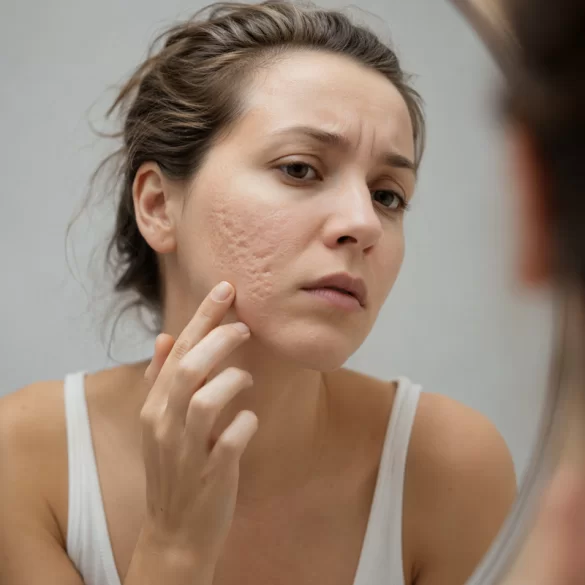

Atrophic scars are a specific type of scarring characterized by the loss of skin tissue, which leads to the formation of depressions or irregularities on the skin surface. They result from an abnormal healing process in which there is insufficient production of collagen and elastin—key proteins responsible for skin structure and elasticity. They are most commonly observed after acne, chickenpox, or mechanical trauma. These changes are not only aesthetic in nature but can also affect skin function, particularly in the case of extensive tissue loss.
Atrophic scars – what are they
Atrophic scars are the result of impaired regeneration of the dermis, in which the process of collagen synthesis (collagenesis) is insufficient relative to the degradation of the extracellular matrix. As a consequence, permanent depressions in the skin structure occur.
In dermatology, several basic types of atrophic scars are distinguished:
- ice-pick scars – narrow, deep, resembling needle punctures,
- boxcar scars – with clearly defined edges and a flat base,
- rolling scars – with a wavy appearance, associated with fibrous subcutaneous bands.
The most common cause of their formation is inflammatory acne, in which damage to the deep layers of the skin occurs. The following are also of significant importance:
- chronic skin inflammation,
- viral infections (e.g., chickenpox),
- mechanical injuries and burns,
- genetic predispositions affecting the healing process.
At the histological level, the following are observed:
- reduced amount of type I and III collagen fibers,
- disrupted architecture of the dermis,
- reduction in the number of fibroblasts (collagen-producing cells),
- thinning of the epidermis.
Atrophic scars are most often located on the:
- face (especially cheeks, temples, forehead),
- back and chest,
- shoulders.
Their presence can significantly affect the patient's quality of life, especially in the context of facial aesthetics, which justifies the need to implement effective therapeutic methods.
Atrophic scars – treatment
Treatment of atrophic scars is one of the greatest challenges of modern dermatology and aesthetic medicine, due to their permanent nature and complex mechanism of formation. Therapy is primarily focused on stimulating collagen production, skin remodeling, and evening out its surface.
Procedural methods used in clinical practice
1. Fractional laser therapy (ablative and non-ablative)
Fractional laser creates controlled micro-injuries in the skin, which activates regenerative processes and collagen synthesis.
Effects:
- smoothing of the skin surface,
- reduction of scar depth,
- improvement of skin tension.
2. Microneedling (microneedle mesotherapy)
The procedure involves mechanical damage to the skin using microneedles, which stimulates fibroblasts to produce collagen.
Often combined with the administration of active substances (e.g., platelet-rich plasma).
3. Microneedle radiofrequency (RF)
A technology combining microneedling with radiofrequency energy, which heats the tissues, intensifying the skin remodeling process.
Effects:
- skin densification,
- reduction of scar depth,
- improvement of skin structure.
4. Subcision (scar subcision)
A surgical procedure involving the mechanical cutting of fibrous bands pulling the skin downwards.
Allows for:
- lifting the base of the scar,
- improvement of the skin contour.
5. Tissue fillers (e.g., hyaluronic acid)
Used for the immediate lifting of sunken areas.
The effect is:
- fast,
- temporary (requires repetition).
6. Chemical peels (e.g., TCA, glycolic acid)
They cause controlled skin exfoliation and stimulation of regeneration.
Most commonly used in the treatment of superficial scars.
Supportive therapies and modern technologies
In the practice of aesthetic medicine clinics, technologies supporting skin regeneration are also used:
- carboxytherapy – improvement of microcirculation and tissue oxygenation,
- platelet-rich plasma (PRP) – delivery of growth factors stimulating regeneration,
- LED light therapies – anti-inflammatory and regenerative effects,
- combined treatments (combined therapies) – increasing the effectiveness of treatment.
Therapy characteristics
| Method | Depth of action | Recovery time | Effectiveness |
|---|---|---|---|
| high | medium–high | very high | |
| Microneedling | medium | low | high |
| Microneedle RF | high | medium | very high |
| Subcision | deep | medium | high |
| superficial | low | moderate |
Key principles of therapy
- treatment requires an individual therapeutic plan,
- combined therapies yield the best results,
- consistency and a series of treatments are necessary,
- prevention (e.g., acne treatment at an early stage) is of significant importance.
It is worth emphasizing that the complete removal of atrophic scars remains difficult; however, modern medicine enables their significant reduction and improvement of skin quality to a clinically satisfactory level.

