Post-acne discoloration
back to main page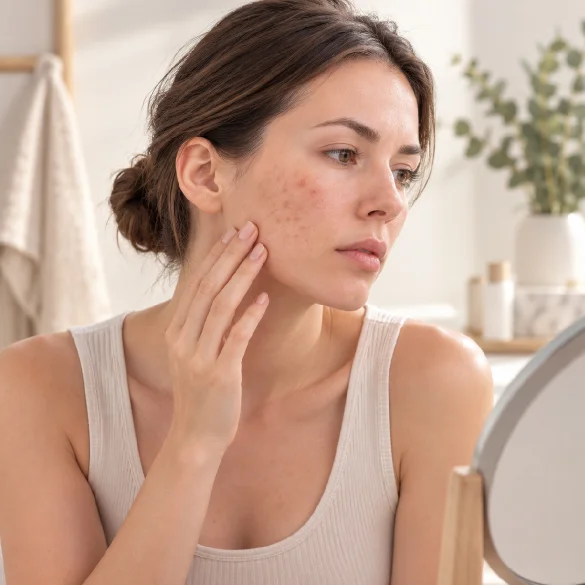

Post-acne discolorations are among the most common consequences of acne and often persist much longer than the inflammatory lesions themselves. For many people, they represent a greater aesthetic problem than active acne, because they give the skin an uneven tone, make the skin look tired, and make it difficult to achieve a uniform complexion.
Post-acne discolorations are not scars. They are the result of excessive melanin production at the site of previous inflammation. The stronger and more prolonged the inflammatory process, the higher the risk of developing persistent pigmentary changes.
In dermatology, post-acne discolorations are referred to as post-inflammatory hyperpigmentation (Post-Inflammatory Hyperpigmentation, PIH). They can occur in people of any age, both after adolescent acne and adult acne.
They most commonly appear on:
- face,
- cheeks,
- chin,
- forehead,
- temples,
- back,
- chest.
The color of the lesions depends on the depth of melanin deposition and the skin phototype. They can take on shades of:
- light brown,
- dark brown,
- grey-brown,
- deep brown,
- sometimes slightly purple.
Without proper treatment, discolorations can persist from a few months to even several years.
Post-acne discoloration - the difference between discoloration and an acne scar
Many people use these terms interchangeably, but from a medical point of view, they are two completely different problems requiring different treatment.
Post-acne discoloration
Discoloration is a change in skin color.
It is formed as a result of stimulation of melanocytes by inflammation and increased melanin production. The skin structure remains normal, only its color changes.
Characteristic features:
- the skin surface remains smooth,
- there is no indentation or protrusion,
- the change is purely pigmentary in nature,
- over time it may gradually fade on its own,
- it responds well to appropriately selected treatments and depigmentation therapy.
Post-acne scar
A scar is permanent damage to the skin structure.
It is formed as a result of the destruction of collagen fibers during an intense inflammatory process and abnormal healing.
Most commonly observed are:
- atrophic scars,
- ice pick scars,
- boxcar scars,
- rolling scars,
- less frequently, hypertrophic scars.
In the case of scars, skin remodeling is necessary by stimulating the production of new collagen. Treatment includes, among others, fractional laser therapy, microneedle radiofrequency, microneedling, or tissue biostimulators.
In practice, discoloration and scars very often coexist, which is why the treatment plan should take into account both problems simultaneously.
Post-acne discoloration - why dark skin is more prone
The risk of post-inflammatory hyperpigmentation increases with the melanin content in the skin.
People with phototypes III-VI according to the Fitzpatrick classification have more active melanocytes, which react much more strongly to any inflammation. Even a small pimple can leave a dark mark that persists for many months.
Factors that increase the risk of PIH include:
- higher skin phototype,
- chronic inflammatory acne,
- squeezing lesions,
- picking at the skin,
- excessive exposure to UV radiation,
- lack of daily sun protection,
- inappropriately selected cosmetics that irritate the skin.
Research shows that in people with a darker complexion, post-inflammatory hyperpigmentation can develop even after minor inflammation or brief skin injuries.
For this reason, acne treatment in people with darker phototypes should include not only the control of inflammatory lesions, but also the prevention of discoloration.
Particularly important are:
- daily SPF 50+ photoprotection,
- quickly soothing inflammation,
- avoiding mechanical damage to the skin,
- appropriately selected skincare supporting the regeneration of the epidermal barrier.
Post-acne discoloration - how not to squeeze pimples so as not to leave marks
The best way to prevent discoloration is not to squeeze acne lesions.
Mechanical damage to the skin leads to much stronger inflammation, damage to blood vessels, and stimulation of melanocytes to intensive melanin production.
During squeezing, the following also occurs:
- transferring bacteria to deeper layers of the skin,
- spreading the infection,
- damaging hair follicles,
- prolonging the healing process,
- increasing the risk of developing both discoloration and permanent scars.
If a lesion requires draining, it is much safer to have professional skin cleansing performed in a cosmetological or dermatological clinic than to interfere with the skin yourself.
In daily prevention, it is worth remembering a few rules:
- not touching the face with dirty hands,
- not scratching healing lesions,
- not removing scabs,
- using anti-inflammatory products in accordance with a specialist's recommendations,
- regularly using a cream with a high SPF filter.
Any additional skin damage increases the risk of permanent pigmentation changes.
Post-acne discoloration - brightening treatments
Modern cosmetology and aesthetic medicine offer many effective methods of reducing post-acne discoloration. Proper diagnosis, determining the depth of the lesions, and individual customization of therapy are of key importance.
The best results are obtained by combining several therapeutic methods, because discoloration occurs at different levels of the skin and has a complex mechanism.
The most effective treatments include:
- Chemical peels – controlled exfoliation of the epidermis accelerates the removal of cells containing excess melanin, evens out skin tone, and stimulates its renewal.
- Fractional laser therapy – stimulates skin remodeling while simultaneously reducing discoloration and minor post-acne scars.
- Laser removal of discoloration – utilizes the phenomenon of selective photothermolysis, thanks to which laser energy selectively breaks down the accumulated pigment without damaging the surrounding tissues.
- IPL photorejuvenation – effectively reduces superficial discoloration, improves skin tone, and reduces post-inflammatory redness.
- Microneedle radiofrequency – improves skin quality, supports collagen remodeling, and is a valuable complement to therapy in patients with simultaneous discoloration and scars.
- Microneedle mesotherapy – increases the penetration of depigmenting substances and stimulates the skin's natural regenerative processes.
- Therapies with tranexamic acid, vitamin C, niacinamide, and growth factors – limit the activity of melanocytes, reduce inflammation, and support the lightening of lesions.
- Depigmenting cosmeceuticals – properly selected home care with substances such as azelaic acid, retinoids, kojic acid, arbutin, or cysteamine is an essential element of effective therapy.
Treatment of post-acne discoloration requires patience and consistency. Visible brightening usually appears gradually over several weeks or months, and the durability of the effects depends on proper care, effective acne control, and consistent use of high sun protection throughout the year.

