Post-inflammatory hyperpigmentation
back to main page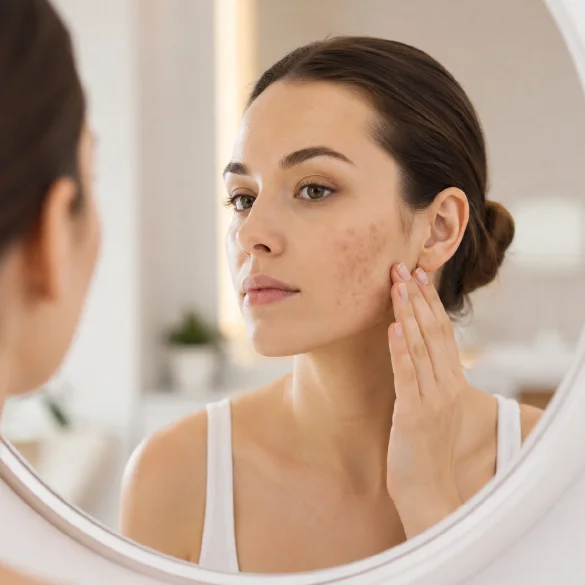

Post-inflammatory hyperpigmentation (PIH, post-inflammatory hyperpigmentation) is one of the most common skin pigmentation disorders. It occurs as a result of inflammation, injury, or skin damage and represents a natural stage of the healing process. It can appear after acne, aesthetic procedures, burns, abrasions, allergic reactions, insect bites, or dermatological diseases.
Although it does not pose a health threat itself, it often persists for many months, worsens skin aesthetics, and significantly affects patients' well-being. In many cases, its treatment requires a comprehensive approach including in-office therapy, home care, and consistent photoprotection.
The process of post-inflammatory hyperpigmentation formation begins at the moment of skin damage. Inflammatory mediators stimulate melanocytes to increase melanin production, which accumulates in the epidermis or deeper - in the dermis. The stronger and longer-lasting the inflammation, the greater the risk of the pigmentation changes becoming fixed.
The highest treatment efficacy is achieved when therapy begins as early as possible, before excess melanin becomes fixed in the deeper layers of the skin.
Post-inflammatory discoloration - how long does it last on the skin?
The duration of post-inflammatory hyperpigmentation depends on the depth of the lesions, skin type, severity of inflammation, and daily sun protection. In some people, the lesions resolve spontaneously, but this process can be very long-lasting.
The most important factors affecting the duration of hyperpigmentation are:
- Location of melanin - hyperpigmentation located solely in the epidermis usually fades much faster than lesions involving the dermis.
- Severity of previous inflammation - the greater the inflammatory process, the more melanin was produced.
- Skin phototype - people with darker complexions (phototypes III-VI) are much more likely to develop intense and long-lasting post-inflammatory hyperpigmentation.
- Exposure to UV radiation and visible light - even a small amount of radiation can reactivate melanocytes and perpetuate the changes.
- Skin regeneration rate - with age, the cell renewal process slows down.
Estimated duration of the lesions:
- minor epidermal hyperpigmentation - from a few weeks to several months,
- deeper hyperpigmentation - from 6 to even 24 months,
- hyperpigmentation that has become permanent without treatment can remain visible for many years.
Contrary to popular belief, the fading of hyperpigmentation does not always mean complete normalization of melanocyte activity. The skin remains more susceptible to the recurrence of pigmentary changes after each subsequent inflammation for a long time.
Post-inflammatory discolorations – the difference between red and brown post-inflammatory discoloration
Patients very often refer to all acne marks as discoloration. In reality, red and brown spots have a completely different biological basis and require a different approach.
Red post-inflammatory marks (PIE)
Red discolorations, referred to as post-inflammatory erythema (PIE - Post Inflammatory Erythema), are not pigmentary discolorations.
They occur as a result of:
- dilation of small blood vessels,
- damage to microcirculation,
- a persistent inflammatory process,
- increased blood supply to the skin during healing.
Characteristic features:
- pink, red, or red-purple color,
- they fade under pressure,
- they occur more frequently in people with fair complexions,
- they respond best to vascular treatment (dye laser, KTP, IPL for appropriate indications).
Brown post-inflammatory discolorations (PIH)
Brown discolorations result from the excessive accumulation of melanin.
Their features:
- light brown, dark brown, or grey-brown color,
- they do not fade under pressure,
- they occur more frequently in people with a darker skin phototype,
- they require therapy aimed at reducing excess melanin.
Distinguishing between the two lesions is of great importance, as using the wrong laser or an inappropriate treatment can prolong treatment or even worsen the problem.
In clinical practice, the coexistence of both lesions - erythema and pigmentary discoloration - is also frequently observed, which is why the treatment plan should always be individually tailored to the skin's condition.
Post-inflammatory discoloration – treatments for discoloration
Modern treatment of post-inflammatory hyperpigmentation is based on multidirectional therapy. The goal is not only to remove existing melanin, but also to inhibit its further production and reduce chronic inflammation.
The choice of methods depends on:
- the depth of the hyperpigmentation,
- duration of its persistence,
- skin phototype,
- the cause of the lesions,
- coexisting dermatological problems.
The most commonly used methods include:
Controlled exfoliation of the epidermis accelerates the removal of cells containing excess melanin and stimulates skin renewal.
The most commonly used are:
- mandelic acid,
- glycolic acid,
- pyruvic acid,
- salicylic acid,
- azelaic acid,
- multicomponent peels.
Regularly performed series of treatments allow for the gradual lightening of hyperpigmentation and improve skin structure.
Laser therapy
Pigment lasers enable selective breakdown of accumulated melanin without damaging surrounding tissues.
Depending on the type of hyperpigmentation, the following are used, among others:
- picosecond lasers,
- Q-Switched lasers,
- selected fractional lasers,
- IPL technologies in appropriately selected indications.
Laser therapy requires special caution in individuals with darker skin phototypes, as improperly selected parameters can trigger further post-inflammatory hyperpigmentation.
Depigmentation therapies
Therapies combining the following are increasingly used:
- ingredients inhibiting tyrosinase activity,
- anti-inflammatory substances,
- antioxidants,
- preparations accelerating skin regeneration.
Such an approach reduces the risk of recurrence and improves the durability of the results.
Microneedling and mesotherapy
In appropriately selected cases, treatments that stimulate skin remodeling improve its regeneration and support the gradual evening out of skin tone.
A prerequisite for safety is the complete resolution of the active inflammatory process before starting therapy.
Photoprotection as an element of treatment
No therapy for post-inflammatory hyperpigmentation will be effective without daily sun protection.
The following is recommended:
- using SPF 50+ filters all year round,
- protection also against visible light (HEV),
- regularly reapplying the protective product during the day,
- limiting exposure to intense UV radiation.
It is systematic photoprotection that reduces the risk of hyperpigmentation recurrence to the greatest extent after the completion of treatment.
Effective therapy for post-inflammatory hyperpigmentation requires patience and an individual treatment plan. The combination of appropriately selected treatments, professional care, and consistent sun protection allows for the gradual recovery of an even skin tone and significantly reduces the risk of new pigmentation lesions forming.

