Warts
back to main page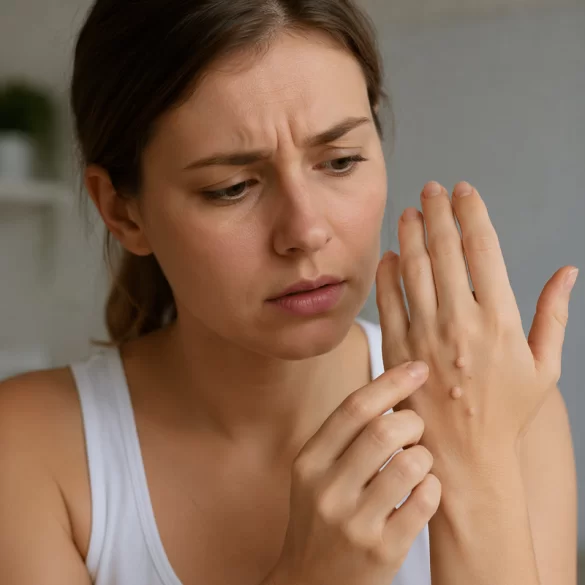
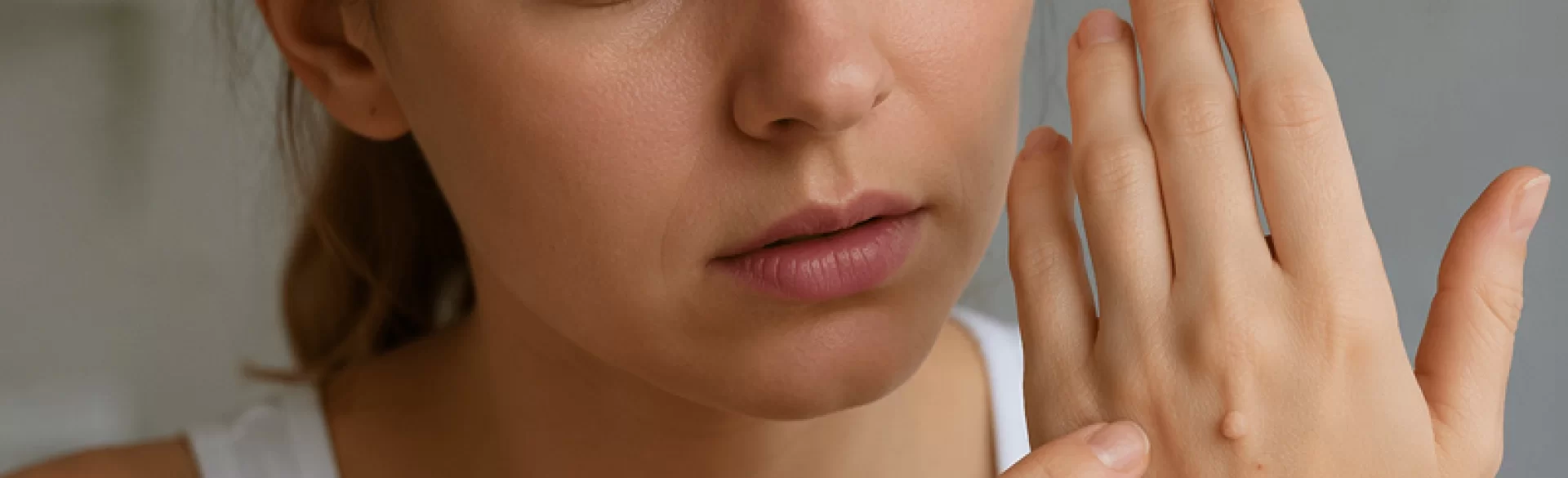
Warts, also referred to as viral warts, are benign skin lesions caused by infection with the human papillomavirus (HPV – Human Papillomavirus). They most commonly appear on the hands, feet, and around the nails, although they can also occur in other locations. They are characterized by a varied appearance and clinical course, and their presence results from a local infection of the epidermis. Warts tend to spread through autoinoculation, i.e., the transfer of the virus to other areas of the skin, as well as through direct or indirect contact.
Warts – what are they
Warts are hyperkeratotic lesions, meaning they are associated with excessive keratinization of the epidermis, resulting from infection with specific types of the HPV virus (most commonly types 1, 2, 4, 27, and 57). This virus infects keratinocytes – epidermal cells – leading to their excessive proliferation and differentiation disorders.
These lesions are benign in nature; however, their presence is associated with a chronic course and a tendency to recur. Depending on the location and type, the following are distinguished, among others:
- common warts (verrucae vulgares) – most commonly on the hands,
- plantar warts (verrucae plantares) – on the feet, often painful,
- flat warts (verrucae planae) – small, numerous, common in children and adolescents,
- periungual warts – difficult to treat, associated with micro-traumas.
The natural course of warts can be self-limiting – in some cases, they undergo spontaneous resolution as a result of the body's immune response.
Warts – where they come from
The direct cause of warts is infection with the HPV virus, which enters the body through micro-damage to the skin. Infection most often occurs in conditions conducive to moisture and epidermal damage.
Factors that increase the risk of infection include:
- direct contact with an infected person,
- using public spaces (swimming pools, saunas, gyms),
- walking barefoot in damp places,
- lowered immunity,
- skin micro-traumas (e.g., nail biting, shaving),
- excessive sweating (hyperhidrosis),
- chronic systemic diseases.
The HPV virus exhibits a high ability to survive in the external environment, which is why indirect transmission (e.g., through towels, footwear) also plays a significant role.
An important mechanism for the spread of warts is autoinoculation, i.e., the transfer of the virus from one lesion to other areas of the skin through scratching or mechanical damage to the lesions.
Warts – what they look like
The clinical presentation of warts depends on their type and location. Lesions may vary in size, shape, and degree of keratinization.
Typical features of warts include:
- a rough, uneven surface,
- color ranging from flesh-toned to grayish-brown,
- clear demarcation from the surrounding skin,
- the presence of small black dots (thrombosed blood vessels),
- a tendency to grow and merge into larger clusters.
In the case of plantar warts, the following are characteristic:
- pain during walking, resulting from pressure,
- penetration of the lesion deep into the skin (as opposed to calluses),
- a surrounding layer of keratinized epidermis.
Flat warts, on the other hand, have:
- a smooth surface,
- small size (1-5 mm),
- a tendency to occur in clusters.
Differential diagnosis includes calluses, corns, seborrheic keratosis, or neoplastic lesions, among others; therefore, in the case of an atypical presentation, a dermatological consultation is recommended.
Warts – treatment
Treatment of warts requires an individual and often long-term approach, because the HPV virus can persist in the epidermis despite the removal of the visible lesion. The therapy aims at both the elimination of lesions and the stimulation of the immune response.
The basic treatment methods include:
Topical treatment
- keratolytic preparations (salicylic, lactic acid),
- cytotoxic agents (e.g., podophyllotoxin),
- immunomodulating preparations.
Cryotherapy (freezing)
- use of liquid nitrogen,
- causes necrosis of infected tissues,
- requires a series of treatments.
Electrocoagulation
- removal of lesions using electric current,
- effective for single lesions.
Laser therapy
- precise destruction of the lesion and nourishing vessels,
- lower risk of recurrence with the appropriate selection of parameters.
Systemic treatment (less frequent)
- used for numerous, resistant lesions,
- includes immunomodulating drugs.
It is worth emphasizing that:
- therapy can last from several weeks to several months,
- recurrences are common,
- effectiveness depends on the patient's immunity and the type of wart.
Self-removal of lesions (e.g., mechanical excision) increases the risk of spreading the virus and complications.
Wart treatments
Modern aesthetic medicine and dermatology offer effective, minimally invasive methods for removing warts, especially in the case of lesions resistant to home treatment.
The most commonly used procedures include:
- fractional and ablative laser therapy
Precise evaporation of altered tissues and closure of blood vessels. A method effective for deep and recurrent lesions.
- vascular laser (e.g., Nd:YAG)
It works by coagulating the vessels nourishing the wart, leading to its gradual necrosis.
- medical cryotherapy
Controlled freezing of lesions with liquid nitrogen – one of the most commonly used methods.
- electrocoagulation and curettage
Mechanical removal of the lesion after its prior destruction with electrical energy.
- combined therapies
In clinical practice, a combination of methods is often used (e.g., laser + topical preparations), which increases the effectiveness of treatment.
The choice of method depends on:
- the location of the lesion,
- the number of warts,
- the depth of infiltration,
- the patient's age and their immunological state.
In specialist settings, such as aesthetic medicine clinics, it is possible to use technologies that allow for precise, safe, and aesthetic removal of lesions with minimal risk of scarring.

