Phases of hair growth
back to main page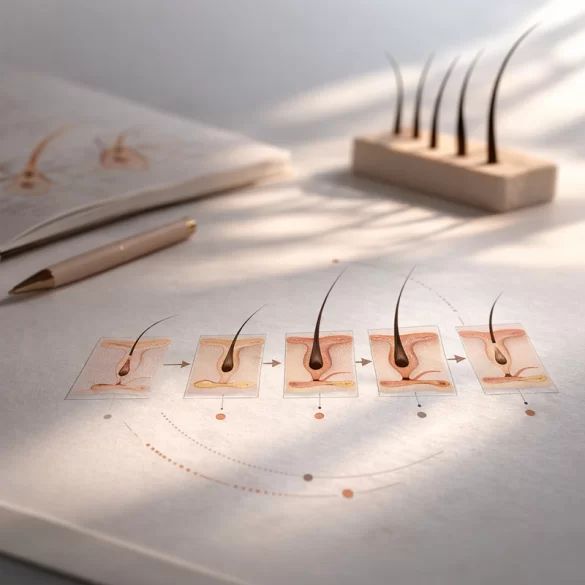
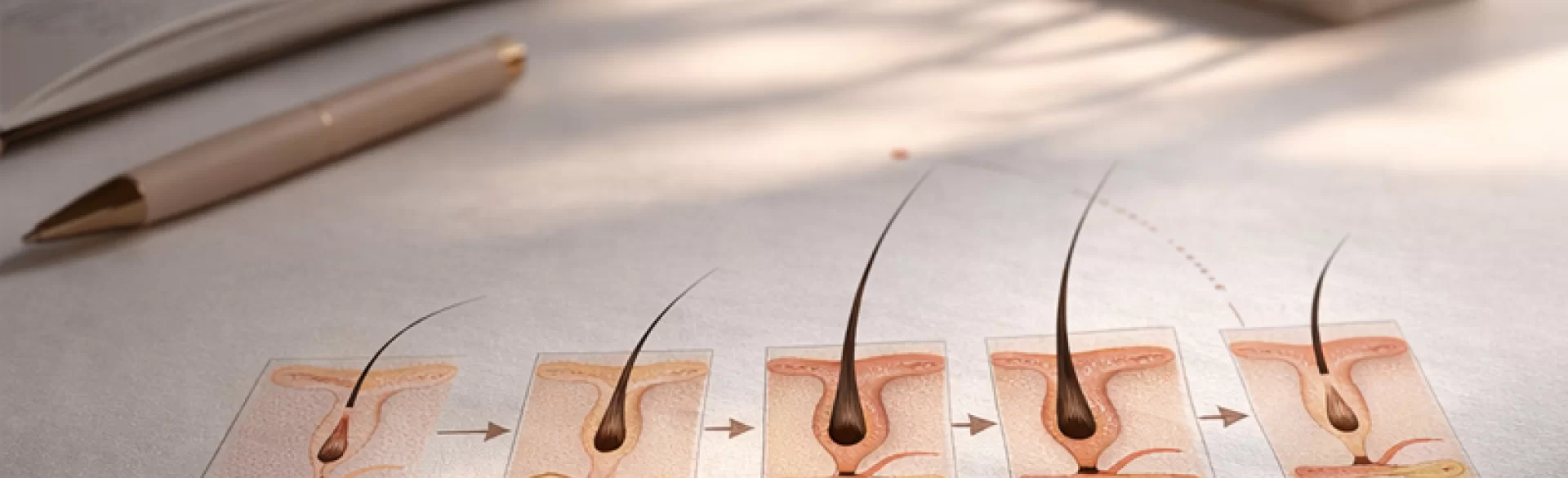
The phases of hair growth are a cyclic, biologically programmed process occurring within the hair follicle (folliculus pili), involving alternating periods of intense growth, regression, and rest. Each follicle functions autonomously, which is why the hair on the scalp is simultaneously in different phases of the cycle. Proper proportions between the growth phase (anagen), transitional phase (catagen), and resting phase (telogen) determine the physiological density of hair. Disruptions in the duration of individual stages lead to excessive hair loss (effluvium) or its progressive miniaturization, characteristic of androgenetic alopecia. Understanding the biology of the hair cycle is crucial in trichological diagnostics and therapy planning.
Hair Growth Phases – Description
The hair cycle is a dynamic process regulated by genetic, hormonal, immunological, and environmental factors. Its activity is concentrated within the so-called dermal papilla—a mesenchymal structure that serves as the signaling center of the hair follicle—and in the area of stem cells located in the so-called "bulge area."
1. Anagen (growth phase)
- lasts on average 2–7 years on the scalp,
- includes 80–90% of the hair,
- characterized by intense cell divisions of the hair matrix,
- active synthesis of keratin and melanin occurs,
- hair grows on average 1–1.3 cm per month.
The length of the anagen phase determines the maximum length of the hair. In androgenetic alopecia, there is a progressive shortening of the anagen phase, resulting in thinner and shorter hair (miniaturization).
2. Catagen (transitional phase)
- lasts about 2–3 weeks,
- includes 1–2% of the hair,
- proliferation of matrix cells is halted,
- apoptosis (programmed cell death) occurs,
- the follicle shrinks and detaches from the dermal papilla.
Catagen is a stage of controlled biological regression, regulated among others by factors from the TGF-beta family.
3. Telogen (resting phase)
- lasts on average 2–4 months,
- includes 10–15% of the hair,
- the follicle remains in a state of relative metabolic inactivity,
- the phase ends with the shedding of the hair (exogen).
Physiologically, a person loses 50–100 hairs a day, which corresponds to the natural transition of hair into the telogen phase.
Biological regulation of the hair cycle
The hair cycle is controlled by a complex network of molecular pathways. Key roles are played by:
- Wnt/β-catenin pathway – initiates anagen and activates hair follicle stem cells.
- Sonic Hedgehog (Shh) – stimulates the proliferation of matrix cells.
- BMP (Bone Morphogenetic Proteins) – maintain the follicle in a resting state.
- TGF-β – induces catagen.
- Androgens (particularly DHT – dihydrotestosterone) – shorten anagen in the frontal-parietal area in genetically predisposed individuals.
Also significant are:
- scalp microcirculation,
- expression of growth factors (VEGF, IGF-1),
- low-grade inflammation (microinflammation),
- oxidative stress.
An imbalance between proliferative and inhibitory signals leads to a pathological shift in the proportion of cycle phases.
Disorders of the hair growth phases
Telogen Effluvium
Occurs when a significant number of follicles prematurely transition from anagen to telogen. The causes may include:
- severe psychological or surgical stress,
- childbirth,
- infections,
- iron deficiency,
- hormonal disorders (e.g., thyroid diseases),
- rapid weight loss.
Characteristic is the delay in symptoms – hair starts falling out about 2–3 months after the triggering factor, which corresponds to the length of the telogen phase.
Androgenetic Alopecia
Leads to:
- shortening of anagen,
- lengthening of the kenogen period (empty follicle),
- progressive miniaturization of terminal hairs into vellus hairs.
The process depends on the sensitivity of androgen receptors, not solely on the level of testosterone.
Alopecia Areata
In the autoimmune mechanism, anagen is interrupted by an inflammatory infiltrate around the follicle.
The significance of hair growth phases in trichological therapy
Understanding the hair cycle has direct clinical implications. Therapies only work on follicles in the anagen phase, therefore:
- the first effects of treatment are usually observed after 3–6 months,
- therapies require consistency and long-term monitoring,
- discontinuation of treatment causes follicles to revert to the previous cycle pattern.
Treatment includes, among others:
- minoxidil – prolongs anagen and improves microcirculation,
- finasteride/dutasteride – inhibit the conversion of testosterone to DHT,
- needle mesotherapy with growth factors,
- platelet-rich plasma (PRP),
- therapies that stimulate microcirculation and follicle metabolism.
The effectiveness of therapy depends on:
- the duration of the disease,
- the presence of miniaturization,
- the preserved viability of stem cells.
In advanced stages, when fibrosis and permanent follicle loss occur, stimulatory therapy is ineffective.

